I believe these #1 rankings are a powerful validation of our product strategy and investments. In our opinion, they reflect our singular focus on building automation fabrics that deliver transformative results for our customers, no matter the challenge.
Redwood’s recognition in the Gartner Critical Capabilities report
“As an essential companion to the Gartner Magic Quadrant, this methodology provides deeper insight into providers’ product and service offerings by extending the Magic Quadrant analysis. Use this research to further investigate product and service ratings based on key capabilities set to important, differentiating use cases.”*
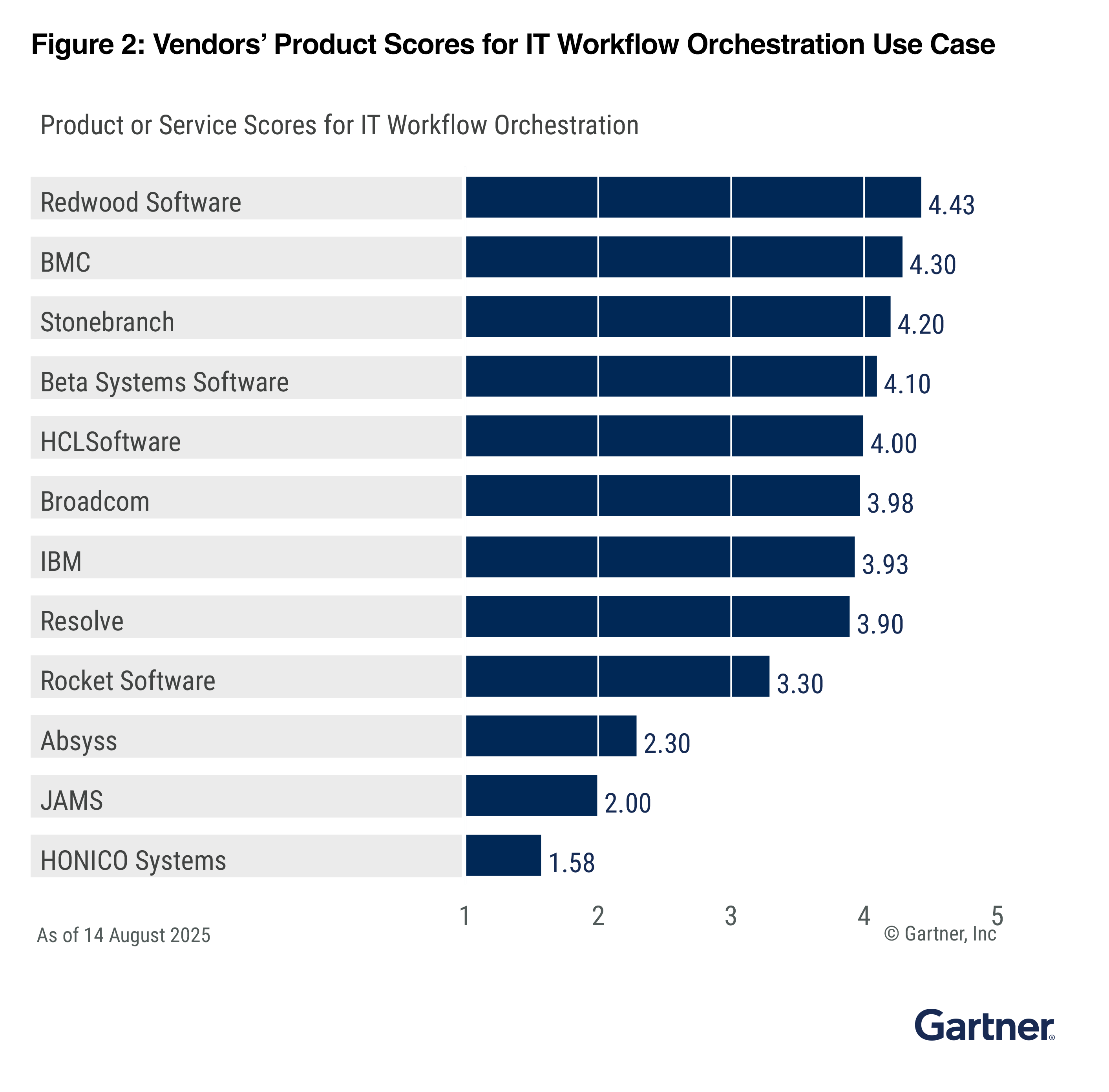
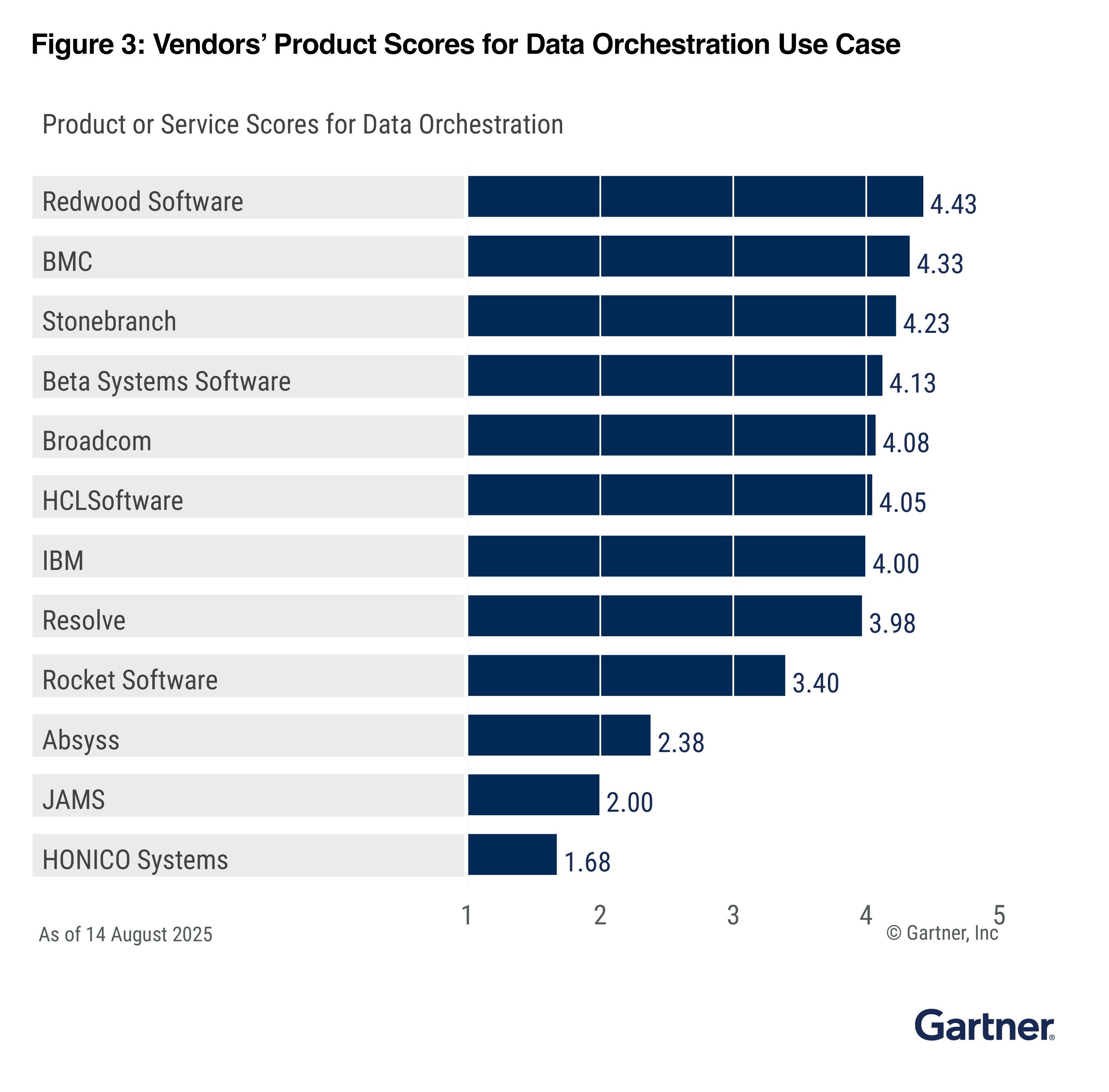
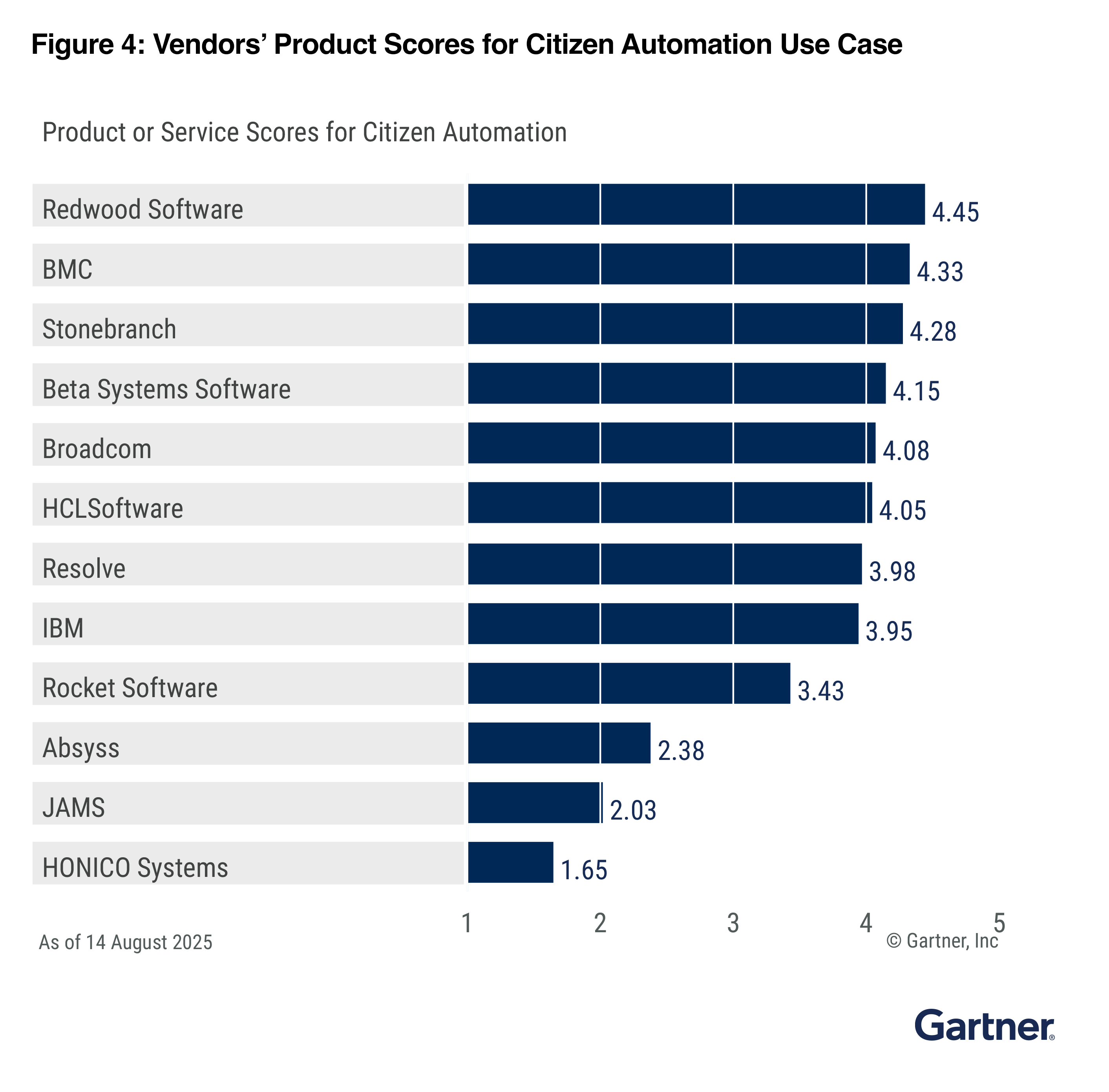
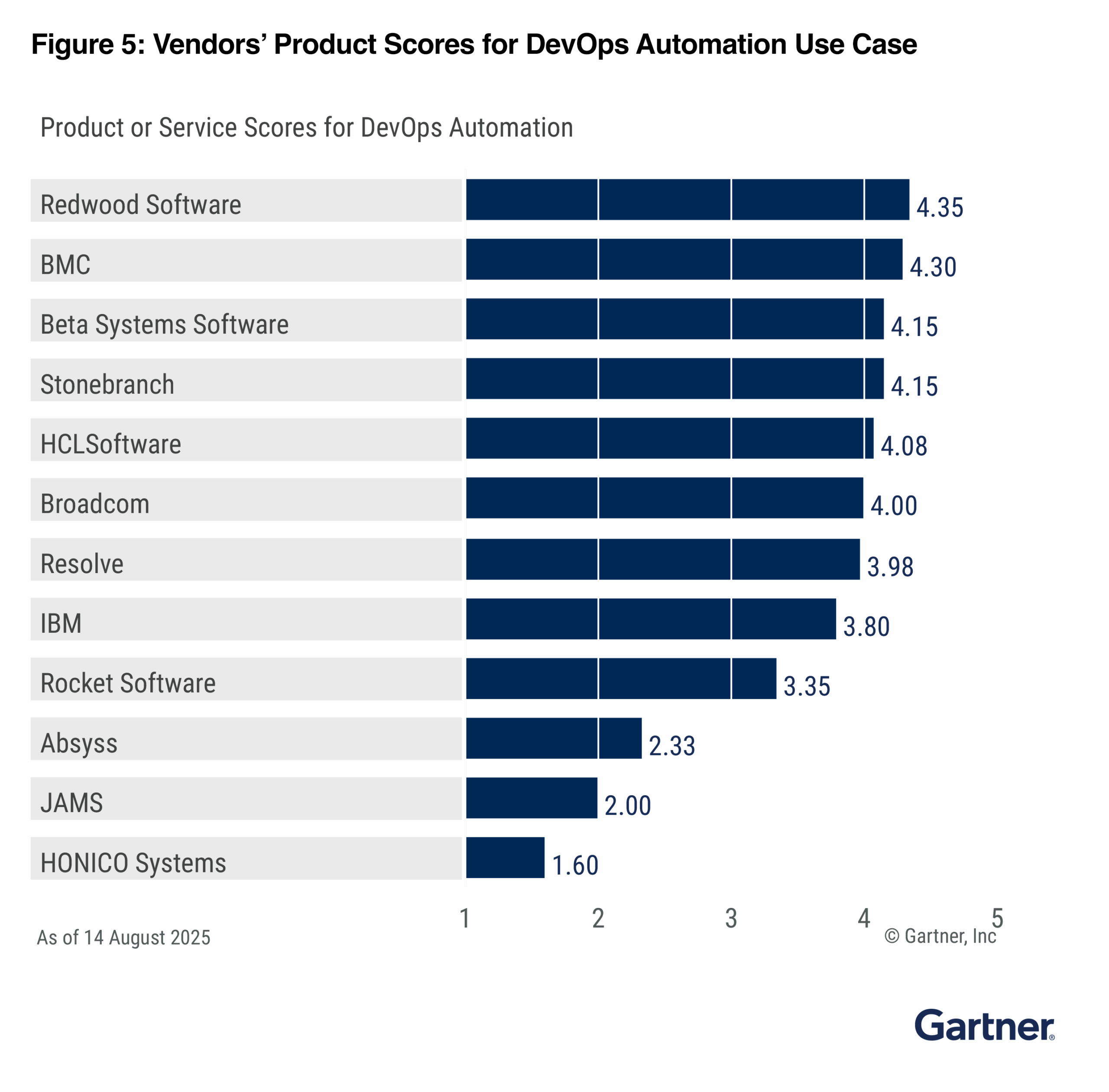
The Critical Capabilities research includes rankings for Use Cases: IT Workload Automation, IT Workflow Orchestration, Data Orchestration, Citizen Automation and DevOps Automation.
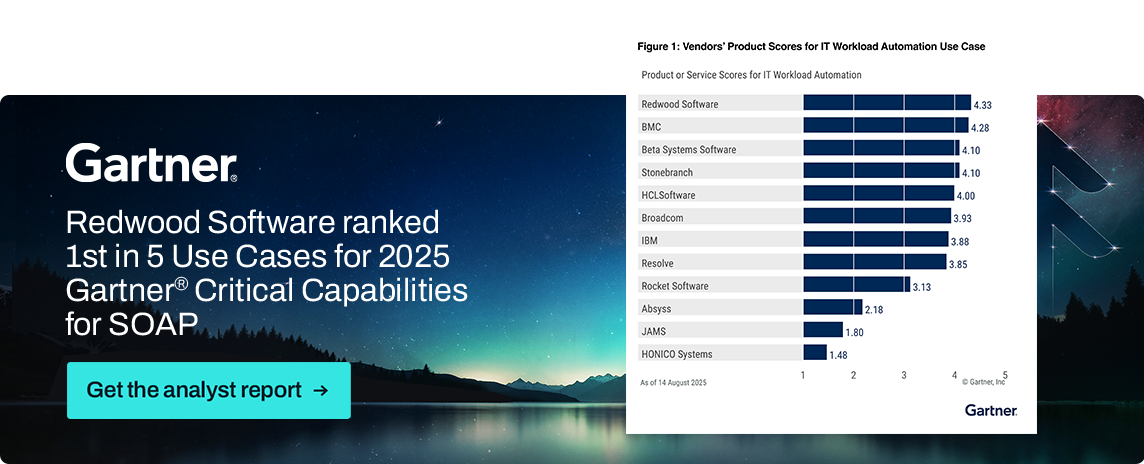
Redwood ranked first in five out of five Use Cases.
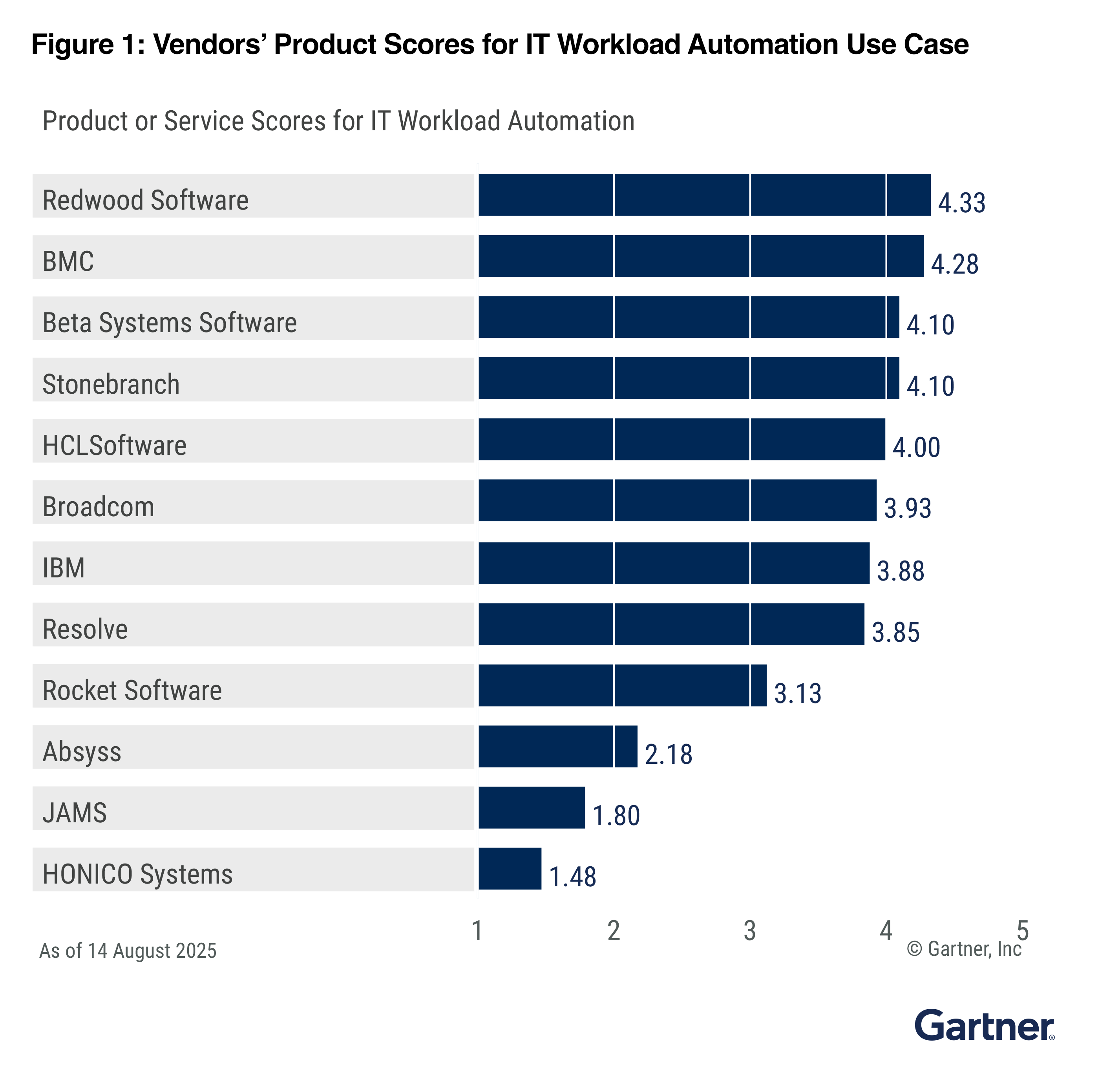
IT workload automation
For the second year in a row, Redwood received the highest score in this Use Case: 4.33 out of 5.
Gartner defines IT workload automation (IT operations persona) as follows: “Automating planning, execution, management and reporting of IT workloads across enterprise systems.”
We believe this ranking reflects the broad power of our composable automation platform to integrate and manage diverse technologies across the hybrid enterprise. Available as native SaaS for the lowest total cost of ownership (TCO) or self-hosted on-premises or in the cloud, Redwood’s flagship workload automation platform delivers the deployment flexibility enterprise customers require. Extensive auditing capabilities, an expansive connector catalog and comprehensive APIs ensure unmatched reliability and business continuity for even the most complex workloads.
IT workflow orchestration
For the second year in a row, Redwood received the highest score in this Use Case: 4.43 out of 5.
Gartner defines IT workflow orchestration (IT operations persona) as follows: “Defining, executing and reporting on IT workflows across diverse IT and enterprise systems.”
We feel this score highlights our strength in orchestrating intricate dependencies across disparate systems. Redwood’s extensive library of pre-built certified connectors eliminates custom scripting, enabling users to visually build and manage complex, end-to-end workflows while centralizing control and visibility. This is further enhanced by the advanced monitoring and observability capabilities: a unified view of process health and performance with built-in AI troubleshooting. Extending this functionality via Redwood Insights, teams can view their entire orchestration ecosystem, from performance to configuration, to diagnose root causes, optimize workflows and track compliance. The result: seamless service delivery and optimal operational control.
Data orchestration
Redwood received the highest score in this Use Case: 4.43 out of 5.
Gartner defines data orchestration (DataOps persona) as follows: “Planning, executing, managing and reporting on data-focused workloads like ETL/ELT and reporting for data use cases.”
We believe our #1 score in this Use Case demonstrates the power of Redwood solutions to unify and manage complex data pipelines from ingestion to reporting. Redwood provides the flexibility to connect to any data source or application and gives DataOps teams the end-to-end visibility required to ensure effective data management and that key information is timely, accurate and readily available for the business.
Citizen automation
For the second year in a row, Redwood received the highest score in this Use Case: 4.45 out of 5.
Gartner defines citizen automation (business user persona) as follows: “Enabling end-users to develop and execute curated automations under IT governance.”
We feel this score represents Redwood’s commitment to empowering business teams and subject-matter experts to create and manage their own automation solutions safely. Our customizable and intuitive user interface includes a visual, low-code automation design studio, which allows teams to abstract away complexity, while centralized IT governance ensures every user-built automation is secure and reliable. To further accelerate this process, Redwood’s new AI assistant provides instant, context-aware guidance, allowing users to find answers and build processes faster than ever.
DevOps automation
Redwood received the highest score in this Use Case: 4.35 out of 5.
Gartner defines DevOps automation (DevOps/SRE persona) as follows: “Developing and testing automation workflows to support product delivery via DevOps tools and practices.”
We believe this recognition highlights how seamlessly Redwood integrates into the software development lifecycle (SDLC). DevOps teams can define, version, test and promote automation workflows just like any other application code, accelerating release cycles and improving collaboration between development and operations.
Boost your digital transformation strategy: Get your copy of the full analyst report here to empower your decision-making process. Demo our suite of workload automation, file transfer and finance automation solutions to start unleashing the human potential in your organization.
Gartner, Inc. Magic Quadrant for Service Orchestration and Automation Platforms. Hassan Ennaciri, Daniel Betts, Cameron Haight, Chris Saunderson, etl. 26 Aug 2025.
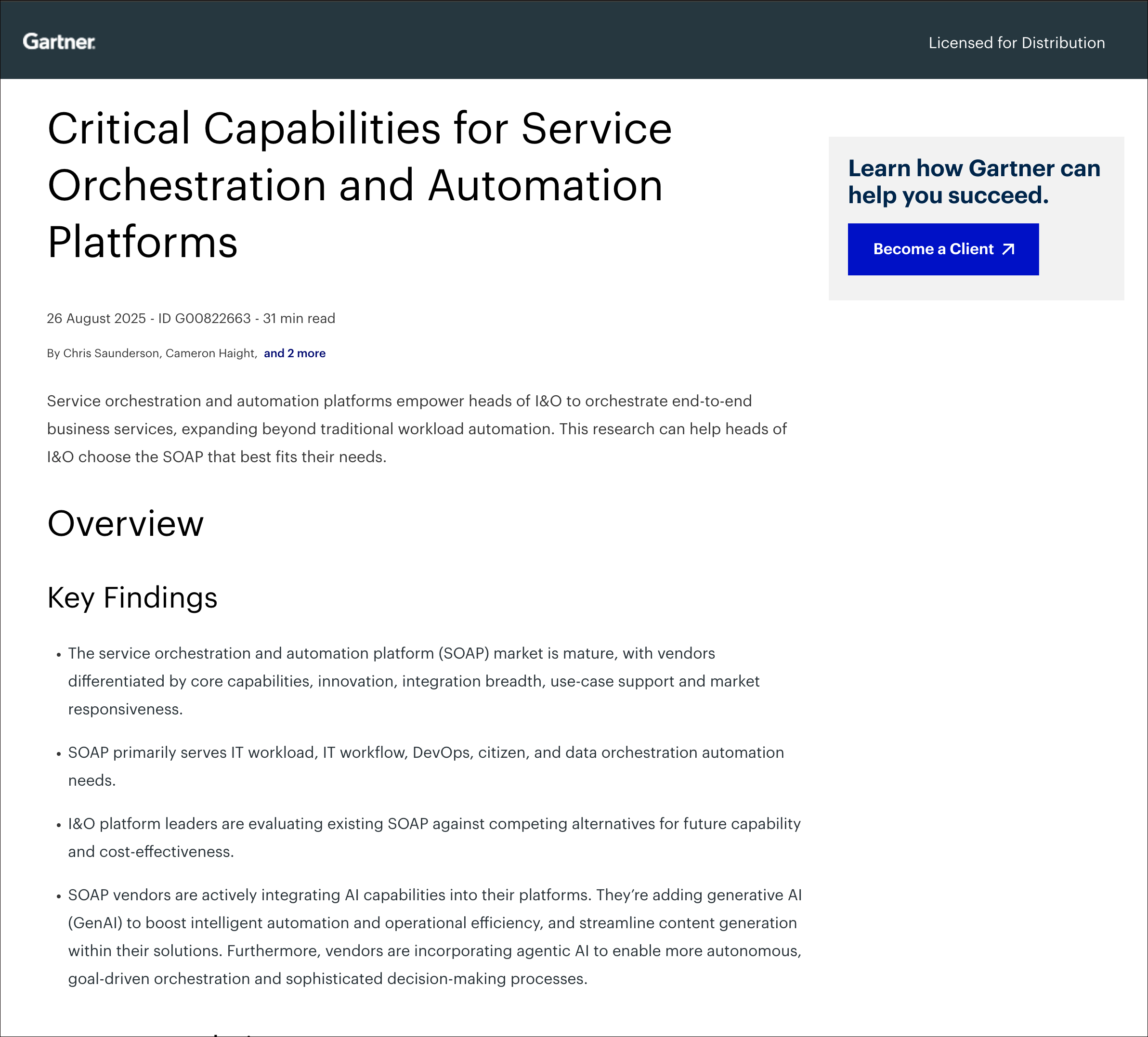
Gartner, Inc. Critical Capabilities for Service Orchestration and Automation Platforms. Chris Saunderson, Cameron Haight, Daniel Betts, Hassan Ennaciri, etl. 26 Aug 2025.
GARTNER is a registered trademark and service mark of Gartner, Inc. and/or its affiliates in the U.S. and internationally, and MAGIC QUADRANT is a registered trademark of Gartner, Inc. and/or its affiliates and are used herein with permission. All rights reserved.
Gartner does not endorse any vendor, product or service depicted in its research publications, and does not advise technology users to select only those vendors with the highest ratings or other designation. Gartner research publications consist of the opinions of Gartner’s research organization and should not be construed as statements of fact. Gartner disclaims all warranties, expressed or implied, with respect to this research, including any warranties of merchantability or fitness for a particular purpose.These graphics were published by Gartner, Inc. as part of a larger research document and should be evaluated in the context of the entire document. The Gartner document is available upon request from https://www.redwood.com/resource/gartner-critical-capabilities-soaps/.
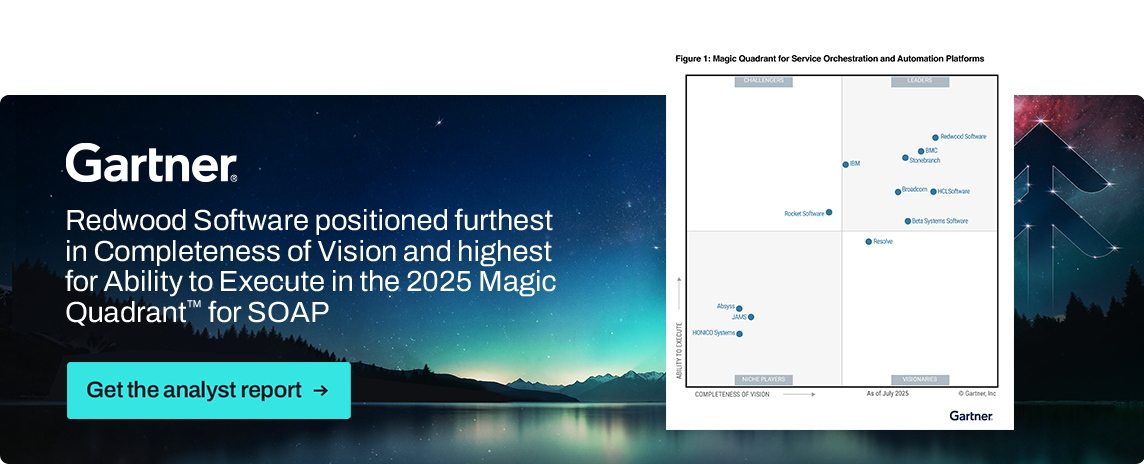
I’m thrilled to announce that, for the second consecutive year, Gartner has named Redwood Software a Leader in its 2025 Magic Quadrant™ for Service Orchestration and Automation Platforms (SOAP) report. This year, we are proud to be positioned furthest in Completeness of Vision and highest for Ability to Execute.
We believe this consistent recognition validates our strategy and the immense value of our automation fabric solutions. Our mission is to unleash human potential by empowering customers with end-to-end automation for their mission-critical business processes, enabling them to maximize efficiency, enhance agility and build a future-ready enterprise.
We see lights-out automation as the engine for continuous growth and success for our customers. This acknowledgment from Gartner further energizes our team as we continue to support enterprises globally.
Understanding the Gartner Magic Quadrant™ for SOAP
The Gartner Magic Quadrant™ is a culmination of research in a specific market, providing a wide-angle view of the relative positions of the market’s competitors. By applying a graphical treatment and a uniform set of evaluation criteria, a Magic Quadrant™ helps you quickly ascertain how well technology providers are executing their stated visions and how well they are performing against Gartner’s market view.
“Leaders execute well against their current vision and are well-positioned for tomorrow.”
“Service orchestration and automation platforms are essential for delivering business services through complex workloads. SOAPs unify workflow orchestration, workload automation and resource provisioning, extending across data pipelines and cloud-native architectures.”
Ability to Execute: How well does the vendor deliver today?
Gartner positioned Redwood highest for Ability to Execute. Redwood feels the Ability to Execute axis assesses the “here and now,” measuring the tangible quality of the vendor’s products and services today.
Our view is that it’s a holistic measure of the entire customer experience and the vendor’s organizational maturity. It’s not just “Does the product work?” but “Is this a well-run company that is easy and reliable to do business with?”
Gartner evaluates Ability to Execute based on seven criteria:
Product or Service
Overall Viability
Sales Execution/Pricing
Market Responsiveness and Track Record
Marketing Execution
Customer Experience
Operations
Completeness of Vision: Does the vendor have a plan for tomorrow?
Gartner positioned Redwood furthest in Completeness of Vision for the second year in a row. In our view this category assesses the “what’s next.” It evaluates the vendor’s strategy, innovation, understanding of the market’s future and if the product will evolve to meet your future needs.
For Redwood, this category is not just about ideas; it’s about the credibility and plausibility of the vendor’s strategy. We believe a “complete” vision is one that is not only forward-thinking but also grounded in a realistic plan that the vendor is capable of executing.
The evaluation scrutinized whether the vendor has the foundational ability to deliver on its promises by assessing their product architecture, financial model and track record of past innovation.
Gartner evaluates Completeness of Vision based on eight criteria:
Market Understanding
Marketing Strategy
Sales Strategy
Offering (Product) Strategy
Business Model
Vertical/Industry Strategy
Innovation
Geographic Strategy
Vision and execution: Why Redwood was named a Leader
Redwood believes being named a Leader doesn’t happen by accident. It’s the result of a clear formula: listen to customers, build for the future and execute flawlessly. We feel this reflects our singular focus on automation fabrics, fueled by innovation and a deep customer obsession. Our strategic roadmap isn’t created in a vacuum; it’s forged in partnership with our customers through advisory boards and user groups.
We deliver on that formula with our enterprise SOAP solutions, available self-hosted, on-premises or through a highly reliable, true-SaaS platform. We believe our position as a Leader speaks to the maturity of our workload automation (WLA) solutions, which offer composable automation purpose-built for the hybrid enterprise. We deliver a unified platform that gives customers the strategic advantage to adapt faster and outpace change.
Redwood feels our forward-thinking approach empowers customers to move beyond simple, custom scripting and siloed tools. They can embrace a fully governed business and IT automation platform that prioritizes the entire digital infrastructure, managing everything from core job scheduling and complex data pipelines to orchestrating event-driven workflows and integrating with DevOps tools. This ensures their critical operations and IT automations run without interruption, meeting the needs of their organization.
We believe our commitment to innovation is clear in our latest platform advancements, which demonstrate a relentless focus on creating a more powerful, intuitive and intelligent automation experience enabling customers’ automation strategies:
Redwood Insights: We’re moving beyond simple monitoring to provide true orchestration observability, turning complex data into actionable knowledge that helps users predict and prevent issues.
AI assistants and co-pilots: Our embedded AI tools are already saving users hours by accelerating development and troubleshooting.
Modern UI: A completely redesigned user interface makes the platform more intuitive and powerful for all users.
Continuous integration and connectivity: We’re constantly expanding our library of pre-built connectors and advanced no-code wizards, making it easier than ever to create custom integrations and automate any process across the enterprise. Redwood offers unmatched integration with SAP applications and technologies, validated by RunMyJobs by Redwood’s SAP Endorsed App Premium certification.
Redwood believes our position in the Gartner Magic Quadrant™ for SOAP is a testament to our commitment to turning cutting-edge technology, from multi-cloud orchestration to AI-driven insights, into real-world results for our customers.
Insights from the 2025 Gartner Magic Quadrant™ for SOAP report
In our opinion, the 2025 Magic Quadrant™ for SOAP report offers an in-depth analysis of the SOAP landscape and highlights the critical role of process automation in driving digital transformation. The report notes that,
“By 2029, 90% of organizations currently delivering workload automation will be using service orchestration and automation platforms (SOAPs) to orchestrate workloads and data pipelines in hybrid environments across IT and business domains.”
Get your copy of the full report here, and demo our suite of solutions to envision what your business could achieve with Redwood behind you.
Gartner, Inc. Magic Quadrant for Service Orchestration and Automation Platforms. Hassan Ennaciri, Daniel Betts, Cameron Haight, Chris Saunderson, etl. 26 Aug 2025.
GARTNER is a registered trademark and service mark of Gartner, Inc. and/or its affiliates in the U.S. and internationally, and MAGIC QUADRANT is a registered trademark of Gartner, Inc. and/or its affiliates and are used herein with permission. All rights reserved.
Gartner does not endorse any vendor, product or service depicted in its research publications, and does not advise technology users to select only those vendors with the highest ratings or other designation. Gartner research publications consist of the opinions of Gartner’s research organization and should not be construed as statements of fact. Gartner disclaims all warranties, expressed or implied, with respect to this research, including any warranties of merchantability or fitness for a particular purpose.
These graphics were published by Gartner, Inc. as part of a larger research document and should be evaluated in the context of the entire document. The Gartner document is available upon request from https://www.redwood.com/resource/gartner-soaps-mq/.
Basic accounting principles exist for a reason. They are neither optional nor vague. They’re meant to give us a consistent, trustworthy foundation for financial reporting, especially when accuracy matters most.
But even now, spreadsheets continue to dominate processes for way too many finance teams. They’re used for accruals, revenue recognition, allocations, reconciliations and other critical functions. And all of this is happening in spreadsheets, outside the systems that are actually built to handle this data. We expect our reports to align with standards like Generally Accepted Accounting Principles (GAAP) or International Financial Reporting Standards (IFRS), yet we’re relying on manual tools that were never designed for this level of complexity.
We all want to uphold principles like reliability and consistency. But the truth is, spreadsheets quietly chip away at both. And they’re so familiar, it’s easy not to notice until something breaks.
Let’s explore the less obvious ways spreadsheets can undermine accounting integrity and what finance automation can do to help.
The silent killer of accounting integrity
At first glance, spreadsheets feel harmless. They’re fast, flexible and the tool most professionals first learned to use. But that same flexibility is exactly what makes them hard to control.
No version control: Anyone can tweak a cell, save a new copy or email the wrong file. There could be six versions of the same schedule floating around.
No audit trail: Adjustments happen, but unless someone manually annotates a journal entry or leaves a note — a step that is often skipped, there’s no method for tracing what changed.
No guarantee of accuracy: Formulas break, references get outdated, links go bad. And if no one catches it, the numbers roll forward.
Now imagine that across dozens of schedules, teams and entities. You’ve essentially built a shadow system outside your ERP — a significant audit exposure. Worse, leadership ends up relying on those numbers. Decisions are made based on the financial information in those files.
One bad cell: Unknowingly compromising reliability
The principle of reliability says our numbers should be verifiable and backed by objective evidence. But in spreadsheet world, “evidence” is often a file path and a line item copied from somewhere else. That’s not a system of record; it’s just a folder on someone’s desktop.
You could have a perfectly valid entry, but if you can’t trace how you got there — or explain why it changed — it’s not really reliable. And in many cases, even the person who made the update would have to dig to remember what they did.
Automation changes that. It builds logic into the process. You’re pulling live values from your ERP, not referencing a hard-coded number from three weeks ago. Documentation lives in the system, not in someone’s email. If something changes, you know who changed it, when and why. That’s what makes information reliable. And that’s what auditors (and leadership) expect.
Consistency is a team sport
Consistency is one of those principles that sounds simple: treat the same financial transactions the same way, every time. Yet, in practice, it gets messy.
Every finance team I’ve worked with has some version of this: one person does it their way, another has their own spreadsheet and over time, the logic starts to drift. Revenue deferrals, expense accruals and intercompany recharges all start off aligned, then slowly diverge based on who’s doing the prep work. That’s not anyone’s fault; it’s just what happens when we rely on tools that don’t enforce consistency.
Automation fixes this by turning those “ways of working” into actual, repeatable processes. You define the logic once, and the system applies it every time across accounting periods, teams and regions. Everyone starts with the same playbook.
Adhering to the consistency principle doesn’t just make audits easier. It makes your reporting more useful. It gives your team confidence in the numbers. And it makes analysis possible because you’re comparing apples to apples.
Invisible knowledge: A liability
Then, there’s the hero problem. Every finance team has one: that person who knows how everything works — the macros, the tabs, the quirks. This individual is often indispensable, holding the entire manual process together. But when they go on vacation, leave the company or just get reassigned, that knowledge goes with them.
This represents a huge risk, even though it isn’t often discussed. If your month-end close depends on one person’s memory of how the spreadsheet works, that’s not a process but a dependency.
Automation helps you get that knowledge out of someone’s head and into a shared system. It turns invisible logic into visible steps. It builds documentation into the workflow. That way, new team members can ramp faster, and no one’s irreplaceable because the process doesn’t live in a file; it lives in the system.
This is how a scalable team is built.
A stronger foundation for modern finance
Accounting concepts haven’t changed much, but everything around them has. We’re moving faster, dealing with more data, experimenting with new accounting methods and being asked to add value beyond the basics, but we still have to get the basics right.
For many organizations, spreadsheets have effectively become the primary system for managing financial processes, operating as a kind of shadow ERP. Even with dedicated enterprise software in place, the most critical accounting work often falls back on a collection of manual, disconnected files. While valuable for quick analysis, spreadsheets cannot provide the integrity and control required to be the backbone of your financial position. The work traditionally performed in these files must be migrated to a centralized system built for scale and auditability.
Finance automation can reduce spreadsheet risk and help your team uphold the accounting principles that matter most — from the matching principle to GAAP compliance. Request a demo of Finance Automation by Redwood today.
Your company is spending more on automation than ever, yet you’re barely seeing a return. It’s a frustrating paradox revealed in the new “Enterprise automation index 2025” from Redwood Software.
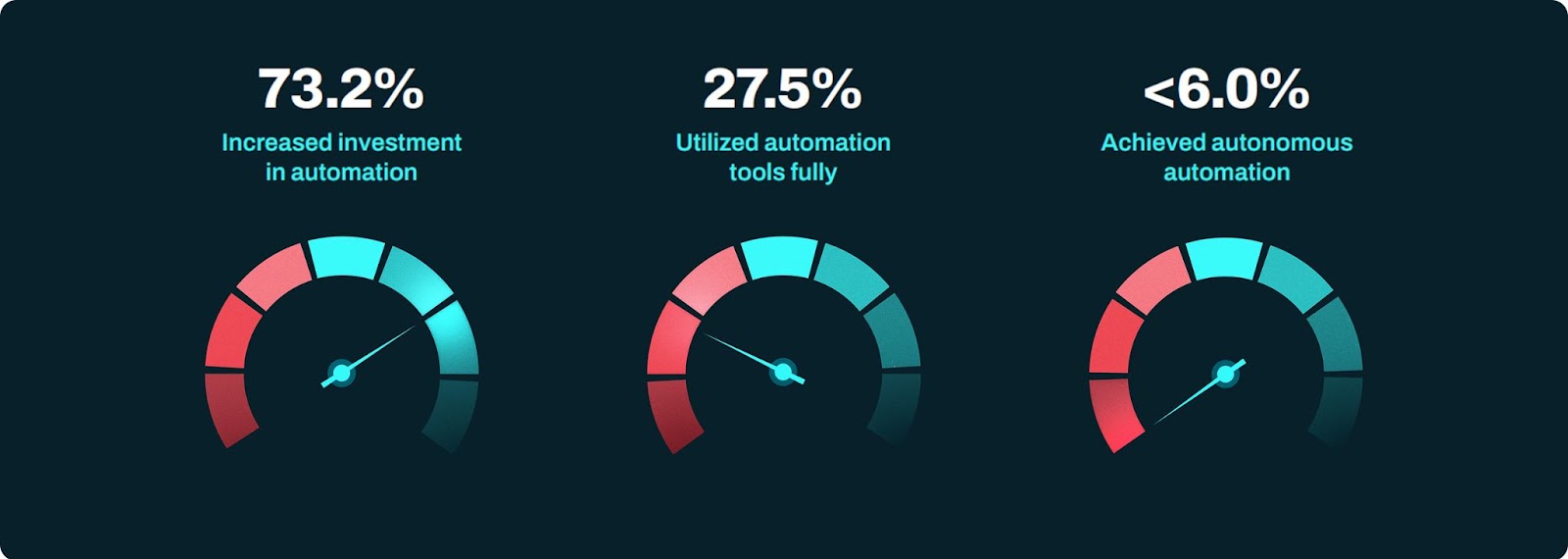
While 73% of companies increased their automation spend last year, less than 30% are fully utilizing their tools. The data is clear: the issue isn’t a lack of investment or technology — it’s a stubborn execution gap.
In a climate where every budget line is under the microscope, automation is still getting the green light. That’s because the business case is solid.
37% of organizations report that automation reduced costs by over 25%
43% have cut manual workloads by at least a quarter
49% say it increased efficiency by the same amount
Those are meaningful results, but they’re not the norm. The data also reveals a widespread failure to scale.
73% of companies increased automation spend last year, but only 28% fully utilize their tools. Less than 6% have achieved autonomous automation for any core business process.Source: “Enterprise automation index 2025”
From where I sit, working alongside enterprise teams on automation migration and orchestration every day, I can tell you this isn’t a technology issue. It’s a stubborn execution gap.
The 4 traps of underperforming automation
Too many organizations treat automation like an arms race, adding new tools to plug gaps and hoping for the best. My team sees the consequences of this approach daily, typically in these four traps:
Ad hoc tool sprawl: Marketing, Finance and IT all buy their own automation tools, creating “shadow automation.” These siloed, ungoverned processes don’t share data, follow security protocols or align with a larger strategy, undermining enterprise-wide visibility.
Stopping at the task level: Teams often automate the simplest, low-hanging fruit and then declare victory, ignoring the cross-functional processes where the real value lies. This technical debt accrues until a critical process, like month-end close or supply chain fulfillment, inevitably breaks, leading to frantic, manual interventions.
Legacy tech dependency: Many enterprises still run their most important processes on outdated schedulers or basic scripts. These tools lack the visibility, error handling and security features required for today’s business. When they fail (and they do), the business impact is immediate and severe, but migrating off them is perceived as too difficult.
No automation strategy: Without a plan to consolidate, migrate and optimize, the collection of tools becomes a digital junkyard. The organization has technically invested in automation, but operationally, nothing has changed. The tools are there, but they’re underutilized, misaligned or completely isolated.
These execution pitfalls are symptoms of a deeper issue, one that consistently derails even well-funded automation projects.
Complexity: The #1 blocker to automation ROI
According to Redwood’s research, the top challenge isn’t budget, talent or tools — it’s complexity. Nearly 20% of professionals point to complex workflows as their number-one barrier to scaling automation.
That echoes what I see in the field. Enterprises are sitting on decades of custom scripts, legacy architecture, fragile integrations and undocumented processes. And every time someone says “We’ll automate that later,” the mess grows.
When you delay migration or fail to redesign around orchestration, you lose the ability to scale. You automate the easy stuff and stall out at the first sign of friction. If you want automation to deliver, you need to:
Standardize before you automate. Don’t just pave the path. A chaotic manual process will only become a faster chaotic automated process. Take the time to map, simplify and standardize workflows first. This initial investment pays dividends in scalability and resilience.
Migrate strategically. A simple “lift-and-shift” of old jobs to a new platform just moves the problem. Strategic migration involves analyzing, consolidating and redesigning workflows to take full advantage of a modern orchestration platform’s capabilities.
Orchestrate across systems. True value is unlocked when you manage processes end to end, from the mainframe to the cloud and across all applications. This breaks down the silos between IT operations, data pipelines and business applications, which the report identifies as a key challenge for industries like finance.
Align to business outcomes. The goal isn’t just to run jobs successfully; it’s to reduce costs, accelerate innovation and improve data visibility — the top three business priorities cited in the research. Frame every automation initiative around these goals.
The path to mature automation: A call to action
If your automation investment isn’t delivering, it’s a critical warning sign. Don’t fall into the trap of simply adding more tools. The path forward requires a shift in mindset: focus on orchestration, elevate automation to a C-suite priority and build a cohesive strategy. It’s the only way to transform it from a tactical fix to a genuine growth lever for your entire organization.