Best Certificate Lifecycle Management Software in 2026
Key takeaways
- The right certificate lifecycle management (CLM) software renews every digital certificate your business uses on time without manual work, works with the certificate authorities you already rely on, and proves itself in a trial on your own systems before you buy.
- Public TLS certificate lifespans are shortening, which makes automated renewal a baseline requirement.
- CA-agnostic support is essential for enterprises that buy from several certificate authorities or run their own private PKI.
- AppViewX leads for hybrid, multi-CA enterprises, pairing automated CLM with built-in PKI-as-a-service and IDC MarketScape Leader recognition for 2026.
- Palo Alto Networks NGTS, Keyfactor Command, DigiCert Trust Lifecycle Manager, and Sectigo Certificate Manager round out the leading options, with strengths that vary by deployment model and existing vendor relationships.
Public TLS certificates are already capped at 200 days and are set to reach 47 days by 2029, which will mean renewing each certificate roughly eight times a year.
What to look for in CLM software
Discovery depth, automation coverage, policy controls, and crypto-agility decide how many of your certificates a CLM platform can manage without manual work.
Certificate discovery
Every automated renewal depends on an accurate inventory. Strong discovery scans networks, cloud accounts, load balancers, Kubernetes clusters, and certificate authority (CA) records to find every certificate, including ones issued outside approved channels.
Ask each vendor how discovery works across hybrid environments and how often the inventory refreshes.
Automated renewal and deployment
Enterprise-grade automation issues the new certificate, installs it with its full chain on every endpoint that used the old one, and confirms the new certificate works.
Support for ACME, SCEP, and EST, plus prebuilt integrations for common endpoints and DevOps tools, decides how much of this runs without custom scripts.
Policy and audit reporting
Policy controls limit certificates to approved CAs, key lengths, and validity periods, and give each one an owner. Look for role-based access, approval workflows, and reports that show compliance status on demand, so audits use current data.
47-day and PQC readiness
Shorter validity periods and the post-quantum transition both require replacing large numbers of certificates on short notice.
NIST finalized its first three post-quantum cryptography (PQC) standards in August 2024, and enterprises will eventually move every certificate to quantum-resistant algorithms. A platform built for crypto-agility inventories the algorithms in use, flags certificates that need migration, and replaces them in bulk.
Here’s how the core capabilities rank for most enterprises.
| Feature | Priority | Why it matters |
| Continuous discovery across hybrid and multi-cloud | Must-have | Keeps the inventory complete as environments change |
| CA-agnostic issuance | Must-have | Avoids lock-in to a single certificate authority |
| Automated renewal and deployment | Must-have | Removes manual steps from every renewal cycle |
| Policy enforcement and ownership | Must-have | Blocks unapproved CAs and weak keys |
| ACME, SCEP, and EST support | Must-have | Standard protocols reduce custom scripting |
| PQC algorithm inventory | Must-have within two years | Migration planning starts with knowing what you run |
| Private PKI-as-a-service | Nice-to-have | Valuable when retiring on-premises CAs |
| SSH key and code signing management | Nice-to-have | Useful when the same team owns those workloads |
Certificate lifecycle management software compared
AppViewX is rated an Overall Leader in KuppingerCole’s Leadership Compass for certificate lifecycle management and machine identity governance. The other four platforms are the alternatives enterprises most often evaluate alongside it:
| Platform | Core strength | Best fit |
| AppViewX | CLM with PKI-as-a-Service and network automation | Hybrid, multi-CA enterprises |
| Palo Alto Networks NGTS | CLM tied into Palo Alto network security | Existing Palo Alto customers |
| Keyfactor Command | CLM paired with EJBCA PKI | Teams running their own PKI, including IoT |
| DigiCert Trust Lifecycle Manager | CLM paired with DigiCert public trust | Organizations sourcing public certificates from DigiCert |
| Sectigo Certificate Manager | Cloud-native CLM with broad integrations | Cloud-first teams preferring SaaS only |
1. AppViewX
AppViewX delivers automated certificate lifecycle management across every CA, cloud, and on-premises system. Discovery finds public and private certificates, and automated workflows issue, renew, and deploy them to the endpoints and cloud services that use them. Built-in PKI-as-a-service lets teams run a private CA without maintaining on-premises infrastructure.
That coverage rests on more than a decade of building PKI and machine identity infrastructure for some of the world’s largest banks, manufacturers, and insurers.
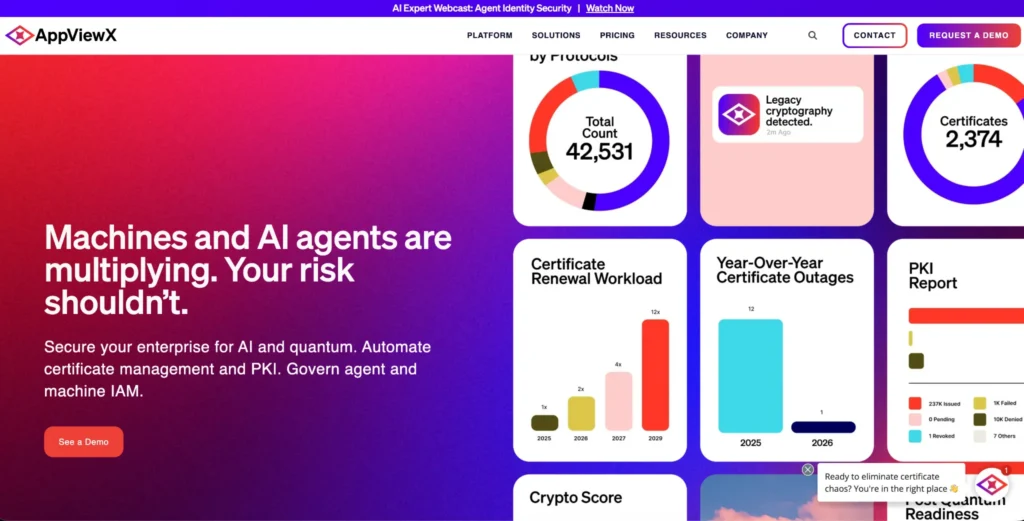
- Standards-based enrollment: AppViewX supports ACME, SCEP, and EST, along with prebuilt integrations across load balancers, cloud platforms, and DevOps tools. Renewals reach web servers, devices, and pipelines through the protocols they already speak.
- 47-day readiness: Automated renewal cycles and re-enrollment policies keep pace with shrinking validity periods, and a new private key is generated at each renewal. Teams set certificate lifespans by policy and can shorten them ahead of each reduction without reworking their processes.
- Flexible deployment: Deployment is agentless, with native certificate automation for Kubernetes. The same platform runs on-premises and as SaaS with identical features, allowing teams to move to the cloud while keeping every workflow they already use.
- Network automation: Network configuration automation puts certificate updates on ADCs and firewalls into a single workflow. Certificate and network teams share one process for every change, which means updated certificates reach production faster.
- Coverage beyond TLS: SSH key and code signing management are available alongside CLM. Agent Identity Security extends the same machine identity foundation to AI agents, bringing them under the controls that already govern certificates.
Test AppViewX against your own requirements and
see how it fits your environment. Talk to an AppViewX expert to get started.
2. Palo Alto Networks NGTS (formerly Venafi)
NGTS is the successor to Venafi TLS Protect, now combined with SaaS private PKI and integrated with Palo Alto’s Strata Cloud Manager and Panorama.
Pros:
Certificate discovery and inventory run with little manual effort, and automated renewal removes the need to track expiration dates by hand.
Teams already using CyberArk privileged access management report a seamless integration that brings certificate visibility into their existing security setup.
Cons:
Licensing costs run higher than many alternatives, which can weigh on teams managing large certificate volumes on a fixed budget.
Initial setup and onboarding take significant effort, and reviewers also flag the interface as an area for improvement.
3. Keyfactor Command
Keyfactor Command provides centralized discovery, governance, and automation, with native integration to Keyfactor’s EJBCA PKI.
Pros:
Native Azure integration and centralized visibility into certificates and keys help teams stay compliant across cloud environments.
It fits midsize and large enterprises with growing numbers of keys and certificates.
Cons:
The interface has a learning curve and may be too complex for new users.
Version updates require careful advance planning, and reviewers would like more customization options in the main portal.
4. DigiCert Trust Lifecycle Manager
DigiCert Trust Lifecycle Manager combines CA-agnostic CLM with DigiCert’s PKI services and public trust certificates and adds configurable workflows for issuance and renewal
Pros:
Expiration notifications, a central inventory, and automated renewal make compliance tracking easier.
The platform is user-friendly, and its consolidated certificate view lowers the chance of missing a renewal.
Cons:
Teams integrating external systems may find practical documentation and applied examples limited.
Reporting and dashboards are less interactive than some teams would like.
5. Sectigo Certificate Manager
Sectigo Certificate Manager is a cloud-native platform supporting public and private CAs, with enrollment through ACME, SCEP, and EST.
Pros:
Teams report better certificate oversight and automation, and the platform fits well into existing processes.
ACME and SCEP automation give teams one place to track deployments, expiry dates, and renewals instead of email and spreadsheets.
Cons:
The interface feels dated and click-heavy, and onboarding assumes solid PKI knowledge.
Domain control validation delays and bugs can slow down large-scale renewals.
How to choose CLM software
Test every vendor against the same criteria and conditions. The most reliable way to do that is a proof of concept on a sample of your environment, which shows how each platform handles real certificates.
Vendor demo questions
- These questions check whether a vendor’s claims hold up in practice:
- How many certificates did discovery find in our environment, and from which sources?
- Which of our endpoints support automated deployment without custom scripts?
- How does the platform manage certificates from CAs the vendor doesn’t operate?
- How long does a bulk replacement take if one of our CAs is distrusted?
- What does the audit report show, and how current is the data behind it?
- What’s the committed roadmap for PQC algorithm support?
Where to start with automation
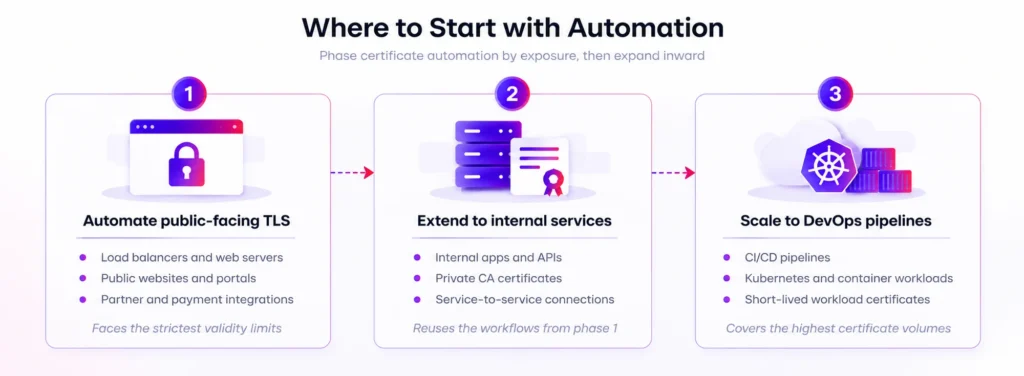
Start with public-facing TLS certificates on load balancers and web servers. They face the strictest validity limits and carry the most customer visibility.
From there, extend automation to internal services and private PKI, then to DevOps pipelines and Kubernetes workloads. Track progress by the share of certificates renewed with zero manual steps, and set a target for each phase before moving to the next.
Why enterprises choose AppViewX for CLM
Security and infrastructure leaders choose AppViewX to manage every certificate under one set of controls, whichever CA issued it and wherever it runs.
AppViewX was named a Leader in the 2026 IDC MarketScape for worldwide CLM software. IDC recognized the breadth of its CLM capabilities, its emphasis on automation, and its customer-validated support.
Its policy-driven, closed-loop workflows manage hundreds of thousands of certificates across hybrid and multicloud environments.