Payments don’t live in a single environment — and they haven’t for years.
In most banks and large enterprises, payment workflows span on-premises core systems, private cloud infrastructure and public cloud services in a multi-cloud IT infrastructure. A mobile app may run in Microsoft Azure, fraud detection in AWS and settlement still inside a data center.
As organizations modernize payments, they often assume cloud adoption will simplify operations. In practice, modernization increases architectural complexity before reducing it. New APIs, new payment methods and new digital channels introduce additional workloads across different cloud platforms. At the same time, regulatory requirements, risk controls and sunk costs keep core systems anchored where they are.
The real challenge is hybrid cloud orchestration: coordinating payment workflows so they execute reliably across cloud providers, on-premises systems and SaaS applications without fragmentation or loss of visibility. Cloud infrastructure determines where workloads run, while orchestration governs how workflows execute across those environments.
What hybrid cloud orchestration means in the payments context
Hybrid cloud orchestration is often mistaken for infrastructure provisioning, virtualization or container orchestration. And those capabilities are important. You need to provision cloud resources, manage Kubernetes clusters and deploy infrastructure-as-code. But that’s not what keeps payment workflows running end to end.
In a payments context, hybrid cloud orchestration sits above infrastructure. It coordinates execution across systems, applications and environments.
A payment workflow is a sequence of interdependent steps, such as:
An API call triggers a transaction
Authentication validates identity
Fraud detection evaluates risk in real time
Core processing posts the transaction
Settlement executes
Reconciliation updates financial records
Reporting pipelines feed dashboards and audit trails
Each step may run in a different cloud environment, often involving external providers. Hybrid cloud orchestration ensures these steps execute in the correct order, with defined dependencies, standardized error handling and full observability across environments.
Hybrid cloud architectures distribute workloads across multiple environments by design. Orchestration ensures that distribution doesn’t translate into fragmentation at the workflow level.
Why payment workflows break down in hybrid cloud environments
In distributed payment architectures, instability tends to surface in the handoffs between systems rather than in the infrastructure itself.
Consider a common hybrid payment use case. A customer initiates a credit card payment through a cloud-based app. An API triggers routing logic in a public cloud environment. Core transaction processing still runs on-premises. Fraud detection functions execute in a separate cloud-native analytics platform. Settlement occurs later in batch. Reconciliation and reporting run through data pipelines that span systems. Individual systems can be stable on their own, but the interaction points between them are where fragility tends to appear.
IT teams often encounter the same operational symptoms in these environments. Scripts and schedulers built for single-system execution struggle with cross-cloud dependencies. When automated tasks fail, retries frequently require manual intervention. Payment status visibility is fragmented across individual systems, making it difficult to see the end-to-end workflow. Error handling may differ between real-time and batch workloads, creating inconsistent recovery patterns. Approval processes can introduce bottlenecks, and manual data entry may creep in to bridge gaps between disconnected systems. As transaction volumes grow, these inefficiencies compound. What began as a minor coordination issue becomes a scaling constraint.
If fraud detection in a public cloud service slows under peak loads, downstream settlement may stall. If retry logic differs between environments, duplicate transactions can occur. And if observability tools only monitor infrastructure metrics instead of business metrics, delays in payment status may go unnoticed until customers report them.
Hybrid cloud environments amplify dependency risk. Every API call, pipeline and automated task adds another coordination point. Fragmented orchestration makes those risks harder to manage.
The architectural reality: Payments must span old and new
In most financial institutions, core payment systems aren’t up for wholesale replacement — and they don’t need to be. They’re stable, deeply embedded in settlement, reconciliation and reporting cycles, and tightly governed. The goal of modernization isn’t to relocate everything into a single public cloud provider, but to introduce new capabilities alongside what already works without increasing operational risk.
At the same time, expectations have shifted toward real-time status updates, immediate transaction visibility, cloud-native fraud detection and CI/CD-driven feature delivery across platforms like Azure, AWS and Google Cloud.
What’s emerging is a durable hybrid cloud model, where legacy systems stay in place and new workloads are introduced incrementally. That model preserves stability at the system-of-record layer while allowing new payment capabilities to evolve around it. Real-time APIs operate alongside batch settlement. Cloud-native fraud detection integrates with on-premises transaction processing. Automated approval workflows connect to ERP platforms that weren’t designed for elastic cloud infrastructure. As these workloads begin to depend on one another across environments, stability in the core must coexist with agility at the edge — and payment workflows have to bridge both without disrupting what’s already trusted.
Hybrid cloud orchestration addresses that coordination challenge by decoupling execution from system location. A payment process can begin in a public cloud app, call an API hosted by a service provider, trigger processing in a data center and return confirmation through a cloud-based dashboard, all within a governed, observable workflow.
That coordination layer allows IT teams to introduce new capabilities incrementally. Compute-intensive workloads scale in the public cloud while sensitive data remains controlled, and dependencies are enforced consistently across systems of record and SaaS platforms.
Payments modernization now unfolds within a hybrid cloud architecture, where long-standing systems of record continue to operate as new capabilities layer in.
Hybrid cloud orchestration as the foundation of payments modernization
Payments modernization ultimately comes down to how execution coordinates across systems. Modern payment operations must support both real-time and batch processing without conflict. A payment authorization must occur instantly, while settlement may occur later. Reconciliation and reporting may follow a different schedule. All of it must align with regulatory requirements and internal governance policies.
Hybrid cloud orchestration provides the coordination layer that makes this possible. It standardizes how workflows are triggered, dependencies are enforced and failures are handled. Instead of isolated automation tools across different cloud platforms, you gain unified control and centralized cloud management across the hybrid cloud environment.
This shift reshapes day-to-day operations. As automated workflows replace email-based approvals and ad hoc handoffs, manual processing declines and exception handling becomes more predictable:
Unified dashboards provide real-time visibility into payment status, transaction volumes and workflow execution metrics across cloud environments, giving teams a clearer view of what’s actually happening
Consistent audit trails capture each step in the payment process, strengthening compliance and governance without adding manual oversight
As orchestration replaces custom scripts and siloed tools, organizations can optimize scalability while reducing technical debt
Hybrid cloud orchestration also supports DevOps and cloud-native development. When CI/CD pipelines deploy new features or infrastructure-as-code modifies architecture, workflows continue executing predictably across environments, reducing modernization risk.
Designing hybrid cloud orchestration for payment workflows
In hybrid cloud payment environments, orchestration design tends to break down in three areas: visibility, coordination and resilience. Addressing those areas deliberately keeps modernization from introducing instability.
1. Seeing the workflow, not just the infrastructure
Infrastructure telemetry tells you whether systems are running, but it doesn’t tell you whether payments are completing.
A container can be healthy while a payment sits stalled between fraud review and settlement. CPU utilization can look normal while reconciliation lags behind batch windows. What operational teams actually need is visibility into the workflow itself — payment status, approval progression, transaction volumes and processing times — correlated with the underlying technical signals.
When business metrics and infrastructure metrics live in separate dashboards, diagnosis slows. When they’re aligned, teams can trace execution from API trigger to final posting without reconstructing events after the fact.
2. Making cross-environment dependencies explicit
Payment workflows are sequencing engines. Fraud checks precede settlement. Invoice approval comes before ACH initiation. Reconciliation aligns with reporting cycles. Those relationships aren’t optional — they’re shaped by liquidity rules, risk controls and regulatory requirements.
In hybrid cloud environments, those dependencies stretch across boundaries:
Workflow step
Common execution location
API initiation
Public cloud service
Fraud detection
Cloud-native analytics platform
Core posting
On-premises system of record
Settlement
Private cloud or data center
Reconciliation
Batch processing environment
Orchestration brings those interdependencies into a single control layer, where execution order and recovery logic are defined once and enforced consistently. That clarity matters because it prevents localized changes from destabilizing downstream processes.
3. Building predictable recovery and scale
Failures in payment operations aren’t hypothetical. What separates stable environments from fragile ones is how they recover. Retry logic, notification paths and escalation thresholds shouldn’t differ depending on which cloud platform executes the workload. When recovery behavior varies by environment, operational risk increases quietly until volumes rise or a real-time rail removes timing buffers.
Cloud security and governance follow the same principle. Authentication models, role-based access controls (RBAC) and encryption standards need to remain consistent across cloud providers and infrastructure layers. Otherwise, hybrid becomes a patchwork of policies rather than a governed architecture.
Scalability is the final stress test. Payment volumes aren’t linear, and peak periods expose architectural shortcuts quickly. Elastic compute, cross-environment failover, redundancy and high availability for mission-critical workloads are prerequisites for operating at scale.
Modernization efforts often struggle when coordination fragments across systems and teams. Legacy automation tools, overlapping orchestration platforms and siloed IT operations create multiple control planes, each governing a portion of the workflow. As new cloud services and SaaS applications are introduced, that fragmentation compounds. Visibility narrows, dependencies become harder to trace and operational exposure increases quietly.
A unified hybrid cloud orchestration layer contains that sprawl by centralizing execution logic across environments and reducing reliance on disconnected tools. Workflows are governed consistently across public cloud, private cloud and on-premises systems.
For payment operations, that containment has practical effects. New payment methods can be introduced without destabilizing established settlement cycles. Approval workflows remain predictable. Payment cycles stay visible and traceable, strengthening audit readiness while reducing manual intervention.
Scale your payment architectures across hybrid cloud
If you’re modernizing payment workflows, start by examining how you execute coordination across your hybrid cloud environment.
Do you have end-to-end visibility into payment workflows?
Are dependencies enforced consistently across cloud platforms?
Is error handling standardized?
Can your architecture scale as transaction volumes grow?
Are automation tools unified or fragmented across different environments?
Hybrid cloud orchestration enables payment workflows to run reliably across public cloud services, private cloud infrastructure and on-premises systems and transforms hybrid complexity into operational control. Designing for hybrid cloud orchestration today positions your organization to meet evolving business needs securely, efficiently and at scale.
Stop treating accruals like a one-off win. Your accounting and finance teams are under pressure to show automation progress. That’s why accruals are so often pitched as a quick win. But treating them as a standalone use case misses the point and exposes a bigger problem.
Accruals, provisions and reclassifications aren’t one-time events. They’re high-frequency, rule-based recurring entries that repeat across entities, geographies and cost centers every single period. They span prepaid expenses, amortization, accounts payable and other liabilities, which are anchored in well-defined accrual calculations that should be automated, but usually aren’t.
This leads to a persistent blind spot in the close process. These entries are built in spreadsheets, posted late and corrected manually. They delay the financial close, inflate manual effort and create discrepancies in the general ledger. Worse, they introduce audit risk because their logic is buried in offline models instead of being visible in audit trails or supported by internal controls.
For example, one biotech company learned this the hard way. They believed their accruals process was “under control.” But after period-end, they discovered 12 manual journal entries sitting unposted, missed entirely due to email delays and Excel-based tracking. Rework was immediate. Compliance documentation had to be recreated. Financial reporting timelines slipped. That wasn’t just a task management issue. It was a systemic orchestration gap across their record-to-report (R2R) function. It’s a cautionary case study in the risks of fragmented workflows.
Follow the delay to its source
The lag in journal entry processing doesn’t start in SAP. It starts upstream, where data entry, approval workflows and logic sit outside the ERP system. Spreadsheets act as de facto accounting software. Preparers spend valuable time extracting reports from CRM or HR platforms, performing manual calculations and emailing supporting documents for approval. It’s a patchwork of high-volume manual processes with no centralized audit trail.
These delays trigger a domino effect. Accruals post late. ERP batch jobs stall. Intercompany eliminations fall out of sync. Financial dashboards show estimates rather than actuals. Forecasting errors are baked in. The journal entry process breaks — not because people aren’t working, but because task-based “automation” tools weren’t designed to handle the end-to-end orchestration needed to optimize journal flows.
The biotech team saw this firsthand. Their forecast included accrual data expected to reverse at the start of the period. But because journals were posted late, those reversals didn’t happen. Their forecasting model — used for real-time decision-making — was wrong by millions. Not because of logic errors, but because journal entry management was decoupled from readiness and timing. Automating journal entries would’ve resolved the issue entirely.
Expose the hidden chain reaction
Every delayed journal entry carries dependencies that most accounting systems don’t track:
This isn’t a process breakdown. It’s a dependency breakdown. The financial close isn’t slowed by bottlenecks. It’s distorted by them. Without orchestration, these hidden connections between recurring entries remain invisible until they affect forecasting accuracy, validation and audit readiness.
These chain reactions aren’t rare. They’re built into accrual accounting. When journal entries still depend on manual intervention, the close becomes a constant exercise in fixing timing mismatches, correcting misclassified debits and reconciling month-end discrepancies after the fact. That’s not sustainable, especially for finance and accounting teams managing thousands of recurring entries across dozens of entities.
The function of financial operations is not just to get journals approved but to deliver accurate, real-time financial data to decision-makers. Automating accruals and journal creation helps streamline not only period-end processes but the entire financial systems infrastructure that supports them.
Automate the lifecycle instead of the task
Unlike other accrual automation solutions that your teams have to tape together with manual programs, Finance Automation by Redwood doesn’t treat accruals as one-off, repetitive tasks or templates to track. It automates the full lifecycle — journal creation, approval, validation and posting — without relying on spreadsheets, manual data entry or disconnected approval workflows.
Business logic is codified once and reused across the enterprise
Data is pulled directly from upstream systems like SAP, CRM or payroll — no copying, no Excel
Accrual automation runs as soon as the prerequisite data is available
Approval workflows adapt dynamically based on the company code, amount or entity
Journals post to SAP automatically once data readiness, controls and approvals are satisfied
Reversals are scheduled and executed as part of the same orchestration
This is how finance teams streamline workflows, optimize resource use and eliminate time-consuming manual tasks that dominate the close process. Automating journal entries from creation through posting creates a faster close, frees your teams from low-value data handling and enables cleaner financial reporting.
This isn’t just another close or point solution. It’s an automation platform built to unify fragmented financial systems, enhance functionality across ERP systems and support the full R2R cycle.
Organizations like Forvia use Finance Automation to post over 32,000 journal entries monthly, including complex, high-risk accruals. They’ve significantly reduced manual accrual bottlenecks, accelerated their month-end close and shifted their accounting teams’ workload toward higher-value analysis.
Their ERP systems are no longer overrun by late journals. Their dashboards reflect actuals instead of outdated placeholders. And their close process runs with real-time accuracy, built-in audit trails and no manual workarounds. This is what a modern, optimized journal entry automation process looks like.
Redefine accruals as a system dependency
When finance leaders evaluate automation use cases, they often start with journal entries and stop at posting. But the real opportunity isn’t in task acceleration. It’s in orchestration. Accruals are not a “win” to check off. They’re a litmus test for system maturity.
Every recurring journal that still requires manual intervention is a gap in your finance automation strategy. These gaps carry real costs, such as missed deadlines, audit rework, forecast variances and a workload that grows faster than headcount. Especially in financial services and other high-volume environments, these manual tasks steal valuable time from your most experienced preparers and delay strategic decision-making.
That’s why automating journal entries and automating accruals are a strategic imperative instead of a tactical fix. It’s how you reclaim time, reduce the risk of errors and optimize financial data quality for downstream planning and compliance. It’s how you shift financial operations from time-consuming reconciliation to forward-looking control.
As a CFO, your role is evolving from managing accounting processes to leading enterprise-wide transformation. That shift can’t happen if financial close workflows are still governed by spreadsheets and manual effort across your organization. Explore the journal gap hidden in your accrual workflows and learn how CFOs like you are streamlining R2R processes, automating accrual workflows and enabling faster close cycles with Finance Automation.
Explore the journal gap hidden in your accrual workflowsand learn how CFOs like you are streamlining R2R processes, automating accrual workflows and enabling faster close cycles with Finance Automation.
Everyone’s investing in automation. So why are some organizations seeing sky-high returns, while others are stuck in neutral?
The answer isn’t just which tool you choose. It’s how deeply you integrate it, how broadly you scale it and how intentionally you manage its applications.
Most enterprises today are under constant pressure to do more with less and do it faster. And they’ve landed somewhere between mere implementation and realization of its ultimate potential value. Redwood Software’s “Enterprise automation index 2026” shows that 61% of automation teams are underutilizing their automation tools, and fewer than 6% have achieved autonomous processes. That represents an enormous missed opportunity for operational gains — and, critically, AI enablement.
Redwood works with some of the most forward-thinking enterprises in the world. When we looked at the data, a clear pattern emerged. Redwood customers consistently outperform the average enterprise across key metrics that matter: efficiency, cost reduction, AI readiness and beyond. Here’s what they’re doing differently and why this matters if you’re looking to optimize the impact of automation on your organization going forward.
1. They turn automation into outcomes
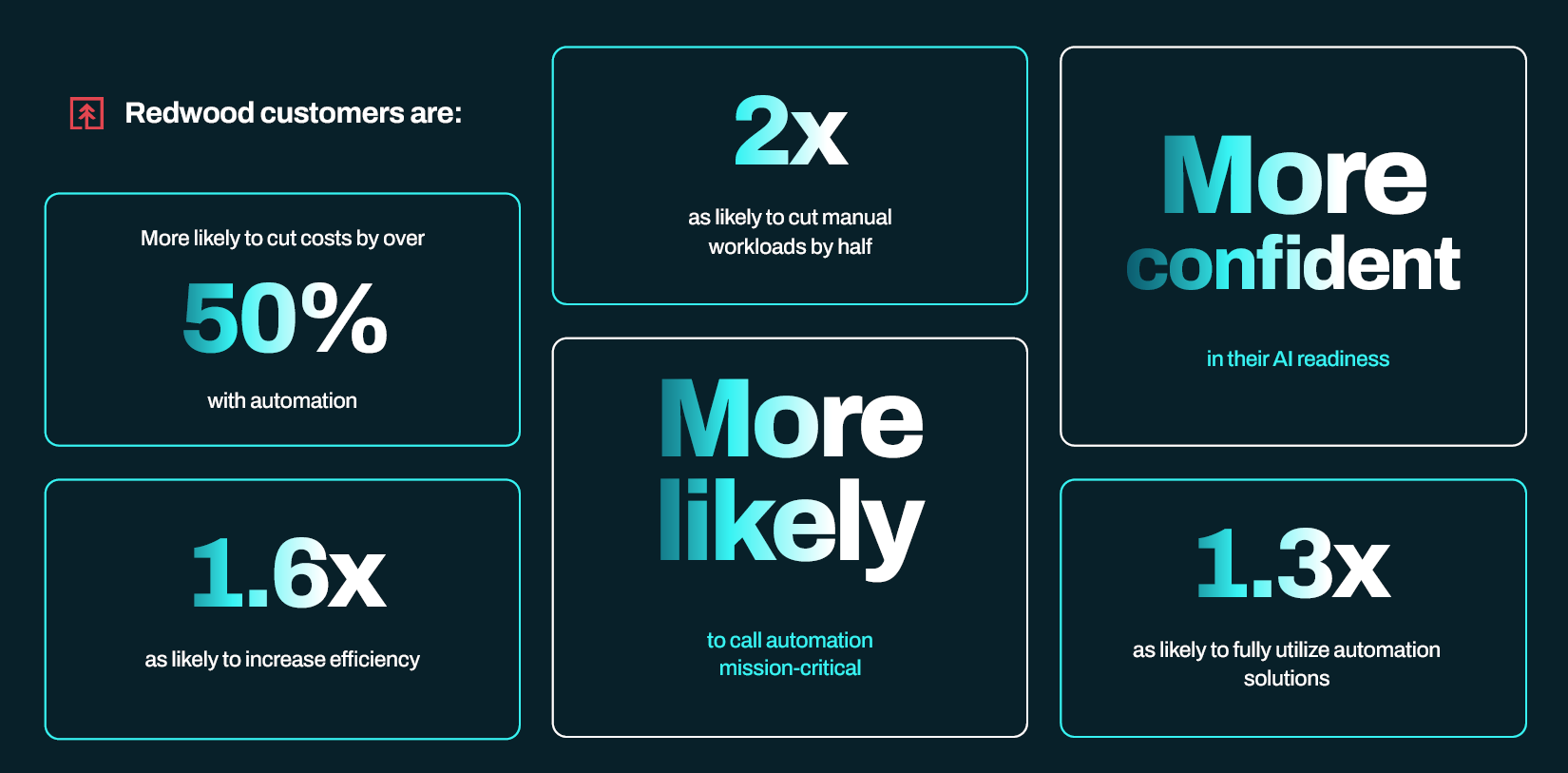
Redwood customers are 1.3x as likely as other automation users to report full utilization of automation solutions.
While most organizations own automation software, far fewer use it to its full potential. Underutilized tools create a false sense of progress: you’ve bought automation, but your workflows still depend on human intervention, tribal knowledge and disconnected systems.
Redwood’s automation fabric model focuses on full-cycle success. That means reaping maximum ROI in deployment, adoption and sustained optimization. Through 24/7 support, a dedicated Customer Success team, on-demand training, integration depth and cross-functional rollout strategies, Redwood customers move beyond implementation to impact.
🛠️ Pro tip: Ask your own teams how many workflows, processes or departments are truly automated end to end. If the number is low, you have a utilization gap.
2. Efficiency is their baseline — not a bonus
Redwood customers are 1.6x as likely to report measurable efficiency gains.
Everyone wants better throughput, fewer delays and less time wasted in handoffs. But only some organizations actually get there—and the difference isn’t the use case; it’s the orchestration.
Redwood customers are more successful in this area because they go beyond automating isolated tasks. They automate how those tasks connect across ERP, SaaS and custom applications. It follows that they experience fewer data silos, faster cycles and real-time responsiveness.
🔁 Efficiency tip: If your automation is still bound to static schedules or buried in silos, you’ll hit a wall. Redwood enables event-driven, conditional workflows that adapt to what’s happening in real time.
3. They cut manual work in half twice as often
Redwood customers are 2x as likely to say automation helped them cut manual workloads by 50% or more.
Manual work remains one of the biggest drains on enterprise agility. But Redwood customers have managed to overcome this barrier, and not with small wins like automating password resets. We’re talking about reducing repetitive work across entire business processes, like closing the books in finance or reconciling inventory in retail.
Redwood customers’ strengths lie in how they orchestrate across systems, not just inside them. That means fewer human handoffs and errors and much more time spent on value-added tasks.
💡 Leadership lens: Want to boost employee satisfaction and reduce risk at the same time? Automate the work people shouldn’t be doing manually anymore.
4. They’re seeing serious cost savings
1 in 3 organizations sees a 25% cost cut, but Redwood users reach 50% and beyond.
Automation isn’t just a performance play. It’s a financial one. Redwood customers win here, too, by minimizing unplanned downtime, eliminating script maintenance, reducing manual effort for routine ops and avoiding expensive workarounds.
🎯 Budget tip: Don’t chase savings through individual point solutions. Look at your entire automation fabric — where inefficiencies live and what systemic improvements are possible.
5. AI readiness is their competitive advantage
Nearly 40% of automation teams aren’t ready for AI, but Redwood customers feel well-positioned to take advantage of it.
Everyone’s talking about AI, but few organizations have the operational maturity to support it. That’s what makes Redwood’s automation foundation different.
AI depends on timely data, orchestrated systems and reliable execution layers. Redwood customers are more likely to say they’re ready for AI because they’ve already done the hard work of integrating automation into their infrastructure and processes.
⚙️ Readiness check: Before launching any AI initiative, ask: Can we trust our underlying processes to deliver clean data, fast execution and secure handoffs? If not, Redwood can help get you there.
6. They treat automation as a business strategy
Redwood customers are more likely to call automation mission-critical.
Cultural buy-in sets the ceiling for automation success. Redwood customers don’t treat automation as an IT line item.
An automation-as-business-strategy mindset shapes how they invest, what they prioritize and how they scale. It’s also why they’re more likely to deliver outcomes that matter, such as improved service levels, business resilience and innovation capacity. 📊 Alignment insight: stand out from your peers by shifting the conversation from “What should we automate?” to “How can automation support our biggest goals?”
Don’t get caught in the automation gap
What stood out in our data was not just how much Redwood customers automate but how strategically they do so. Orchestration turns good automation into great outcomes.
But it’s become clear that the gap between automation investment and successful adoption isn’t closing — it’s widening. And as AI accelerates, that gap will only become more consequential.
Redwood customers outperform not because they bought a better tool, but because they committed to a smarter approach of making automation a foundation, not a feature.
Read more about what your peers are achieving — and challenged by — in enterprise automation. Download the full report.
As faster and instant payment technologies become more visible, many organizations approach payments modernization as a choice between two paths: real-time payments or batch processing. Real-time execution is often framed as progress, while batch processing is treated as something to phase out.
That framing doesn’t match how payment systems operate in practice.
Modern payment environments are built around multiple settlement models, risk controls and reporting obligations. Some payments need to move immediately, but others can’t. Many require both real-time decisioning and delayed settlement. Speed alone doesn’t determine whether a payment flow works reliably.
Most enterprises today process payments across credit cards, debit transactions, ACH payments, account-to-account transfers and alternative payment methods, which behave differently once a transaction is initiated. Some depend on immediate authorization, and others on settlement windows tied to business days. Many combine both.
As a result, organizations are rarely deciding between real-time and batch payments. They’re managing both models at the same time, often inside the same customer or partner journey. The harder problem is coordinating them across payment systems, gateways, processors and banks without creating fragile workflows or time-consuming manual intervention.
In practice, most payment journeys already operate as hybrid workflows. A transaction may begin with a real-time checkout or authorization, then move through batch-based settlement, reconciliation and reporting later. That’s why payments modernization isn’t about replacing batch processing with real-time rails. It’s about designing payment workflows that coordinate both models reliably across the payments stack, from initiation through settlement and post-payment operations.
Payments modernization, at its core, is an orchestration challenge.
Both models in modern payment environments
Real-time and batch payments exist because payment ecosystems serve different business needs. Each execution model reflects tradeoffs between speed, control, liquidity and operational effort.
Enterprise payment systems are rarely simple. A single payment operation may touch customer-facing apps, payment gateways, PSPs, acquirers and multiple financial institutions before funds actually settle. Each step introduces different timing, risk and data requirements. Real-time execution supports fast decisioning and customer experience, while batch processing supports liquidity management, reporting and auditability.
What are real-time payments?
Real-time payments are designed to move funds from payer to payee within seconds, with confirmation returned almost immediately. Settlement doesn’t wait for end-of-day cycles or multi-day clearing windows.
In the United States, real-time payment systems include the RTP network operated by The Clearing House and the FedNow Service from the Federal Reserve Banks. Participating financial institutions use these networks to support immediate payments between bank accounts, including account-to-account transfers and request-for-payment scenarios.
Similar systems operate globally. Countries such as Brazil and Australia have adopted real-time payment infrastructures that support local payment methods through banking apps, fintech platforms and digital wallets.
Common real-time payment use cases
Real-time payments are used wherever immediacy changes the outcome of a transaction. That includes P2P transfers, instant disbursements for the gig economy, insurance payouts and time-sensitive B2B payments where delays impact cash flow or customer satisfaction. Request for payment scenarios also rely on real-time execution so payers can respond and funds can move without waiting for business days to pass.
While credit cards feel instantaneous, real-time bank payments behave differently. They move funds account to account and settle immediately through real-time payment systems, which creates different liquidity and risk considerations for payment operations teams.
How real-time payments actually run
Real-time payments are event-driven and API-based. Execution begins when something happens: a checkout is completed, a request for payment is approved, a disbursement is triggered.
From there, everything must happen quickly. Payment routing decisions, authorization checks, tokenization and fraud detection occur in milliseconds. If liquidity isn’t an option, or a downstream system is unavailable, there is little time to recover. This immediacy improves customer experience and conversion rates, but it also raises the stakes for payment operations. Failures are visible right away. Retries must be automated. Fallback paths must already exist.
Because failures surface immediately, real-time payment flows depend on automation. Retries have to happen without human intervention. Not to mention, fallback paths need to be defined in advance so a single outage doesn’t stop payments entirely.
This is where payment orchestration becomes critical. Without an orchestration layer, every real-time failure becomes a visible customer issue. With orchestration, transactions can be rerouted, retried or deferred into batch workflows when conditions require it without breaking the overall payment experience.
What is batch payment processing?
Batch payment processing takes a different approach. Transactions are grouped together and processed on a schedule rather than individually as they occur.
Batch processing persists because it solves problems real-time execution can’t. Grouping transactions reduces processing costs, simplifies reconciliation and makes liquidity planning more predictable. For ACH payments and large-scale disbursements, these efficiencies matter more than speed.
Batch workflows also support downstream activities like reporting, chargeback handling and audit preparation. These processes depend on complete payment data and structured settlement cycles, which is why batch execution remains embedded in payments infrastructure even as real-time capabilities expand.
Why real-time payments can’t replace batch processing in enterprise environments
The expansion of real-time payment capabilities has not removed the need for batch processing, and it’s unlikely to do so.
Many payment methods still require scheduled settlement. ACH payments, reconciliation activities and certain cross-border flows depend on batch execution to ensure traceability and compliance. Financial institutions and service providers rely on these cycles to manage risk.
Liquidity is another constraint. Real-time payments require immediate funding, which can introduce pressure at scale. Treasury teams use batch settlement schedules to manage cash positions across accounts, regions and legal entities.
There’s also the reality of downstream work. A payment doesn’t end when funds move. Chargebacks, retries, reporting and metrics collection often happen later — and in batch. Even when a payment is initiated in real time, the work around it usually isn’t.
Consider a digital checkout that authorizes and confirms payment in seconds. The customer sees an immediate result, but settlement may still occur later through batch processing. Reconciliation, reporting and metrics collection often follow scheduled workflows tied to business days and regulatory requirements.
Bringing real-time and batch together with unified payment orchestration
Modern payment orchestration solutions are designed to manage this complexity without forcing all payments into a single execution model.
A payment orchestration layer sits above payment gateways, processors and banks. Orchestration doesn’t replace payment processors, PSPs or acquirers. It coordinates them. The orchestration layer defines how payment flows move across systems, how routing decisions are made and how exceptions are handled when something goes wrong.
By centralizing this logic, organizations avoid hardcoding payment behavior into individual applications. Governance, monitoring and control move into a single platform, which makes it easier to manage both real-time and batch execution consistently as volumes and payment options grow.
This layer becomes especially important as organizations expand into new markets or support additional payment options. Different geographies rely on different payment rails. Local payment methods behave differently than global card networks. Without orchestration, each variation adds more custom logic to applications.
What orchestration handles
In practice, a payment orchestration platform manages functions such as:
Routing transactions based on availability, geography or cost
Supporting fallback paths during outages
Automating retries when transient failures occur
Applying fraud detection and secure payment controls consistently
Centralizing payment data and operational metrics
Managing payment data consistency across workflows
Coordinating tokenization and fraud detection across payment methods
Centralizing these functions reduces duplication and makes payment operations easier to scale. Instead of updating logic in every app or integration, teams adjust orchestration rules once and apply them across the entire payment ecosystem.
Real-time vs batch payments: Key differences in practice
Teams often talk about real-time and batch as if they’re competing approaches, but day-to-day payment operations usually rely on both. The differences below aren’t about which model is “better.” They’re the practical constraints that shape how you design payment workflows, choose payment rails and set up routing, retries and fallback paths across payment systems.
This comparison is also useful when you’re deciding where to standardize controls like fraud prevention, tokenization and monitoring. Real-time execution compresses the timeline for decisioning, while batch processing creates structured cycles for settlement, reporting and reconciliation.
Area
Execution
Settlement timing
Liquidity impact
Typical use cases
Operational recovery
Real-time payments
Event-driven
Seconds
Immediate
Instant payments, disbursements
Retries and fallback
Batch payments
Scheduled
Business days
Predictable
Payroll, ACH, reconciliation
Managed in cycles
In most modern payment stacks, these models don’t exist in isolation. Real-time execution often handles initiation, authorization and confirmation, while batch workflows handle settlement, reconciliation and reporting across business days. The goal isn’t to force one timing model onto every payment method. It’s to coordinate them so payment data stays consistent, exceptions stay manageable and success rates hold steady as volumes grow.
Benefits of payment orchestration in modern payment operations
As payment ecosystems grow more complex, payment orchestration helps organizations manage volume, variation and risk without adding fragility to their payment operations.
Higher payment success rates
One of the most immediate benefits of orchestration is improved success rates. When a payment fails due to a temporary outage or routing issue, orchestration enables automated retries or rerouting to alternative payment paths. Without this capability, many failures surface as manual exceptions that slow down operations and impact revenue.
Centralized visibility and monitoring
Payment orchestration provides a centralized view across omnichannel payment flows. Metrics such as success rates, authorization rates and failure patterns can be monitored in one place rather than across disconnected systems. This visibility helps teams diagnose issues faster and respond before failures cascade.
Lower operational overhead
By centralizing routing logic and monitoring, orchestration reduces the effort required to maintain separate integrations for each payment method, processor or gateway. Changes can be made once at the orchestration layer instead of being repeated across multiple applications, which saves time and reduces operational risk.
More consistent customer experiences
Orchestration helps deliver consistent payment behavior across checkout flows, apps and digital channels. Customers are less likely to encounter unavailable payment options or failed transactions based on geography, timing or temporary outages.
Scalable payment operations
As payment volumes grow or new payment methods are introduced, orchestration allows organizations to extend payment capabilities without reworking existing workflows. This makes it easier to scale payment operations while maintaining reliability and control.
Payment orchestration in the modern payments stack
In a modern payments stack, orchestration connects applications, payment gateways, PSPs, acquirers and banks through a single control layer. Rather than embedding routing logic in each system, orchestration centralizes decision-making. When outages occur, fallback rules can be adjusted centrally. When new payment options are added, they can be introduced without rewriting core applications.
In this model, applications initiate payments, orchestration governs execution and downstream systems handle processing and settlement. The orchestration layer becomes the control point for routing, retries and monitoring, while existing payment infrastructure continues to do what it does best.
This separation improves scalability. New payment methods, processors or geographies can be introduced without reworking core workflows, reducing downtime and integration effort over time.
Designing payment workflows for a hybrid world
Real-time and batch payments will continue to coexist as payment technologies evolve. Payment ecosystems are expanding, not converging. Modernizing payments means coordinating both models across payment flows, applying consistent governance and supporting new capabilities without disrupting what already works. Organizations that take this approach build payment systems that are resilient, scalable and ready to evolve as payment technologies and business needs change.
Designing payment workflows for a hybrid environment starts with understanding where real-time execution adds value and where batch processing remains essential. From there, orchestration rules can be defined to align routing, settlement and reporting with operational and regulatory requirements.
As payment infrastructure continues to evolve, the ability to orchestrate real-time and batch payments within a single framework will shape how effectively enterprises manage risk and deliver reliable digital payment experiences.
Just over a year ago, SAP introduced SAP Business Data Cloud (BDC) and its Databricks partnership and later in the year extended that with its Snowflake partnership, positioning SAP BDC as the next evolution of enterprise data management on SAP Business Technology Platform (BTP). The announcement — and the ecosystem behind it — were not incremental updates. They signaled a strategic shift in how SAP customers are expected to manage data, analytics and AI going forward.
This shift comes at a decisive moment, preceding SAP Business Warehouse (BW) reaching the end of mainstream maintenance in 2027, with extended maintenance ending in 2030. SAP BW/4HANA remains supported until at least 2040, but the long-term direction is clear. If you’re running SAP today, you’re likely moving from primarily on-premises, centralized data warehousing toward a cloud-based, multi-service data architecture.
That change is structural, and structural changes introduce new operational realities. As you modernize your data landscape as part of a broader SAP Cloud ERP or SAP Cloud ERP Private journey in GROW with SAP or RISE with SAP, the goal isn’t just architectural alignment. It’s to accelerate transformation while keeping operating costs predictable and avoiding new layers of technical debt.
What fundamentally changes with SAP Business Data Cloud
In a traditional SAP BW landscape, most data warehousing functions lived inside one system boundary. Data extraction, transformation, modeling, scheduling and reporting were tightly coupled. Even in complex SAP ERP environments, there was a central anchor point for enterprise data.
SAP BDC operates differently. Instead of one primary platform, you’re working across a set of tightly integrated services on SAP BTP. SAP Datasphere, SAP Analytics Cloud , SAP BW and BW/4HANA, Databricks and Snowflake form a broader data fabric.
SAP Datasphere, evolving from SAP Data Warehouse Cloud and incorporating capabilities from SAP Data Intelligence Cloud, is positioned as the core enterprise data management platform. It integrates with SAP Analytics Cloud for analytics and planning, and with Databricks and Snowflake for data pipelines, advanced analytics and AI scenarios.
From a data perspective, integration is stronger than ever. Semantics, metadata and access across SAP systems are more aligned than in previous generations.
But integration isn’t orchestration. As your landscape expands across these services, you still need a way to coordinate how jobs, dependencies and business processes execute across them.
Where orchestration becomes operationally critical
In SAP BDC environments, each component has its own scheduler and automation capabilities.
SAP Datasphere runs replication flows and transformations
SAP Analytics Cloud refreshes dashboards and publishes stories
SAP BW and BW/4HANA continue to run process chains
Individually, these systems work. The challenge appears when those jobs are part of a larger end-to-end business process.
Take a straightforward example. You run an extract, transform and load (ETL) or replication flow in SAP Datasphere. Once the data is updated and validated, you need to publish a new SAP Analytics Cloud story based on that refreshed dataset. Both steps can be scheduled locally. What connects them? What ensures the SAP Analytics Cloud publication only happens after the upstream process has completed successfully?
The same pattern applies if you’re using Databricks or Snowflake instead of SAP Datasphere. A machine learning or analytics job runs overnight. When it finishes, downstream reporting or operational updates need to be triggered. Each platform can manage its own workload, but the dependency between them isn’t governed unless you introduce orchestration across systems.
A second, equally common scenario is nightly batch processing across multiple services. You may schedule jobs independently inside SAP Datasphere, Databricks, Snowflake or SAP BW. Each executes reliably, but you don’t have a consolidated view of what’s happening across SAP BDC as a whole. There’s no single operational window into cross-platform execution, and understanding overall status may require reviewing several consoles.
That’s where orchestration extends the value of SAP BDC — by coordinating native schedulers and providing transparency across the ecosystem. It also reduces operational overhead. Instead of managing multiple schedulers, agents and custom scripts across environments, you establish a unified control layer that scales with your architecture. That’s particularly important in RISE with SAP environments with SAP Cloud ERP Private, where clean core principles discourage custom code inside the ERP and where unnecessary infrastructure adds cost and complexity.
The role of RunMyJobs in the SAP BDC era
RunMyJobs by Redwood provides that orchestration layer. It’s the only workload automation platform that’s both an SAP Endorsed App and included in the RISE with SAP reference architecture. RunMyJobs’ secure gateway connection to a customer’s RISE with SAP environment can be installed, hosted and managed by the SAP Enterprise Cloud Services team, eliminating the need for additional infrastructure and supporting clean core strategies from day one. Recognized as a Leader in the Gartner® Magic Quadrant™ for Service Orchestration and Automation Platforms, RunMyJobs centralizes scheduling, dependency management and monitoring across SAP and non-SAP systems.
For SAP BDC environments, RunMyJobs offers out-of-the-box connectors for:
Because RunMyJobs uses a secure gateway connection, very similar to how SAP Cloud Connector works, rather than requiring agents to be deployed across every SAP system, you avoid the operational costs and upgrade friction associated with agent-heavy architectures. That reduces maintenance effort, lowers total cost of ownership (TCO) and minimizes risk during SAP upgrades or RISE with SAP transformations.
In practice, you can:
Trigger downstream analytics only after upstream data validation completes
Coordinate nightly batch processes across multiple cloud services
Establish a single pane of glass for visibility into SAP BDC execution
You don’t have to stop scheduling locally if that works for your teams, but by introducing an orchestration layer, you gain consistent control across the full landscape.
Supporting your path forward
There isn’t one correct response to the end of SAP BW mainstream maintenance. You may accelerate toward SAP Datasphere and a cloud-centric architecture. You may move selectively while continuing to run SAP BW/4HANA well into the next decade. Or, you may operate a hybrid model for years.
RunMyJobs supports all of the above, offering orchestration for classic SAP BW environments and all major components of SAP BDC. Whether you’re stabilizing existing SAP BW process chains or orchestrating new cloud-based workflows, the objective is the same: maintain control over execution across your environment.
You don’t have to complete a migration to benefit from orchestration. And you don’t have to abandon SAP BW to modernize your control layer. In fact, many organizations introduce orchestration early in their RISE with SAP and SAP Cloud ERP transformation to de-risk migration, retire legacy schedulers and create a scalable SaaS control tower before complexity compounds. That approach helps reduce disruption during go-live while positioning your automation strategy for long-term innovation.
But AI pipelines introduce additional operational dependencies. Training jobs, scoring runs, data refresh cycles and reporting updates must align across systems. As those chains grow, so does the need for consistent governance and monitoring. With RunMyJobs, the leading orchestration platform for the autonomous enterprise, you can apply consistent governance, monitoring and error handling across both traditional data warehousing processes and new, AI-driven workflows. That consistency is what turns experimentation into enterprise-grade transformation, without introducing new layers of manual oversight or operational costs.
See how RunMyJobs provides a coordination layer across SAP BTP, SAP BDC and your broader landscape:
Architect for control
As your SAP data landscape becomes more distributed across SAP BTP services, execution coordination becomes more important. Data integration continues to improve across SAP’s ecosystem. The next question is how you want those integrated systems to run together.
If you’re evaluating how to orchestrate SAP Datasphere, SAP Analytics Cloud, SAP BW, Databricks or Snowflake, particularly as part of a RISE with SAP and SAP Cloud ERP journey, the goal isn’t just coordination. It’s to modernize your execution layer in a way that supports clean core principles, reduces TCO and accelerates transformation across your enterprise.
The next step is practical: understand how orchestration connects to each of these platforms in your landscape.