SAP Sapphire 2026 will be underway starting next week, and as in past years, Joule has been central to nearly every conversation about the future of enterprise AI. That’s no surprise. Since its official announcement in September 2023, Joule has evolved from a conversational copilot into a genuinely agentic system that can reason through multi-step workflows, coordinate across SAP applications and initiate action rather than simply respond to prompts.
The industry trajectory behind this shift is well-documented. The November 2022 launch of ChatGPT accelerated enterprise AI adoption faster than most anticipated, moving organizations from isolated experimentation to embedding AI directly into daily business operations. Analysts at Gartner and Forrester now converge on the same conclusion: the near-term future of enterprise AI is defined by the transition from passive, prompt-based assistants to autonomous AI agents capable of goal-driven execution.
But the capability to act and the infrastructure to execute and scale reliably are two different things.
When Joule acts, something has to execute
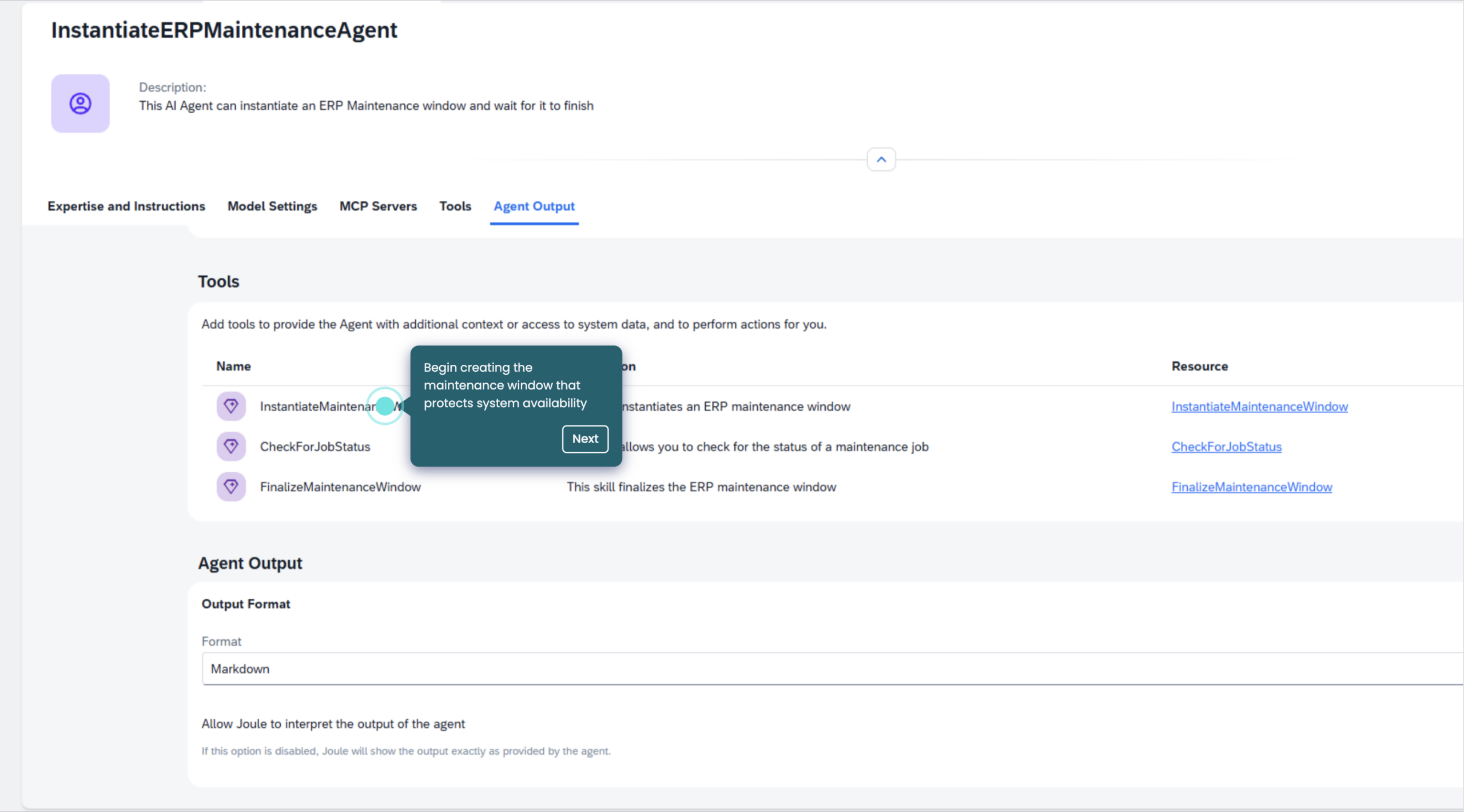
The maintenance window is a solid use case to examine that gap, because it exposes exactly where agentic intent meets operational complexity.
Consider an unplanned SAP system maintenance window. Traditionally, this requires multiple manual steps and cross-team coordination: pausing background jobs, stopping dependent integrations, managing approvals and verifying that dependencies are resolved before maintenance can proceed. The SAP Business Technology Platform (BTP) team handles iFlows. The Basis team manages job suspension separately. Each manual handoff introduces risk, and as SAP landscapes become more interconnected, that complexity only increases.
With RunMyJobs by Redwood integrated into Joule, a Basis administrator can take a goal-oriented approach instead. They express intent — preparing systems for a maintenance window — and Joule handles the conversational layer, understanding the request and applying business context. RunMyJobs handles execution: orchestrating the required actions across SAP and connected systems using predefined workflows, policies and controls that have already been defined, approved and governed.
In other words, Joule is responsible for understanding and interacting while RunMyJobs is responsible for deterministic, auditable execution. Every step that runs has been scoped in advance. What changes is how teams interact with automation, but not the rigor with which it operates.
Conversational and agentic AI alone aren’t sufficient for enterprise automation. Without a reliable orchestration layer, AI initiatives introduce risk into mission-critical processes. RunMyJobs acts as the control plane between conversational intent and system execution. It’s cloud-native, an SAP Endorsed App and the only workload automation and orchestration platform that’s part of the RISE with SAP reference architecture. It provides centralized scheduling, dependency management, execution and observability across complex SAP and non-SAP landscapes, with role-based access control (RBAC), enforced approvals and a complete audit trail for every action taken.
Unlocking business value from Joule with RunMyJobs
Building Joule integrations with RunMyJobs just became significantly more accessible.
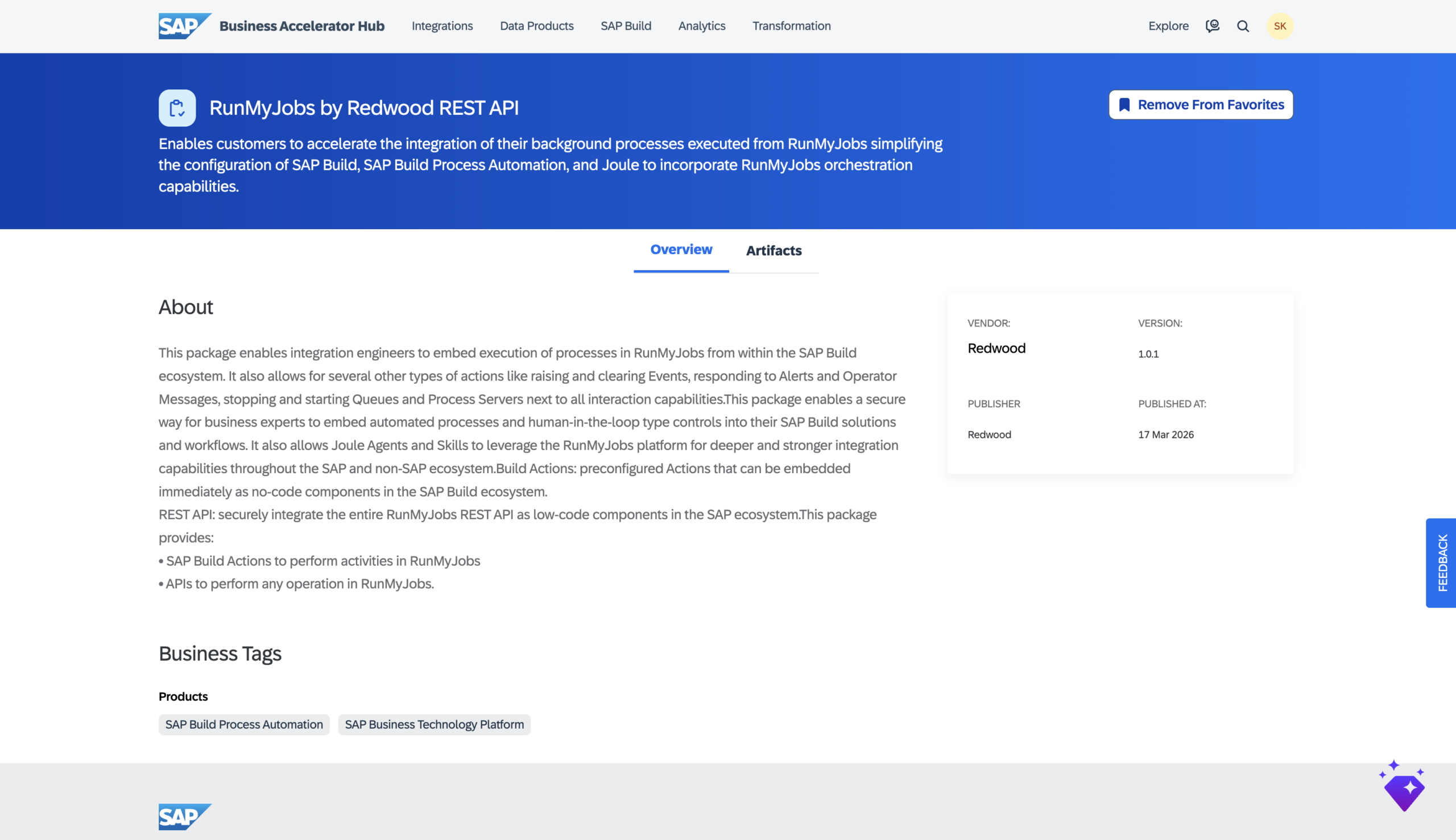
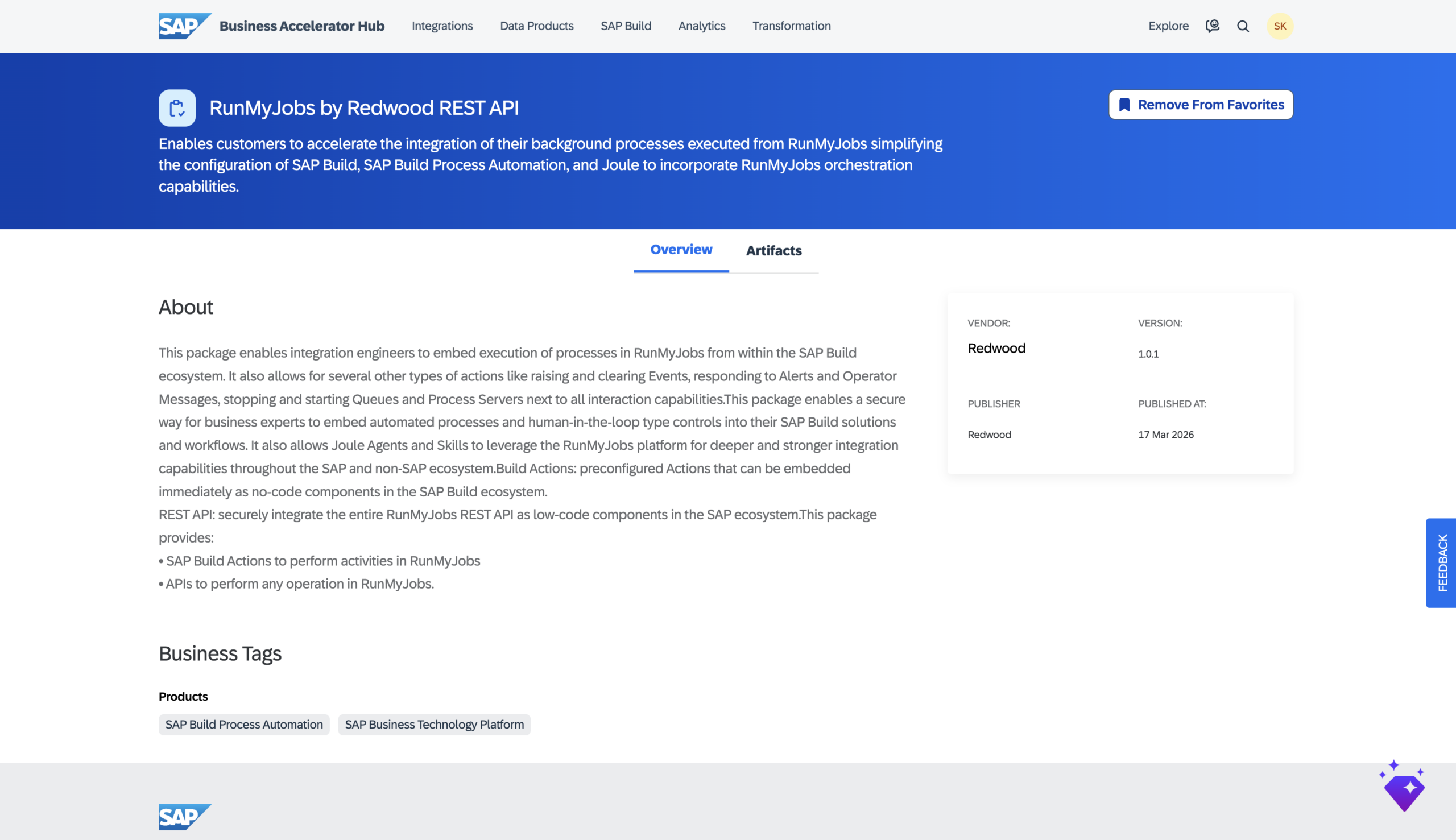
RunMyJobs’ REST API and pre-built SAP Build Actions are now published in the SAP Business Accelerator Hub, which has a few practical implications for teams building on SAP BTP. Development teams building Joule skills and agents can invoke RunMyJobs’ orchestration capabilities directly as no-code components within Joule Studio — no custom integration work required — with the full REST API accessible as low-code components for more advanced scenarios.
Inclusion in the Accelerator Hub also reflects a deeper level of alignment with SAP, as these integrations are designed within SAP’s extension framework and consistent with clean core principles and SAP BTP development standards. Furthermore, for customers with high security requirements, RunMyJobs now supports OAuth from SAP BTP, including Joule, to its REST API.
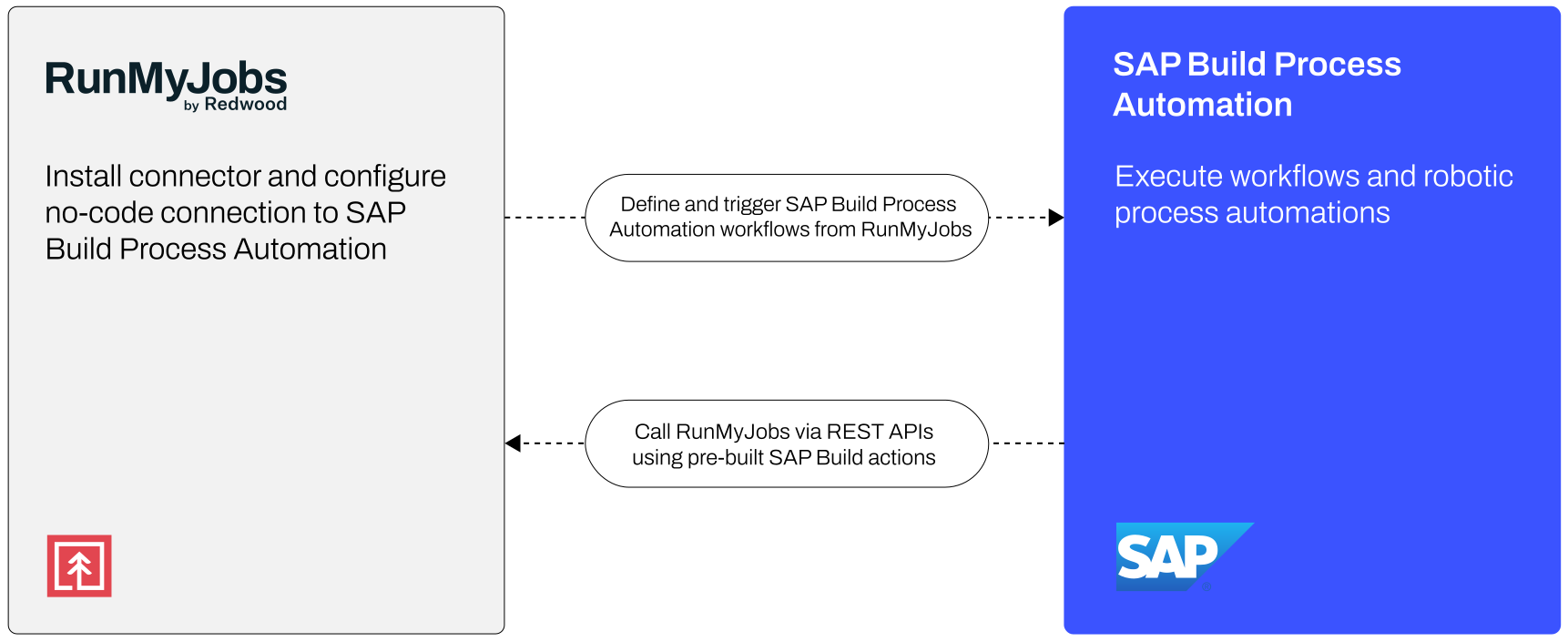
The integration is genuinely bi-directional: RunMyJobs can trigger and orchestrate SAP Build Process Automation workflows as part of larger end-to-end business processes, while SAP Build applications and workflows can call RunMyJobs capabilities — raising and clearing events, responding to alerts, managing queues — directly from within the SAP BTP ecosystem. And Joule can incorporate RunMyJobs as part of AI-driven automation scenarios, using it as the governed execution layer for Agents and Skills that need to operate reliably across SAP and non-SAP systems.
Two paths to governed agentic execution
Joule Agents can now connect to RunMyJobs in two ways: via Joule Skills using the pre-built SAP Build Actions in the SAP Business Accelerator Hub or through the Model Context Protocol (MCP) server.
MCP is an open standard that gives AI systems a shared way to connect with external tools without custom integrations, and its addition to RunMyJobs means Joule Agents can trigger workflows, check job status and interact with your automation landscape through a protocol already adopted across every major AI platform.
Whenever AI is introduced into enterprise systems, the first concern is control. That’s why governance is foundational to this approach.
In RunMyJobs, every action is governed, logged and auditable. RBAC ensures that only authorized users can trigger specific workflows. So, a new interface doesn’t expand permissions. It simply provides a different way to interact with existing, approved automation.
Policies are enforced automatically. If an approval or validation is required, the workflow will not proceed without it. Every step executed by RunMyJobs is logged, including what was triggered, when it ran, who approved it and how it executed across systems. That audit trail is always available.
This matters not just in regulated environments, but because compliance, traceability and accountability are always critical. AI automation must operate within those controls.
Maintenance is a powerful starting point, but it’s only one example. The same conversational orchestration pattern applies across SAP-driven business processes and functions:
Finance teams can trigger period close and reconciliation activities that depend on correct sequencing and validation
Supply chain operations, where timing and cross-system coordination are critical, benefit from AI orchestration that reduces manual handoffs and delays
Retail, utilities and HR teams can apply the same approach to order-to-cash, meter-to-cash and employee lifecycle workflows, respectively
When SAP introduced SAP Build at the SAP TechEd conference in 2022, the message was deliberate: automation shouldn’t require a developer. Business users, those who understand the processes, should have the tools to design workflows, automate decisions and remove manual effort from everyday tasks without writing code.
SAP Build brings together a number of capabilities on SAP Business Technology Platform (BTP): SAP Build Apps and Code for application development, SAP Build Work Zone as a portal service and SAP Build Process Automation (SAP BPA) for workflows and robotic process automation (RPA). SAP BPA merges the previous SAP Workflow Service and SAP Intelligent Robotic Process Automation (iRPA) into a single, low-code offering for workflow management — and it’s where automation becomes more accessible, more contextual and more aligned with how business teams actually work.
But accessibility at the task level creates a new operational question. Once SAP BPA is running at scale, the conversation shifts from “What can it automate?” to “How reliable, secure and efficient is the automation?” Workflows need to be sequenced, governed and run reliably across multiple systems, teams and dependencies. That’s where the design of individual automations meets the reality of enterprise process orchestration. With Redwood Software’s new SAP BPA connector and RunMyJobs by Redwood REST API actions now available in the SAP Business Accelerator Hub, that connection is now bi-directional and more accessible than ever.
Separate by design, connected by purpose
SAP BPA is designed to build custom task-level automation for common and repetitive tasks. Think of processes like:
Extracting invoice data and posting it into SAP
Uploading journal entries from spreadsheets
Parsing contract terms and triggering follow-up actions
These steps are focused on a specific function or interaction. It’s important to look at how they operate within broader business processes.
For example, order-to-cash doesn’t start and stop with a single workflow. A financial close isn’t just a sequence of approvals. Supply chain execution depends on precise timing, cross-system dependencies and conditions being met upstream before the next step can begin.
SAP BPA is well-suited to automating the tasks and user-driven workflows within those processes. RunMyJobs complements this by orchestrating the end-to-end process those tasks belong to — coordinating execution across systems, managing dependencies and ensuring every step runs at the right time, in the right sequence, with full process visibility and control.
Extending SAP BTP without fragmenting your processes
This relationship becomes especially relevant as SAP customers move deeper into cloud transformations through RISE with SAP and SAP BTP adoption. SAP’s clean core principle encourages organizations to move extensions, integrations and custom logic out of the ERP core and onto SAP BTP, where they can be maintained without disrupting the core system. SAP BPA fits naturally into this model, as it lives on SAP BTP and allows process logic to be built and maintained there rather than embedded inside the ERP.
But moving logic to SAP BTP doesn’t automatically communicate it to the end-to-end processes that logic belongs to. An SAP BPA workflow running on SAP BTP still needs to be triggered at the right moment, handed off correctly to downstream steps and governed as part of a larger orchestrated flow.
RunMyJobs provides that orchestration layer. As the only orchestration platform that is both an SAP Endorsed App and included in the RISE with SAP reference architecture, RunMyJobs coordinates execution across SAP and non-SAP systems without requiring custom code in the core or local installation of third-party software inside the ERP. It maximizes the return on your SAP investment.
The SAP Build Process Automation connector for RunMyJobs
The SAP BPA connector for RunMyJobs makes this integration concrete and operational. With the connector installed, you can incorporate SAP BPA workflows directly into larger orchestrated business processes.
In practice, across a range of use cases, that means you can:
Trigger SAP BPA workflows as a step within a broader RunMyJobs process chain
Use the outcome of an SAP BPA workflow to drive downstream dependencies across systems
Coordinate SAP BPA automations alongside SAP ERP jobs, file transfers, data pipeline steps and non-SAP workloads
Monitor SAP BPA workflow execution alongside every other step in the process from a single platform
Leverage pre-built, enterprise-grade automation activities that include the security, governance and guardrails required for mission-critical processes
Extend these workflows into SAP Joule scenarios by invoking RunMyJobs as part of Joule skills and agents
Rather than treating SAP BPA as a standalone automation tool, you embed it into the processes it supports. Instead of building workarounds to connect SAP BPA to the rest of your automation landscape, you can let the connector handle that.
Available in the SAP Business Accelerator Hub
The integration goes further than a single connector. RunMyJobs’ REST API and pre-built SAP Build actions are now published in the SAP Business Accelerator Hub, making it easier for teams building on SAP BTP to incorporate RunMyJobs orchestration capabilities directly into their SAP Build applications, workflows and extensions.
This has a few practical implications:
It lowers the barrier for SAP BTP development teams and citizen developers. Instead of building custom integrations from scratch, you can invoke RunMyJobs capabilities directly as no-code components within SAP Build and Joule Studio. Pre-configured actions are available immediately, and the full REST API is accessible as low-code components for more advanced scenarios.
It reflects a shared vision and aligned roadmap with SAP. Inclusion in the SAP Business Accelerator Hub means these integrations are designed to work within SAP’s extension framework, consistent with clean core principles and SAP BTP development standards.
It enables true bi-directional integration:
RunMyJobs can trigger and orchestrate SAP BPA workflows as part of larger business processes
SAP Build applications and workflows can call RunMyJobs capabilities — raising and clearing events, responding to alerts, managing queues and more — directly from within the SAP BTP ecosystem
Setup is designed to be straightforward and aligned with how SAP and RunMyJobs environments are typically managed.
From the RunMyJobs side, configuration consists of:
Installing the SAP BPA connector from the RunMyJobs Connector Catalog
Configuring the connection using SAP BPA endpoints and authentication
Incorporating SAP BPA workflows as steps within orchestrated process definitions in RunMyJobs
Once configured, SAP BPA workflows become fully governed participants in your broader automation landscape. They can be scheduled, triggered by events, monitored for success or failure and coordinated with every upstream and downstream dependency across your systems.
Distributed automation needs a control plane
As SAP customers move to SAP Cloud ERP, RISE with SAP and SAP BTP, process logic is becoming more distributed across services, extensions and applications. This brings flexibility but also a new requirement: those processes still need to run as one.
RunMyJobs addresses this by connecting SAP BPA workflows with the broader processes they belong to, orchestrating execution across systems, managing dependencies and ensuring that distributed automations operate as a single, reliable flow. It allows you to extend on SAP BTP without fragmenting how processes are executed or governed.
Automation at the task level is only part of the equation. Proven and efficient orchestration is what makes it enterprise-grade.
One data point from Redwood Software’s Manufacturing AI and automation outlook 2026 stood out: Upper management predominantly sees operations as 51–75% automated. Plant and front-line leaders? They report 26–50%.
Both groups are looking at the same factory. Both are telling the truth. And that’s exactly the problem.
The view from a distance
The further you are from execution, the more automated things look. Dashboards are green. KPIs trend in the right direction. Automated systems do what they were designed to do. From a leadership vantage point, the investment is paying off — and in many ways, it is.
About 6 in 10 manufacturers have cut unplanned downtime by at least 26% with automation, with a meaningful share reporting reductions beyond 50%. Uptime and throughput are improving. Production lines are more stable. These are legitimate, measurable outcomes.
The 51–75% perception reflects what leaders can see:
✅ Individual manufacturing systems performing well
✅ Investments translating into operational efficiency gains
✅ The organization trending toward greater stability
That view is inherently scoped to what happens inside those systems.
Up close, friction comes into focus
Move closer to execution, and the picture changes. Individual platforms may work, but coordination across them — ERP to MES, planning to procurement, quality events to supply chain adjustments — still depends on human intervention.
Front-line teams don’t have to be skeptical of automation to encounter its limits. What looks like a 70% automated operation from a conference room feels closer to 40% when you’re the one bridging systems with spreadsheets because they weren’t designed to talk to each other.
That dynamic shows up clearly in the data. Only 40% of manufacturers have automated exception handling, despite 22% citing it as a top source of disruption. More than a quarter still move sensitive information through email or manual methods.
Where maturity lives: The space between systems
It would be easy to treat this as a reporting problem: something better dashboards or more shop-floor visibility could close. It isn’t. The gap maps to how automation has been applied — and where it hasn’t.
Most organizations have done solid work automating within systems. ERP processes run as expected. MES workflows are stable. Control systems do their jobs. Those results show up cleanly in dashboards and quarterly reviews, and they’re real.
But no meaningful manufacturing workflow stays inside one system. Forecasting feeds scheduling, production affects inventory, quality events ripple into supply chain decisions. At every one of those handoffs, automation stops and someone picks up the slack.
That’s the 51–75% vs. 26–50% gap in a nutshell. Leadership watches systems perform. Front-line teams manage what happens in between: the timing, the manual data pulls, the spreadsheet that keeps two platforms in sync because nobody built a bridge.
Nearly three-quarters of manufacturers sit in mid-stage automation maturity right now. Tasks are automated, but the workflows connecting them remain only partially orchestrated. Each new automation initiative can make this harder to see. A new initiative makes an individual system more capable, which looks like progress from the top, while the manual stitching between systems stays unchanged and unmeasured.
78% of manufacturers have automated less than half of their critical data transfers. The majority of cross-system execution still depends on how information moves between platforms, not on how well any individual system runs.
This is also why AI readiness remains elusive for most manufacturers right now. If the coordination layer doesn’t exist for your people, it won’t exist for your models. You can’t automate your way to AI-ready if the gaps are structural.
Start with handoffs
The perception split tells you exactly where to look next. Not at the systems themselves, but at the handoffs between them.
The manufacturers breaking through have shifted their focus accordingly. They’re automating exception handling across systems, connecting data flows between platforms and using event-driven workflows instead of scheduled scripts. They’re also 2.7x as likely to have reached the higher stages of automation maturity.
The “Manufacturing AI and automation outlook 2026” breaks down where those coordination gaps show up most often, what high-maturity manufacturers do differently and how the perception divide plays out across roles, systems and KPIs.
SAP Sapphire 2026 has delivered one of the clearest, most unambiguous messages the enterprise software industry has sent in years. Not through a single announcement, but through the weight and coherence of everything taken together.
The conversation has shifted decisively. From what AI can do in theory to what it can sustain in production. From isolated tools to systems that connect highly complex critical processes end to end. From experimentation to execution. SAP has put its full organizational weight behind a single claim: the Autonomous Enterprise isn’t coming. It’s here, and it is the only viable operating model for what comes next.
SAP CEO Christian Klein said it plainly in the official press release: “For the mission-critical processes of our customers, ‘almost right’ just isn’t good enough.” That’s not the language of a company still running AI experiments, but of a company that has decided.
At Redwood Software, we agree. We’ve been at the forefront of every trend and leading the automation world for 30 years, from batch scheduling to cloud-native orchestration to agentic AI. Each wave has required enterprises to re-anchor around a governed execution layer. This moment is no different; it’s the next natural evolution of a stack we’ve been preparing the world’s leading organizations to run more autonomously for decades.
But agreeing on the destination isn’t the same as solving the journey. And the journey — the hard, unglamorous, architectural work of making AI reasoning actually do something inside the systems that reliably run your business — is where most enterprises are still stuck. The announcements from Orlando this week make that journey more achievable, but they don’t make it automatic. Here’s what each of them means for the enterprises trying to close the gap between ambition and execution.
The biggest hidden cost in this space is not model inference or integration development. It’s teaching the agent what your business actually does: the decades of mission-critical logic encoded in existing automation estates and the process knowledge that took years to build and can’t be reconstructed by prompting an AI.
Joule Work: The right interface needs the right engine
The reimagined Joule experience is the announcement that generated the most excitement in Orlando, and rightly so. As SAP describes it, Joule Work means users now interact primarily with Joule, describing a desired business outcome on desktop or mobile and letting Joule orchestrate the right combination of workflows, data and agents to get it done, across SAP and non-SAP systems alike. That vision isn’t just directionally correct. It is, increasingly, the model that early adopters and leaders in their industries will use for a competitive advantage as AI agents take on more of the decisional work across the entire enterprise, including IT, finance, supply chain, HR, CX and more.
But there’s a pattern that plays out in enterprise after enterprise, and it’s one that the Joule announcement doesn’t fully resolve on its own.
Once AI becomes part of a process, early results look positive, work moves faster, less labor is required and teams process more volume. Then, friction inevitably starts to accumulate — not because the AI is performing poorly, but because the systems around it were designed for a fundamentally different model.
In mission-critical processes such as a global financial close or complex manufacturing runs, a single event triggers thousands of interdependent steps, each governed by specific conditions across the ERP and beyond. These processes are engineered for high-fidelity, deterministic inputs. When an agentic AI produces a probabilistic result, it often fails to clear the hard gates required for the next execution step. This creates a surge of “exceptions” that quickly outstrips the team’s ability to manage them, as the mission-critical work shifts into the growing void between what the AI decides and what the production environment actually requires to move forward.
The question this creates isn’t whether Joule’s recommendations are good. They are. The question is what happens next. When Joule surfaces an insight, recommends an action or flags a supply chain exception, something still has to reach into the ERP, trigger the right next step, monitor the outcome, handle the exceptions and close the loop with a complete audit trail. That last mile is an orchestration problem, not a UI problem.
For example, if a depreciation run fails at 2 AM, Joule can see the issue and reason how to fix it, but RunMyJobs executes: it diagnoses the failure, parses the error logs, isolates the locked cost centers, executes the remediation chain within strict deterministic guardrails. The result is a complete operating model: Joule is the interface that empowers people with insight, but RunMyJobs is what gives Joule the context that enables it to reason and the safe pair of hands to act.
200+ agents: A milestone and an architectural warning
SAP details a suite deploying more than 50 domain-specific Joule Assistants, orchestrating over 200 specialized agents across finance, supply chain, procurement, human capital management and customer experience. The example given — an Autonomous Close Assistant capable of compressing the financial close process from weeks to days by automating journal entries, reconciliation and error resolution — illustrates both the ambition and the depth of domain knowledge behind it.
From a partner that has spent 30 years in enterprise orchestration, a candid observation is warranted: 200 agents without a governed bridge to production will collide. Unleashing a fleet of probabilistic thinkers on the critical processes that weave through your ERP, cloud-native apps and legacy systems is an operational liability.
A single trigger in an order-to-cash or financial close cycle can activate thousands of conditional steps that assume high-fidelity inputs. These systems weren’t built to absorb the “almost right” outputs of probabilistic reasoning. Because this logic is load-bearing, any deviation from the expected outcome doesn’t result in a clean error; it creates a ripple effect of inconsistencies that quietly degrade the process until it crashes and requires a human to step in and fix what the system wasn’t designed to handle.
AI agents don’t behave deterministically. Their outputs are probabilistic, varying with context, input quality and conditions that shift constantly. Introduced across 200 agents operating simultaneously — optimized for their own domain, interacting with shared resources, shared data and occasionally competing priorities — the conflicts aren’t theoretical. The finance agent and the supply chain agent aren’t always pulling in the same direction. At machine speed, those conflicts don’t surface in a meeting but ultimately in the core of what a business does to stay in business. The result is silent, systemic data debt, scaling inconsistency across your business faster than any human team can reconcile or even identify.
Most organizations respond predictably with more monitoring layers, more validation steps, more governance controls. Each fix addresses a local issue. Across the business process, coordination overhead climbs. The technology works and the outputs are often good enough, but the system can’t rely on them without additional effort. Scaling becomes difficult because the cost of maintaining flow increases with volume. It’s no longer a question of whether AI can be used in the process, but whether the process can run without constant intervention.
The answer requires a governed orchestration layer that sits above the agent ecosystem to coordinate interactions, manage shared context across competing goals, resolve conflicts before they reach systems of record and ensure every autonomous action is traceable, auditable and accountable.
SAP is building brilliant agents. RunMyJobs makes sure they can work reliably at enterprise scale across highly complex, high-volume and long-running end-to-end processes that go way beyond what successful execution of individual tasks requires.
Joule Studio 2.0: SAP validates the architectural bet every enterprise should be making
The press release describes SAP Business AI Platform as a new foundation that unifies SAP Business Technology Platform, SAP Business Data Cloud and SAP Business AI into a single governed environment, with Joule Studio as the AI-first development tool that lets developers build using the no-code, pro-code and AI frameworks of their choice. That last phrase matters more than it might appear.
Agent frameworks are changing every few months. The optimal model for finance workflows today may be superseded next year. The LLM that handles procurement reasoning well may not be the right choice for supply chain planning. Enterprises that embed their orchestration logic inside any single vendor’s agent framework inherit that framework’s constraints and upgrade cycle. The deterministic logic governing compliance steps, SLA requirements and audit trails must remain stable as the probabilistic layer above it evolves. If the orchestration layer and the intelligence layer are the same layer, stability and agility become incompatible goals.
Redwood’s platform is agnostic by design, because an orchestration layer must be independent of an intelligence layer, not inside it. Build agents in Joule Studio. Build them with Claude directly. Build them in LangGraph or CrewAI. RunMyJobs orchestrates all of them within a single governed execution layer, connecting their outputs to the mission-critical processes that run the business. An SAP Endorsed App, RunMyJobs has proven its effectiveness for SAP customers over the last two decades and continues to orchestrate across the newest innovations in SAP solutions.
The architectural principle SAP is endorsing this week — that the intelligence layer and the orchestration layer must be decoupled — is one Redwood has advocated for years. We don’t care where you build your agents. We care about whether they deliver results.
The Anthropic partnership: What the complete stack looks like
SAP confirmed that Claude will be among the foundation models SAP’s AI platform leverages to power Joule agents across HR, procurement and supply chain, with agents connecting to SAP Business AI Platform to ground decisions in real business context and operate safely within defined processes. This is a structural validation of the three-layer architecture the autonomous enterprise requires.
Claude provides world-class reasoning capability, grounded in SAP’s business context and data models. SAP provides the domain intelligence — process knowledge, industry-specific logic, ERP depth — that makes AI decisions relevant to real business outcomes. RunMyJobs provides the execution layer: the governed bridge between what the AI decides and what actually happens in the production systems that run the business.
These three layers are complementary, not competing. RunMyJobs is the only agentic orchestration platform that is an SAP Endorsed App and part of the RISE with SAP reference architecture. When Claude and Joule determine that an action needs to be taken, the governed pathway from that decision to production execution runs through infrastructure SAP itself has validated.
The deeper point is about the cold-start problem every enterprise faces when deploying agentic AI. The biggest hidden cost in this space is not model inference or integration development. It’s teaching the agent what your business actually does: the decades of mission-critical logic encoded in existing automation estates and the process knowledge that took years to build and can’t be reconstructed by prompting an AI. Rebuilding that logic from scratch to every new agent is not feasible at scale. And a probabilistic agent operating without that grounding, feeding outputs into deterministic downstream systems without the right constraints, can propagate errors through interconnected processes before anyone catches them.
With RunMyJobs, that work is already done. Existing jobs, workloads and enterprise connectors become governed tools that Claude-powered agents can invoke immediately, operating within the strict guardrails that mission-critical processes require, with the full process context they need to act correctly from their first interaction.
SAP Industry AI: Sector intelligence is only valuable if it reaches the operations layer
SAP describes SAP Industry AI as seven autonomous solutions enabling start-to-finish industry processes, with sector-specific logic, data models and regulatory requirements embedded throughout. The work with RWE on autonomous asset management for offshore wind turbines is the flagship example: agents designed to analyze data from thousands of past incidents, identify the likely root cause and generate pre-filled work orders with the right tools and proven fixes from other sites.
The work order, however, is not the outcome. What happens after it’s generated is where most enterprises are still losing time, trust and SLA compliance.
In a typical production environment today, that work order enters a queue. A human picks it up, navigates to the right system, verifies the data, triggers the remediation workflow, monitors it, handles the exceptions and logs the outcome. Each step is latency, a potential failure point and a cost. The insight is real, but execution is still manual. The further that manual effort sits from the original AI decision, the harder it becomes to trace, audit or trust.
RunMyJobs closes that loop with continuous monitoring for impending failures — database deadlocks, resource exhaustion, pipeline stalls — and autonomous remediation execution, parameterized restarts and data integrity confirmation before downstream consumption. Human intervention occurs at defined escalation points, not as continuous operational correction. SAP Industry AI tells you a turbine will fail, and RunMyJobs fixes it before it has a critical impact on the business.
What Sapphire 2026 tells us about where the work is
Step back from the individual announcements and the signal is clear. SAP Sapphire 2026 is the moment the enterprise software industry stopped describing the agentic future and started engineering for it.
The vision is coherent. The domain expertise is genuine. The partnerships with Anthropic, AWS, Google Cloud, Microsoft, NVIDIA and Palantir confirm that the ecosystem is converging around a shared architectural direction.
What the announcements also confirm, through an operational lens, is that the execution gap remains the defining unsolved problem.
Only 16% of organizations have successfully deployed agentic AI at scale. That number sits alongside bold keynotes and record partnership announcements, and it should give every enterprise leader pause — not because the technology is immature, but because most enterprise processes were designed for deterministic sequencing and predefined outcomes. They weren’t designed to coordinate probabilistic AI systems, human judgment, compliance policies and operational dependencies simultaneously within the same process. Until that architectural reality is addressed, organizations tend to remain in a middle state that is increasingly familiar: partial automation that looks like progress, ongoing manual validation that absorbs the productivity gains, complexity that grows faster than capability and limited ability to scale without proportional increases in operational overhead.
Leaders are asked to invest further. Outcomes remain uncertain because the system around the models can’t yet be fully trusted.
SAP’s announcements this week extend the vision and accelerate the journey. What still has to be solved — what no single vendor solves alone — is the governed orchestration layer between AI reasoning and the systems behind and running the global economy. The layer that constrains probabilistic outputs before they reach deterministic systems. That makes human intervention deliberate rather than continuous. That makes every autonomous action auditable, compliant and accountable by design rather than by retrofit.
The autonomous enterprise is here. The question is whether your execution layer is ready for it.
That’s the layer Redwood has been building, refining and proving in production across more than half of the Fortune 50 for three decades. While others build AI that thinks, Redwood builds AI that does.
If you’re an I&O leader, the execution gap is costing you more than you think in manual intervention, coordination overhead and AI initiatives that deliver pilots but not production. Give your agents direct connectivity to the mission-critical backend, without rebuilding what already works.
If you’re a CIO or Chief AI Officer, the window to establish your enterprise control plane is now — before agent proliferation outpaces your governance model. Begin your governed journey to the autonomous enterprise with the only agentic orchestration platform in the RISE with SAP reference architecture.
Manufacturers have invested heavily in automation, and most will tell you it’s working. Uptime is good, dashboards are green. But ask them what happens when a supplier calls with a three-day delay or when a quality deviation surfaces mid-run. The answer is almost always the same: someone figures it out. Manually. Across a handful of systems and a few phone calls.
That pattern is exactly what Redwood Software’s “Manufacturing AI and automation outlook 2026” research confirms. Only about 40% of manufacturers have automated exception handling, yet 22% call it a top operational bottleneck.
I find that gap genuinely striking. The workflows that carry the most risk, the ones where a slow response costs you, are the ones most likely to depend on a person in the right place at the right time.
Automation stops at the system boundary
Most automation tools are built for predictable conditions: known inputs, fixed sequences and logic that lives inside one application. That works fine when everything goes to plan, but exceptions are the opposite of that.
Take a supplier delay. It doesn’t sit in your supply chain platform. It touches your production schedule, inventory positions, customer commitments — almost immediately. A quality deviation detected in your MES needs to reach your ERP for financial impact, feed into compliance tracking and trigger replanning. None of that happens in one system.
This is where a lot of automation strategies fall apart. The tools you’ve deployed were designed for steady-state operations. When an exception hits a system boundary, the automated response stops and a person picks it up. The orchestration doesn’t extend across systems, so humans become the connective tissue.
Point automation solves for execution within a single system. But exception handling requires the ability to detect a state change in one place, evaluate what it means in context and trigger the right sequence of actions across multiple systems in the right order. That’s orchestration, and most manufacturers haven’t built that layer yet. Instead, they’ve built siloed automation inside individual systems and informal coordination between them.
Manual exception handling also limits where AI can go. AI-driven tools in manufacturing depend on consistent, event-driven data across systems. When exceptions break that flow, or when a quality deviation sits unresolved in one system while others operate on stale context, the operational foundation AI needs simply isn’t there.
Manufacturers asking why their AI pilots aren’t scaling often find the answer in the gaps that manual exception handling creates. That connection between data flow maturity and AI readiness runs deeper than most automation roadmaps account for.
Running on schedules while exceptions don’t wait
Another research finding that stuck with me: roughly 78% of manufacturers have automated less than half of their critical data transfers. That’s a lot of data still moving on schedules.
The problem with scheduled data movement is that exceptions surface late. If your systems are syncing every few hours, you’re working with a picture of what happened, not what’s happening. By the time the exception shows up in the right system, the downstream effects — inventory misalignment, planning data out of sync, decisions made on stale information — are already in motion.
Event-driven workflows change that. When the exception occurs, it propagates immediately. Paired with well-defined SLA rules, which surface delays before they compound, the response starts before the damage has time to spread. That’s an entirely different operating model, not just a faster version of the same one.
Build your automation capabilities around orchestration rather than mere task execution, and you get end-to-end processes designed to handle conditional logic across systems rather than within them. It changes what your automation solutions can deliver.
Uptime is the easy metric. This is the hard one.
Here’s how I think about automation maturity: How much of your operation holds together when something goes wrong — without someone having to step in?
Early-stage automation gets individual tasks off someone’s plate. Mid-stage gets processes partially connected. But exceptions still route to people, because the automation wasn’t built to handle variability across systems. High-maturity organizations have extended automation into that gap: detecting exceptions automatically, triggering coordinated responses across ERP, MES and supply chain systems, without waiting for a human to notice and act.
A manufacturer that hums along under normal conditions but loses hours to manual firefighting every time something deviates is operating at a lower maturity than its uptime numbers suggest. KPIs like inventory turns and data accuracy lagging behind operational uptime, which we saw consistently in the research, are often a symptom of this exact gap.
Think about what happens during manual firefighting. Someone:
Identifies the exception
Figures out which systems are affected
Contacts the right people in each function
Waits for responses
Manually updates records across platforms
The outcome depends heavily on who’s available and how well they know the cross-system dependencies. Two people handling the same exception type can produce meaningfully different results. That inconsistency doesn’t show up on an uptime dashboard. But it does show up in inventory accuracy, planning reliability and, eventually, customer commitments.
Don’t treat disruption as an edge case
Exception handling often gets treated as something you’ll address after the core processes are running smoothly. The next phase, the future state, the thing on the roadmap after the bigger wins.
That sequencing is backwards. Your most critical workflows are also the ones most likely to break down under real conditions. Automating the steady-state version of those workflows and leaving the exception paths manual means your automation coverage is highest exactly where the stakes are lowest.
Automation metrics tell you what you’ve built for, but how your team handles exceptions tells you how well it works. It’s key to automate disruption as well as execution.
The full “Manufacturing AI and automation outlook 2026” goes deeper on exception handling, with benchmarks on automation maturity and common challenges in the industry. Read the full report.