An interview with Andrew Raynes, former Chief Information Officer, Royal Papworth Hospital NHS Foundation Trust and a globally recognised leader in healthcare transformation and digital innovation.
Automation has become a strategic priority across the NHS, yet many organisations still approach it as an IT project or a collection of point solutions. Through our work with more than 70 NHS organisations, we’ve seen that the greatest value comes when automation is treated as an organisational transformation— redesigning end-to-end processes to enable better ways of working.
To explore what successful transformation looks like in practice, we spoke with Andrew Raynes, former Chief Information Officer at Royal Papworth Hospital NHS Foundation Trust. With more than 25 years’ experience in healthcare and the public sector, Andy shares why successful automation depends as much on people, processes and culture as it does on technology—and what NHS leaders need to do to unlock its full potential.
Q&A with Andrew Raynes
Q: Why do many NHS organisations approach automation as an IT deployment rather than a transformation programme?
Andy: There is something about making an improvement through automation/tech but not understanding that difference it will make to sufficiently adapt let alone exploit it. In some organisations, digital is still seen as a cost centre rather than an enabler of change.
For me, successful transformation is about people, processes and technology working together. You can purchase automation software but implementing it at scale fundamentally changes business processes and often the roles of the people involved. That’s where the real challenge – and opportunity – begins.
Automation isn’t simply replacing repetitive tasks. It’s redesigning end-to-end processes, understanding how work changes, bringing people along on that journey, and ensuring technology enables staff to focus on more valuable and meaningful work.
Ultimately, project leaders need to think about all three elements—people, process and technology—and understand how each will be affected by the transformation.
Q: Where do end-to-end automation programmes typically break down?
Andy: There are three common failure points.
First, organisations don’t always have a clear vision of the future state. Without understanding where you’re trying to get to, it’s difficult to design the journey. That’s why defining both the current (“as-is”) and future (“to-be”) processes is so important.
Second is change management. Communication, education and empathy are essential. People need to understand why change is happening, what it means for them, and how they’ll be supported. If you fail to take people with you, the disconnect begins long before technology is implemented.
The third challenge is technology reliability. Even after months of preparation, if the technology fails on day one, confidence disappears almost instantly. Thorough testing and ensuring the solution works from the outset are critical to maintaining trust across the organisation.
Q: How do you see the role of the CIO evolving as organisations embrace automation and AI?
Andy: Increasingly, the CIO’s role is about enabling others to lead change rather than leading every initiative directly.
The people closest to clinical or operational work are often the strongest advocates for new technology because they understand both the challenges and the opportunities. Their peer-to-peer influence is incredibly powerful.
In healthcare, I often describe successful transformation as clinically led, operationally delivered and digitally enabled. Digital provides the tools and expertise, but lasting transformation happens when the business owns the change.
But it is not only the CIO’s role that is evolving. Everyone involved in these new ways of working will need to adapt and take on new roles and responsibilities. Leading this transition effectively—and providing the right support to help people develop new skills and adapt to change—is essential to bringing the wider organisation with you.
Q: How should healthcare organisations be measuring the impact of automation?
Andy: Start by being realistic.
Business cases often assume optimistic benefits, but in reality, outcomes rarely achieve the absolute maximum expected. Setting achievable goals makes success more meaningful and creates opportunities to exceed expectations.
Equally important is shared ownership. Benefits shouldn’t sit solely with digital or transformation teams—they need to be jointly owned by operational leaders and those responsible for delivering the change.
I also think we should move beyond simply talking about benefits and instead focus on value. Value considers both what you’ve invested and what you’ve achieved. Sometimes a lower-cost project delivering 80% of the expected benefits creates more value than an expensive programme delivering only 40%.
Understanding your baseline before the project begins is equally essential. Without knowing your starting point, it’s impossible to accurately measure improvement afterwards.
Q: How can organisations balance patient perspectives with staff experience when redesigning care pathways?
Andy: The answer is inclusion.
Recently, at Royal Papworth, we invited a patient representative into one of our process modelling workshops alongside our clinical administration team. It gave us an entirely different perspective.
Patients ask questions that professionals often don’t think to ask. Seeing the process “under the bonnet” helped them understand the complexity while also highlighting pain points, we’d become accustomed to.
The workshop led directly to practical improvements. For example, changes to telephone routing reduced call waiting by 39% for one clinic.
User groups—whether patients or staff—are incredibly valuable, but only if organisations act on the feedback. Listening is only the first step. Building confidence comes from showing people that their input leads to meaningful change.
Q: What excites you most about AI and intelligent automation in healthcare?
Andy: What motivates me most is seeing technology genuinely make a difference.
There’s nothing more rewarding than hearing someone say, “That really improved how we work” or “That made care better for our patients.”
AI and automation have enormous potential to help an increasingly stretched healthcare workforce by removing administrative burden and allowing skilled professionals to spend more time doing the work that only humans can do.
But alongside that opportunity comes responsibility.
Concerns around data protection and cybersecurity are valid, and open discussion is essential if we are to continue developing proactive safeguards against these risks. As AI adoption grows, we also need to think carefully about ethics, sustainability and environmental impact.
The computational power behind AI is significant, and we all have a responsibility to ensure these technologies are used thoughtfully and for the greatest possible benefit.
The future is incredibly exciting—but it must also be responsible.
Final thoughts
Andrew’s message is clear: the technology is rarely the limiting factor. Organisations achieve the greatest value when leaders create a clear vision, redesign processes, and bring people with them through change.
Luckily, no organisation must navigate transformation alone. Learning from peers can help avoid common pitfalls, accelerate delivery and realise greater value.
Join our free NHS peer community, created exclusively for NHS professionals and partners to explore real-world case studies, practical lessons and proven approaches from organisations delivering automation and transformation at scale.
Other resources:
A research study by Veera Häkkinen (Digital Workforce Healthcare Solution Consultant) about the new roles and responsibilities healthcare professionals are taking on as AI is integrated into care processes. The study explores these roles in the context of the EU AI Act and its requirements and compares different levels of human oversight through practical scenarios: https://trepo.tuni.fi/handle/10024/236238
A case study in transforming breast cancer follow-up at Helsinki University Hospital—sharing measured outcomes and exploring when to use algorithmic automation versus AI for maximum impact and secure control: https://digitalworkforce.com/rpa-news/hus-care-pathway-automation/
None of it is difficult. Somebody has to do all of it.
It is Monday morning. One of your suppliers has sent an email. From next month, the prices they charge you go up by 4.8%, across everything you buy from them.
Nothing about that email is unusual. A supplier has asked for more money for the same goods, and you get some version of it most weeks, from some supplier, in some category. It is not a crisis, nobody escalates it, and it will be handled.
Watch what has to happen before it is.
A supplier asks for a 4.8% price increase
Somebody has to:
Find the contract
Read the indexation clause
Check the correct index
Calculate the increase the contract actually permits
Decide whether to challenge it
Talk to the supplier
Update the agreed price
Make sure future orders use the new one
Weeks later, check that the invoices follow it
Any competent person in your team can do any one of these nine steps. The problem is that somebody has to do all of them, in order, for this supplier, this month.
And this is one email, one supplier, one price change.
Now multiply that by the thousands of suppliers and contracts you are responsible for, and by every purchase, commercial change and exception that arrives across a year.
Nobody in your organisation has ever seen that total, because no system holds a line called hours spent finding things. Your ERP records the order and your contract system records the clause, but neither of them records the forty minutes somebody spent working out which clause applied. So the work stays expensive and invisible at the same time, spread across hundreds of people who each experience it as a small annoyance.
Small annoyances do not get put on a board slide. They get absorbed, which is a polite word for paid for.
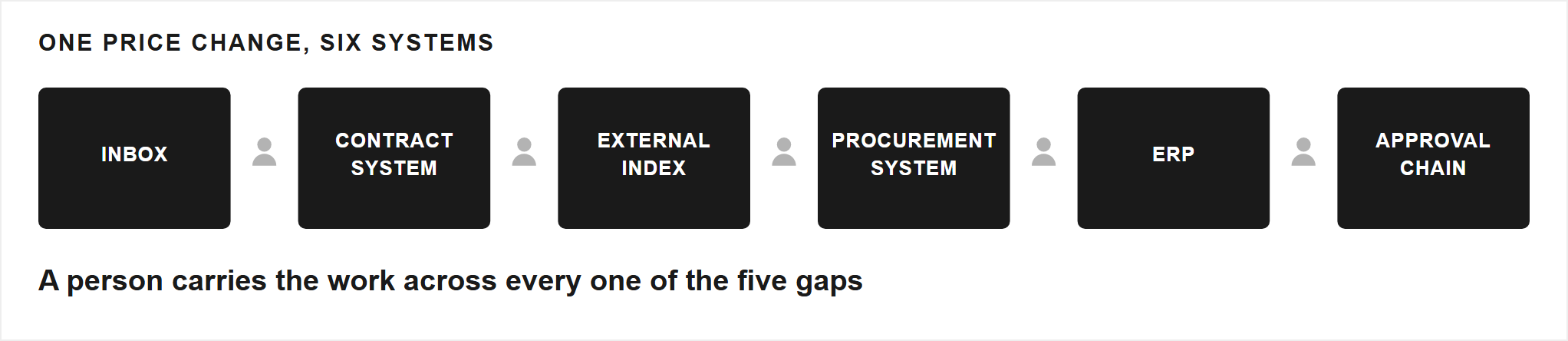
Those nine steps happen in six different places
Look at where that work actually took place.
The email arrived in an inbox
The terms were in the contract system
The index was published on somebody else’s website
The agreed price lives in the procurement system
The order and the invoice sit in the ERP
The approval ran through a chain of people, each of whom had to be asked, reminded and asked again
Nobody designed the work that way. Each of those systems was bought by a different function, on a different cycle and against a different set of requirements. Every one of them is good at what it does. Every one of them was a sensible purchase at the time.
What nobody bought was the thing that carries a case from one system to the next. That job went to a person by default, and it has stayed with a person ever since. It is the subject of the last article in this series.
Six systems, five handovers, one person. Each system was bought by a different function against different requirements, and each one is good inside its own edges. The gaps between them were never anybody’s purchase, so a person stands in each one, five times, for every price change that arrives.
You get the same equation every year
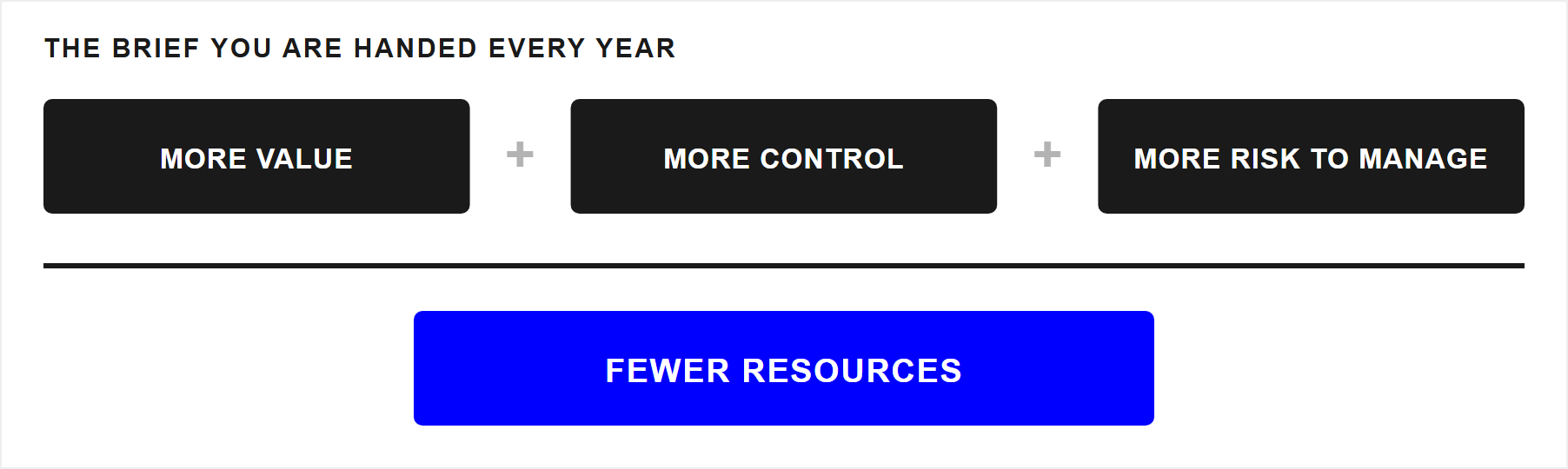
You are asked to deliver more value, hold more control and carry more risk, and to do all of it with fewer resources.
If you have worked in procurement or in finance for longer time, you have been handed some version of that every single year. Save more. Control more. Carry more risk, because there is always more risk. Do it with the same team, or with a smaller one.
The risk part is growing fastest in the work. The list of things you are expected to know about a supplier now runs to ownership, sanctions exposure, financial health, certifications, sub-tier dependencies, sustainability and cyber posture. Every one of those requirements arrived with a good reason attached, but none of them arrived with extra people attached.
The brief, drawn as the equation it is. Three terms on top, all of them growing, over a denominator that keeps shrinking. Eighty-six percent of chief procurement officers meet the savings target on the top line. What this series is about is everything the equation leaves no time for.
Here is the part that makes it interesting.
You are meeting the target. Deloitte’s 2025 survey of more than 250 chief procurement officers across 40 countries found that 86% of them met their cost savings targets.
So this is not a story about a function that fails at what it measures. You hit the number you negotiated. You can evidence it. The awkward question is a different one: what happened to everything you never got to?
The constraint is human attention
Your software is fine.
Your process design is fine and your team is good. I have spent a long time inside these functions, and the people in them are rarely the problem.
There is a finite amount of expert attention in your function every week. It is the scarcest resource you have and the most expensive one you buy. The work in front of you asks for more of it than exists.
That is the constraint. Budget, headcount and tooling all sit downstream of it.
Once you name it, a number of things stop being mysterious. Why savings you genuinely negotiated leak away quietly over the following two years. Why the supplier you screened at onboarding is still on the approved list three years later, under different ownership. Why a contract renewed on terms nobody had re-read.
None of that is negligence. It is arithmetic. Every one of those tasks was somebody’s job, and that somebody had a finite week.
You prioritise, you sample, you react
So what does a function do when the work exceeds the attention available to do it?
It does the only rational thing. It prioritises, samples, and reacts.
It puts expert attention on the biggest contracts and the loudest problems. It checks part of the population and assumes the rest behaves the same way. And it waits for something to surface before it goes looking.
Every one of those is a good decision. I would make the same three. Given fixed attention and unbounded work, that is what a competent leader does, and anyone who tells you otherwise has not run a category.
You can watch it happen in the way an approved supplier list ages. Everyone on that list was checked properly on the day they were added, by someone doing a careful job. That check was a photograph of a single afternoon. Since then:
Ownership has changed
Certificates have lapsed
A parent company has been bought by somebody you would not have approved
Nobody decided to stop looking. There was never a week when re-checking a supplier who had caused no trouble was the best use of the time.
But look at what each one costs.
Prioritising means most of your spend receives no expert attention at all. It is not that it was reviewed and cleared. Nobody looked.
Sampling means you judge the health of a whole population from a fraction of it, then report that judgement as though you had checked everything.
Reacting means you find the problem after it has happened, and after it has cost you something.
This is your operating model. It is a good design for the shortage it was built around.
Count the two piles and price the bigger one
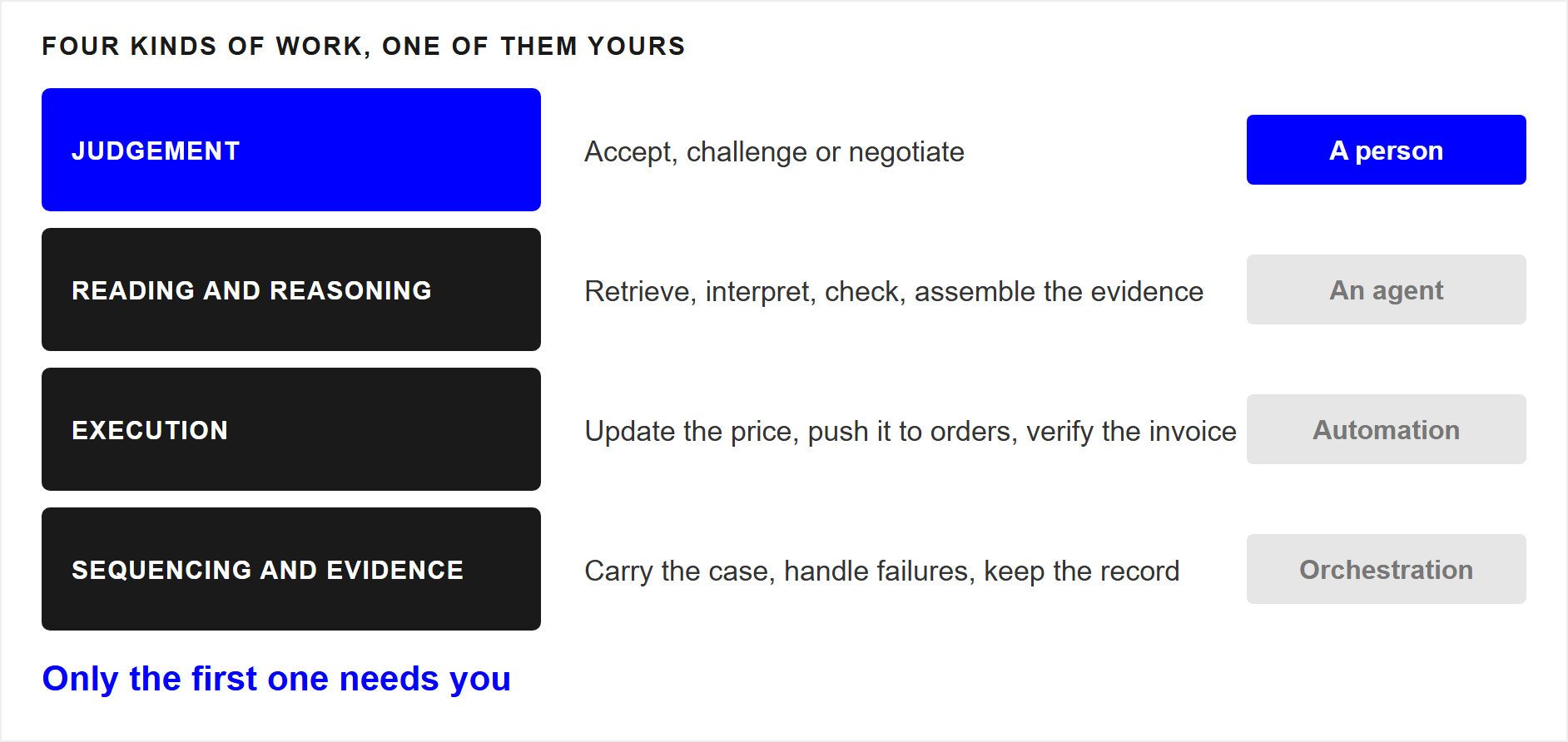
Go back to those nine steps and sort them into two piles. Eight of them are retrieval and checking: finding, reading, calculating, transferring, remembering and monitoring. One of them is a decision, which is whether you accept this increase, challenge it or negotiate.
Eight steps of retrieval, one step of judgement. The list above runs in order, which is how the work feels when you are doing it. Sorted into piles it stops being a sequence and becomes a ratio. The eight are drawn the same size because none is harder than another, and none of them is why you recruited the person doing them.
That single question needs judgement, commercial instinct and a relationship with the supplier. It is the part your people are good at and never have enough time for.
You can run this on one process this week. It takes an afternoon and needs no budget. Pick something ordinary, such as a price increase, a supplier onboarding or a contract renewal. Choose one that happens often and that nobody in the room considers difficult.
Then three moves.
Count the retrieval steps. Count every action that involves finding, reading, checking, calculating, transferring or chasing. Be honest about the ones that happen in somebody’s head or in a spreadsheet nobody owns.
Count the steps that need judgement. These are the moments where a person weighs something and decides. In most processes there are far fewer of them than people expect. Naming them out loud is uncomfortable.
Price the first pile. Loaded hourly cost of the people doing it, multiplied by the time it takes, multiplied by how often the process runs in a year.
That last number is what your organisation currently pays for retrieval on one process. It is usually the first time anybody has seen it as a single figure, and usually larger than the room expects.
Two things tend to happen when a team does this properly.
The retrieval pile is longer than anyone guessed. The steps that live in somebody’s head never appear on a process map, so nobody counts them.
The judgement pile contains steps that need no judgement. What they need is a rule an experienced person has applied for years without ever writing it down.
Then ask the only question that really matters about the list. Which of those steps genuinely required a person?
Only one kind of work needs you
When a team answers that question honestly, the list stops being a sequence and starts being four different kinds of work. They are not interchangeable, and each of them has a different answer.
Judgement. Accept, challenge or negotiate. This needs commercial instinct and a relationship with the supplier. It belongs to a person who is accountable for the category. It should stay exactly where it is.
Reading and reasoning. Retrieving the contract, interpreting an indexation clause a lawyer wrote four years ago, checking the published index and assembling the evidence behind a recommendation. This used to require a person for one reason only, which is that reading was human work. AI agents now do this part reliably enough to run it on every case instead of a sample.
Execution in your systems of record. Updating the agreed price, pushing it into future orders, checking that the invoices follow it. This is integration and automation, and most large organisations already own most of the pieces.
Sequencing and evidence. Something has to carry a case across those six systems, decide what happens when a step fails, route the exception to the right person, and keep a durable record of who decided what and on what basis. This is orchestration. Almost nobody owns it.
Only the first row needs a person. The other three were human work because reading, executing and sequencing had nowhere else to live. Judgement is different in kind. It needs commercial instinct and a relationship with the supplier, so it should stay exactly where it sits today.
That last one is where the interesting failure lives. The email arrived at the front of your business, inside a supplier relationship that a named person owns. The consequence landed at the back, as a purchase order, an invoice and a payment in your finance systems. Those nine steps crossed the line between your front office and your back office four times. Each time, a person picked something up and carried it.
Most large organisations have automated pieces on both sides of that line. Very few own the crossing itself, which is where the time goes and where the errors surface.
None of this comes for free. Agents that read contracts have to be governed. They have to be monitored, corrected when they drift, tested against the decisions your best people actually make, and answerable when somebody asks why a recommendation came out the way it did. Capacity you cannot govern is not capacity. It is exposure, and you already have enough of that.
That is the work my colleagues and I do at Digital Workforce. People, AI agents and automation running as one governed flow across the systems a business already owns, from the front office through to the back. We operate it, so somebody is accountable on the day it drifts.
Where does your team spend its attention this week?
Next Monday, that supplier email arrives again. Someone will handle it well. It will take most of a morning.
The pressure your function is under has not changed much in forty years. What has changed, quite recently, is what it costs to pay attention to something, and that is what the rest of this series is about.
The next piece asks an uncomfortable question. Procurement has bought wave after wave of technology since the 1980s, and every one of those waves was worth buying. I would buy all of them again. So why is that same equation still sitting on your desk?
Before then, here is one question to take back to your team. Of all the expert attention your function will spend this week, how much of it will land on an actual decision?
If you want to take it further
On 30 September I am joining Brian Halpin of SS&C Blue Prism for a session on this, starting from a supplier price increase.
If you have run the count on one of your own processes, bring it. The discussion is usually more useful than the slides.
Deloitte’s 2025 Global Chief Procurement Officer Survey establishes that 86% of CPOs met their cost savings targets. The survey covers more than 250 CPOs across 40 countries, and the figure is self-reported. deloitte.com
The 4.8% price increase, the nine steps and the six systems are an illustrative example drawn from a common procurement scenario. They are not a customer figure and not a benchmark.
About the author
Stefan Meller is Principal Account Executive for Enterprise and Public at Digital Workforce.
The latest workforce census from The Royal College of Radiologists, recently featured by Digital Health, highlights an encouraging trend: AI adoption in radiology continues to increase as NHS organisations seek new ways to improve productivity and manage growing demand.
It’s a positive sign that healthcare is embracing AI. But as we read the findings, one thought kept coming back to us.
One of the most interesting themes emerging from the RCR findings is the opportunity to support the operational processes that underpin patient care. Every referral, appointment and clinical handover forms part of a wider care pathway, where hundreds of individual activities work together to move patients through the healthcare system. Improving these workflows not only helps ensure patients receive the right care at the right time but also releases valuable clinical capacity for the work that matters most.
As the Royal College of Radiologists points out, administrative and operational workflows remain an area where AI has significant untapped potential.
We believe this is where some of healthcare’s greatest productivity gains still lie.
Every improvement in a care pathway has the potential to make a difference. When AI, intelligent automation and workflow orchestration are applied to the operational processes that support patient care, NHS organisations can reduce repetitive administrative work, improve consistency and give clinicians more time to focus on patients.
Turning opportunity into practice
The good news is that this isn’t simply a future ambition. It’s already happening.
One example is the Radiology Referrals Vetting AI Agent developed by SS&C Blue Prism and deployed at Sandwell & West Birmingham NHS Trust. The solution demonstrates how AI can support imaging referral vetting while keeping clinicians firmly in control.
Rather than replacing clinical judgement, the AI agent works alongside existing radiology teams. It reviews incoming referrals, checks clinical information against local policies and guidelines, identifies duplicate requests and prepares structured recommendations for clinician review. Straightforward referrals are progressed in seconds, while more complex cases are escalated with the relevant clinical context attached, ensuring governance and human oversight remain at the centre of every decision.
The results demonstrate what’s possible when AI is integrated into a connected clinical workflow rather than a standalone tool.
At Sandwell and West Birmingham NHS Trust, the solution is expected to return approximately 3,000 clinical hours every year, reduce referral processing time by 75%, autonomously resolve 80–90% of imaging referrals, and reduce GP feedback times to under one hour. Most importantly, those hours are being returned to radiologists so they can spend more time on complex reporting, urgent cases and patient care.
If you’d like to see how the solution works in practice, you can watch the Imaging Vetting AI Agent demonstration and explore the Sandwell and West Birmingham NHS Trust case study.
As AI adoption continues to accelerate across the NHS, the conversation is naturally evolving.
Rather than asking “Where can we use AI?”, healthcare organisations are increasingly asking “Where can AI, automation and intelligent workflows help us deliver better care?”
For us, that’s where the greatest opportunity lies.
Perhaps the most interesting question is no longer how many AI solutions an organisation has adopted, but how those technologies are supporting everyday clinical practice. When operational processes become more connected and efficient, clinicians gain more time to focus on patients and organisations are better placed to meet growing demand.
Whether it’s imaging referrals, outpatient pathways, waiting list management or clinical administration, the most impactful innovations are those that connect seamlessly into existing care pathways and help healthcare professionals spend less time on repetitive tasks and more time caring for patients.
Continue the conversation
If you’re exploring how AI, intelligent automation and workflow orchestration could support your radiology or diagnostic services, we’d love to continue the conversation.
Visit our NHS Healthcare page to discover how Digital Workforce is supporting NHS organisations in delivering more efficient, connected care through intelligent automation, AI and agentic AI. You can also join our NHS Community, where healthcare leaders exchange real-world case studies, practical insights and experiences from across the NHS.
If you’re looking to deepen your understanding of AI and healthcare automation, explore agentacademy.ai for on-demand learning, webinars and practical resources.
Later in autumn, we’ll host a dedicated webinar exploring how AI agents and intelligent automation can support imaging referral vetting and broader diagnostic pathways. We’ll share practical NHS experiences, lessons learned and discuss how organisations can identify where these technologies could deliver the greatest impact.
We also offer NHS organisations a complimentary imaging referral workshop and opportunity assessment.
Together, we’ll explore your current referral workflow, identify opportunities to reduce administrative burden and estimate how much clinical time could be released through AI-supported imaging referral vetting. Whether you’re just starting to explore AI or already have initiatives underway, the workshop provides a practical way to understand where the greatest opportunities may exist within your organisation.
If this topic resonates with you, we’d love to continue the conversation. Drop us an email
Digital Workforce has acquired the Agentic AI for customer service business of Front AI Oy, a Nordic leader in customer service automation. The transaction is a business purchase, and the business transfers to Digital Workforce on July 1, 2026. Front AI continues as an independent company.
With the purchase, Digital Workforce expands agentic AI and virtual customer service agents to its process automation and orchestration. Digital Workforce can now transform and orchestrate customer service processes more extensively.
Built for regulated industries. Banking, insurance, and the public sector require control, compliance, and data governance that are core to Digital Workforce’s business.
One managed service. Customer service processes are offered service as software. Customers have one contract, with a single point of accountability across the services and technologies.
Scales with demand. Customer service keeps pace while staying personal. Customers get faster service, and organizations can provide premium service without growing the team.
Voice is ready also for the Nordics. Automation meets people in natural spoken conversation, also in Nordic languages.
Around 30 customer contracts and the team of 8 people transfer to Digital Workforce with the business.
Jussi Vasama, CEO of Digital Workforce, comments:
“I am excited for this major accomplishment and the potential it opens for our customers. Digital Workforce is built on two things: productized services and deep industry understanding. We use both to orchestrate complex business processes for large enterprises, the public sector, and regulated industries. These organisations now want to transform their operations and disrupt the way they collaborate with their customers. Agentic AI and voice are key technologies in delivering premium interactions.”
Jari Annala, Founder and CEO, Front AI, comments:
“We built a strong agentic AI business, with our customers at the heart of it. Digital Workforce is the right new home for it. Our customers keep the same team and the same service, now with deep automation and process orchestration expertise behind them. Our people gain a stronger platform to apply their expertise. We are proud of what this team achieved, and confident that agentic AI will go far as part of Digital Workforce.”
Media enquiries
Digital Workforce Services Plc
Jussi Vasama, CEO
Tel. +358 50 380 9893