For many organizations, the first wave of AI delivered what amounted to speed upgrades: faster content, faster insights, faster answers. These early wins have been real, but they haven’t fundamentally changed the way work moves across the enterprise.
As soon as teams began trying to extend AI beyond isolated tasks — past the browser tab, outside the development environment or into workflows that cross departments — progress stalled. The models were perfectly capable, but in most cases, the enterprise wasn’t ready to support them.
AI today largely operates in silos:
Summarizing a document in one tool
Generating a draft in another
Answering a question inside a chat window
Those applications are useful, yes. But transformational? No. And certainly not autonomous.
The next phase of AI will operate very differently. Agentic AI promises to reason, plan and participate in the work, not just advise on it. For any AI system to influence real business processes, the organization must first create the environment to support it.
It’s critical to build a foundation for the next decade of AI to operate with clarity, coordination and control.
Why leaders often think they’re ready
When AI experiments stall, the reflex is to look at the model.
Should the prompt be rewritten?
Should the model be retrained?
Should the team switch providers?
In fact, most AI slowdowns have nothing to do with model quality. They’re caused by the operational surface the model enters. Across enterprises, the same foundational gaps appear again and again, regardless of industry or scale.
Work happens in silos. AI has no shared control layer. Automations, scripts, SaaS workflows and departmental tools all run independently. This fragmentation increases the likelihood of “shadow AI” — and the blind spots in security and cost that come with it.
Every department uses different guardrails. Access, approvals and policies vary wildly across teams. AI simply can’t follow rules that don’t exist consistently.
Workflows assume predictability, but reality doesn’t. Static, rule-based logic breaks the moment conditions change. AI becomes another exception handler instead of a force multiplier.
Leaders lack cross-system visibility. Throughput, failures, bottlenecks and downstream impacts are scattered across tools. You can’t operationalize intelligence you can’t see.
These gaps don’t make agentic AI unrealistic, but they reveal what’s missing. To safely give AI the ability to plan and act, enterprises need coordination, governance, adaptability and visibility working together under a unified orchestration approach.
Before autonomy: The architectural fundamentals
Across enterprises making real progress toward AI readiness, one theme is clear: they’ve perfected the architecture underneath the model. These organizations are doing more than just experimenting with clever tools. They’re building the conditions for intelligent systems to operate safely and consistently.
Unification: One orchestration layer to coordinate the work
Imagine an AI system evaluating a delivery delay. It checks order data in one application, inventory in another, customer records in a third and workflow timing in a fourth. Without orchestration, those steps become disconnected guesses. With it, they become a single, synchronized, visible and aligned action path governed by business rules.
A unified layer provides the control plane that keeps all forms of work — human, automated or AI-assisted — moving in the same direction.
Boundaries: Guardrails for scaling intelligence — not risk
Guardrails vary in format, but they all answer the same question: What is safe for this system to do? Instead of a long list, the most effective enterprises keep it simple with:
Actions that are always permitted
Actions that require verification or approval
Actions that are never allowed
When these rules are applied consistently across departments, intelligent behavior becomes predictable. AI stops guessing how decisions should work and starts following the same standards everyone else does.
Transparency: Governance that keeps humans in control
As soon as automation can influence workflows, visibility becomes non-negotiable. Leaders need to see how a decision unfolded, what it touched and why it behaved the way it did. That requires:
Observability into processes
Clear documentation of decision paths
Audit trails that withstand scrutiny
The ability to unwind or adjust actions when needed
Governance turns autonomy into something accountable, rather than opaque.
Coexistence: A blended environment of deterministic and dynamic automation
Enterprise leaders sometimes assume they must choose between traditional automation and AI-driven adaptability, but the highest performers do the opposite. They preserve their deterministic backbone: the scheduled workflows, validations and rule-based logic that keep operations steady. Then, they layer adaptability where variability actually occurs.
In other words, it’s reinforcement, not replacement. Rule-based processes handle what is predictable, adaptive decision loops handle what isn’t and orchestration brings the two together.
How experimentation becomes an operating model
AI experimentation is happening everywhere at once. Marketing might test a summarization tool, Finance could be exploring anomaly detection and Operations may pilot an automation assistant. The activity is high, but the impact is uneven. Some pilots work, others stall and many echo work already happening elsewhere in the organization.
What’s missing is structure. Modern AI only becomes meaningful when it’s connected, governed and repeatable. That requires shifting from scattered experimentation to an operating model that gives every team the same foundation to build upon.
The transformation underway resembles the moment when analytics matured from isolated dashboards into full data platforms. AI is undergoing a similar transition. What begins as a collection of tools eventually becomes an operational discipline shaped by shared infrastructure, shared controls and shared context.
In practice, this means we have to start thinking differently about how AI gets introduced and supported. Investment decisions move away from individual tools and toward foundational capabilities that every team can rely on, like interoperability and visibility. Talent evolves as well, with roles focused on designing supervised automation, not just building models in isolation.
Metrics also expand. Instead of measuring AI success through cost savings alone, executives are beginning to track the health of end-to-end processes: throughput, order delivery rate, consistency, service quality and customer satisfaction, for example. These are the signals that show whether the enterprise is truly becoming more adaptive.
Risk posture changes, too. Rather than waiting for AI to cause a problem, leaders establish guardrails and safety patterns before AI touches a core workflow. True autonomy starts with boundaries.
This evolution marks a larger shift: the move from experimenting with AI to preparing the enterprise for it. When you treat orchestration and governance as shared capabilities instead of departmental add-ons, innovation becomes faster, safer and easier to scale. AI moves from being something scattered teams try out to something the entire organization can trust.
What agentic orchestration will unlock (when the foundation is ready)
Agentic AI at scale remains a future capability, but the directional value is already clear. Once you have orchestration, governance and interoperability in place, you can unlock an entirely new class of capabilities:
Systems that adapt faster than conditions can destabilize them
Cross-system decision-making that reflects real business context
Self-service interactions where users request outcomes, not workflows
Operations that continue running even when inputs, timing and exceptions change
Insight that spans applications, dependencies and data in motion
Your teams can gain a level of clarity, context and control that may be elusive today.
The advantage will go to those preparing now
Organizations making progress toward autonomous operations share a common pattern. They’re not racing toward agentic AI, but building the scaffolding that will support it.
That means they’re:
Consolidating automation under a unified orchestration layer
Strengthening governance to define how decisions and actions occur
Insisting on interoperability across systems and tools
Using AI assistance to improve deterministic workflows
Piloting new AI patterns in controlled, low-risk environments
Defining KPIs that reflect throughput, delivery, consistency and service quality
Preparation accelerates innovation, creating an environment where AI can be introduced safely, evaluated clearly and scaled confidently. Enterprises that begin now won’t just be ready for agentic AI. They’ll be structurally positioned to benefit from whatever comes next.
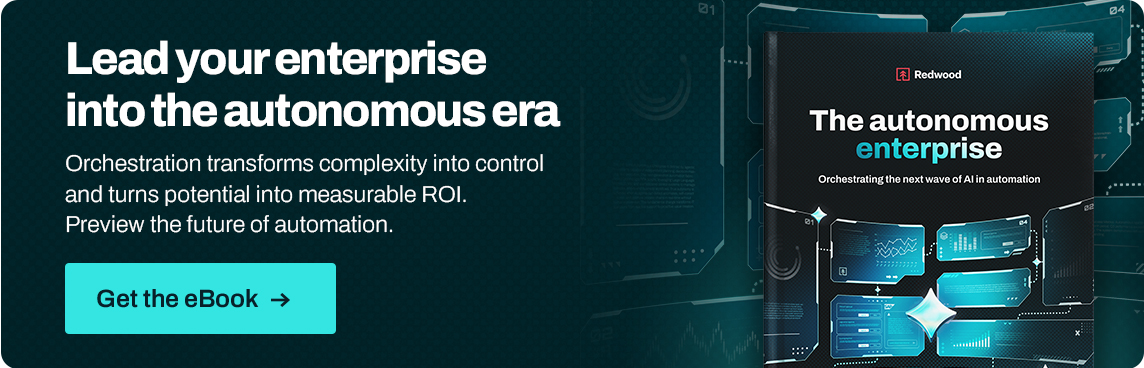
To explore the now, next and beyond of AI, read “The autonomous enterprise” and get a deeper look at how orchestration, governance and preparation shape the path to more intelligent operations.
Press release 11.11.2025: Digital Workforce signs a deal with Södersjukhuset – a leading Swedish hospital
Digital Workforce is pleased to announce the signing of an agreement with Södersjukhuset, one of the largest hospitals in Scandinavia, to support and accelerate its automation program. The agreement builds on an earlier collaboration and will see a team of Swedish consultants from Digital Workforce working alongside Södersjukhuset’s team to identify, develop, and implement automation solutions.
Södersjukhuset Hospital is owned by Stockholm Region, a large public organization that promotes ongoing cooperation between its various departments in the development of automations. The hospital’s collaboration with Digital Workforce aims to further enhance its internal processes and provides a pathway to scale solutions across the wider organization, if needed.
“Digital Workforce is a leading process automation expert in the healthcare sector, with a particularly strong presence in the UK and in our country of origin, Finland. Notably, Nordic social and healthcare organizations have many similarities, enabling proven solutions to be replicated effectively across the region to deliver meaningful results”, explains Sanna Ranta, Account Executive at Digital Workforce.
“It is exciting to extend our collaboration with Södersjukhuset, whose team we have had the pleasure of working with for several years. The new contract provides us with a great opportunity to further strengthen the impact of automation”, says Juha Nieminen, Head of Healthcare at Digital Workforce.
For further information, please contact:
Sanna Ranta, Account Executive – Digital Workforce
sanna.ranta@digitalworkforce.com
About Digital Workforce Services Plc
Digital Workforce Services Plc (Nasdaq First North: DWF) is a leader in business automation and technology solutions. With the Digital Workforce Outsmart platform and services—including Enterprise AI agents—organizations transform knowledge work, reduce costs, accelerate digitization, grow revenue, and improve customer experience. More than 200 large customers use our services to drive the transformation of work through automation and Agentic AI. Digital Workforce has particularly strong experience in healthcare, automating care pathways across clinical and administrative workflows to reduce burden, enhance patient safety, and return time to patient care. Following the acquisition of e18 Innovation, the company has further strengthened its position in the UK healthcare pathway automation. We focus on repeatable, outcome-based use cases, and we operate with high integrity and close customer collaboration. Founded in 2015, Digital Workforce employs more than 200 automation professionals in the US, UK, Ireland, and Northern and Central Europe. Our vision: Transforming Work – Beyond Productivity. https://digitalworkforce.com
Press release 11.11.2025: Digital Workforce signs a deal with Södersjukhuset – a leading Swedish hospital
Digital Workforce Services Plc announces a contract extension and expansion with Portsmouth Hospitals University NHS Trust
Press release 20 November 2025
Our partnership with Portsmouth Hospitals University (PHU) NHS Trust continues to strengthen through a new three-year agreement, under which Digital Workforce Services will continue to deliver and expand intelligent automation services in collaboration with the Trust and our partner PSTG Ltd.
This reflects the strong collaboration and trusted relationship we’ve built together since their automation journey began. We’re pleased to have supported PHU along the way, responding to their evolving automation capability and requirements, and adapting our role to align with the development of their exceptional in-house expertise.
The new agreement includes an extension of services for a further three years, and importantly, the introduction of new BPA (Business Process Automation), Orchestration, and IDP (Intelligent Document Processing) capabilities, along with a new 24/7 Incident Management Service – all designed to strengthen operational resilience and support the Trust’s roadmap toward agentic automation solutions that can act intelligently, adapt dynamically, and further amplify the impact of digital workers across care pathways.
We’re incredibly proud to continue this partnership – one built on collaboration, trust, and shared ambition – as we work together to deliver innovation, transformation, and better outcomes for staff and patients across the NHS.
Chris Price, Healthcare Business Development Director, Digital Workforce Services Plc:
“From day one, this has been a true partnership – sharing knowledge and building sustainable automation capability that delivers lasting value for the NHS.”
Enzo Daniele, Managing Director, PSTG Ltd:
“We’re proud to continue innovating with Portsmouth Hospitals University NHS Trust, ensuring automation delivers measurable benefits for staff and patients.”
For further information, please contact:
Christopher Price, Business Development Director, Healthcare UK & Ireland, Digital Workforce Servics Plc christopher.price@digitalworkforce.com
About Digital Workforce Services Plc
Digital Workforce Services Plc (Nasdaq First North: DWF) is a leader in business automation and technology solutions. With the Digital Workforce Outsmart platform and services—including Enterprise AI agents—organizations transform knowledge work, reduce costs, accelerate digitization, grow revenue, and improve customer experience. More than 200 large customers use our services to drive the transformation of work through automation and Agentic AI. Digital Workforce has particularly strong experience in healthcare, automating care pathways across clinical and administrative workflows to reduce burden, enhance patient safety, and return time to patient care. Following the acquisition of e18 Innovation, the company has further strengthened its position in the UK healthcare pathway automation. We focus on repeatable, outcome-based use cases, and we operate with high integrity and close customer collaboration. Founded in 2015, Digital Workforce employs more than 200 automation professionals in the US, UK, Ireland, and Northern and Central Europe. Our vision: Transforming Work – Beyond Productivity. https://digitalworkforce.com
Helsinki, Finland – Digital Workforce Services Plc continues to drive innovation in insurance claims processing with its Agent Workforce solution, now delivering measurable results for insurers and third-party administrators. Built on top of Microsoft Azure, the solution uses advanced agent capabilities and orchestration technologies from Microsoft Foundry, supported by open-source frameworks.
Since its launch, Agent Workforce has helped insurers reimagine their entire claims journey, from first notification of loss (FNOL) to final settlement, by deploying specialist AI agents for tasks such as data capture, coverage eligibility, fraud detection, adjudication, and settlement. The solution’s modular architecture enables rapid onboarding and integration with existing claims systems, accelerating transformation and improving customer outcomes.
Key Highlights:
• Proven Impact: Early adopters report significant reductions in manual processing time and improved accuracy in claims handling.
• Scalable Architecture: Powered by Azure, Agent Workforce offers enterprise-grade reliability, security, and scalability.
• Advanced Orchestration: Microsoft Foundry coordinates Agent reasoning workflows and orchestration.
• Industry Recognition: The solution is recognised for its ability to generalise across multiple insurance lines and adapt to evolving business needs.
“In traditional insurance operations, achieving more outcomes has always meant hiring more people. With Agent Workforce, powered by Microsoft Foundry and Microsoft Azure, we’re changing that equation. Our AI-native agents allow claims leaders to scale and improve their operations without increasing headcount. This means insurers can process more claims, deliver faster results, and realise unprecedented ROI, all while freeing skilled professionals to focus on the most complex and empathic work. Thanks to the flexibility and reliability of Microsoft technology, the Agent Workforce solution truly decouples human labour from outcomes, unlocking new levels of efficiency and growth,” said Karli Kalpala, Head of Strategy at Digital Workforce.
“Microsoft Foundry helps Agent Workforce deliver solutions that enable customers to focus on innovation and efficiency, while benefiting from the flexibility and enterprise-grade reliability that Microsoft Azure provides,” said Tarja Jernström, Commercial Partner Lead at Microsoft Finland. “The Agent Workforce solution addresses a variety of automation challenges and allows customers to take advantage of Azure’s advanced and future proof AI capabilities.”
For more information
Karli Kalpala, Head of Strategy and AI Agent Business, Digital Workforce Services Plc, karli.kalpala@digitalworkforce.com
About Digital Workforce Services Plc
Digital Workforce Services Plc (Nasdaq First North: DWF) is a leader in business automation and technology solutions. With the Digital Workforce Outsmart platform and services—including Enterprise AI agents—organizations transform knowledge work, reduce costs, accelerate digitization, grow revenue, and improve customer experience. More than 200 large customers use our services to drive the transformation of work through automation and Agentic AI. Digital Workforce has particularly strong experience in healthcare, automating care pathways across clinical and administrative workflows to reduce burden, enhance patient safety, and return time to patient care. Following the acquisition of e18 Innovation, the company has further strengthened its position in the UK healthcare pathway automation. We focus on repeatable, outcome-based use cases, and we operate with high integrity and close customer collaboration. Founded in 2015, Digital Workforce employs more than 200 automation professionals in the US, UK, Ireland, and Northern and Central Europe. Our vision: Transforming Work – Beyond Productivity.
https://digitalworkforce.com | https://agent-workforce.com