Enterprises are sprinting toward AI-powered futures, yet many are dragging decades-old technology behind them. They’re adopting cloud ERP, implementing new data platforms and dreaming of AI-driven insights. But, ironically, they’re still running critical backend processes on legacy job schedulers that were never designed for today’s data volume, velocity or complexity.
It’s a disconnect that’s quickly becoming unsustainable. While the pace of AI adoption is moving faster than other disruptive innovations, it simply won’t work if the rest of IT doesn’t catch up. And as SAP made clear at SAP Sapphire 2025, there’s no value in building AI on a shaky foundation.
The new mandate: Modernization beyond ERP
SAP’s strategy has evolved beyond ERP. SAP CEO Christian Klein says true transformation is now about incorporating the “flywheel” of applications, data and intelligence. The implication is that SAP Business Technology Platform (BTP), embedded AI and unified data models aren’t peripheral to the core — they are the core.
The explosion of SaaS tools hasn’t produced better outcomes. In his SAP Sapphire Orlando 2025 keynote, Klein noted that global productivity growth has slowed rather than accelerated because too many businesses are duct-taping together apps and automations without the foundation to make them work together.
The implication is clear: You can’t just modernize your ERP and call it a day. Supporting systems, especially those running behind the scenes, such as workload automation (WLA), must evolve in lockstep. Otherwise, you’re introducing friction into every cross-system process (and therefore, AI model) you run.
Old schedulers, new risks
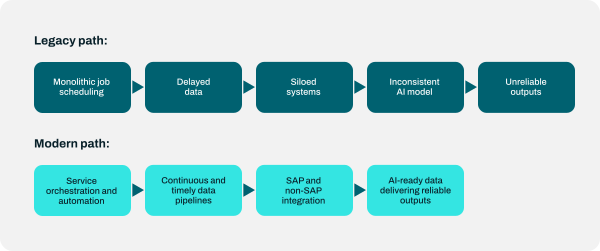
Traditional job scheduling tools were built for a different era. They rely on locally installed software, custom scripts and fragile connections to coordinate batch jobs in static environments. They were never designed for real-time, intelligent processes across cloud-native applications and rapidly evolving AI models.
Sticking with these tools introduces unacceptable risks:
Operational complexity from maintaining brittle, outdated architecture
Technical debt from endless scripting and patchwork connectors
Challenges with maintaining clean core principles
Fragmented automation across SAP and non-SAP systems
Inability to leverage SAP’s AI roadmap due to data silos and latency
Delayed time-to-value from SAP innovations
You can’t derive reliability and maximum value from AI if your job scheduler is stuck in the past.
Hidden costs of sticking with what worked in the past
Lost agility: You can’t adapt job logic or build new automations fast enough to keep up with changing business needs.
High support burden: Teams waste time firefighting job failures, maintaining scripts and investigating manual handoffs.
Transformation delays: Legacy schedulers slow down cloud migrations and SAP modernization projects.
Compliance risk: Unsupported scripts, lack of auditability and limited visibility introduce risks and compromise clean core.
Missed AI value: Data pipelines are fragmented or delayed, preventing timely, reliable input into analytics and AI tools.
Why AI fails without clean, timely data
It’s easy to think AI fails because the models are wrong. But in enterprise environments, the more common culprit is something far less glamorous: bad data. When job scheduling is not modernized, it can quickly become unreliable or disconnected and fail to feed AI systems with what they need to produce in-depth, accurate insights. When they deliver irrelevant or dated insights or hallucinations, it undermines trust in the intelligence you’re trying to deploy.
AI can’t magic its way past old and brittle plumbing that was already on the brink of needing replacement. Trying to update your kitchen or bathroom with fancy new showerheads and faucets with all kinds of bells and whistles may make it look nice, but the water that’s critical to its functioning may struggle to get there at the right time and temperature. A remodel will always require a certified inspection of the pipes and supporting foundation to ensure they work safely and reliably with the upgraded fixtures.
No workaround necessary: The modern approach to WLA
SAP has been loud and clear about the clean core mandate. What was once a push to keep ERP extensibility under control is now a requirement for AI readiness. SAP’s vision of a “fit-to-suite” architecture, where apps, data and automation are in harmony, can’t happen if your WLA layer brings discord into the mix.
Trying to keep your legacy scheduler working is like bringing a VHS tape to a Netflix pitch meeting. Sure, you might find a dusty adapter somewhere in the back closet, but you’ll be miles behind before you even press play. No amount of workarounds will make outdated technology compatible with a world that’s already streaming ahead.
Modernizing WLA for SAP and non-SAP processes means orchestrating every part of your business to be faster and more intelligent. It means having:
Cloud-native SaaS that orchestrates processes across hybrid environments without additional infrastructure
Frictionless architecture that provides a singular secure gateway to connect with every SAP and non-SAP application, reduces maintenance and eliminates failure points
Deep SAP integration that aligns with SAP product roadmaps and innovation strategies
Pre-built templates and connectors to accelerate time-to-value without violating clean core
Centralized orchestration for SAP and non-SAP processes from a single interface
Automation purpose-built for an SAP cloud and AI future
Redwood Software and SAP share a trusted partnership built on over 20 years of co-development, innovation and roadmap alignment, making RunMyJobs by Redwood a strategic extension that maximizes the ROI of your SAP investments.
What sets it apart?
SAP Endorsed App, Premium certified: RunMyJobs reduces risk, accelerates time-to-value and offers long-term reliability to SAP customers. It’s certified across a broad range of SAP technologies, meeting SAP’s highest standards for performance, security and integration. It delivers native functionality and deep integration across complex hybrid and cloud deployments, with built-in, SAP-specific templates and connectors that eliminate custom code and scripting. This supports clean core strategies and helps customers solve critical business challenges more efficiently.
The only WLA solution included in the RISE with SAP reference architecture: RunMyJobs is included in the RISE reference architecture through managed services offered and delivered by SAP Enterprise Cloud Services (ECS). ECS handles the direct installation and maintenance of the RunMyJobs’ secure gateway connection within your RISE landscape, eliminating the need for extra infrastructure, custom workarounds and friction in the RISE journey. You can also opt into additional ECS-managed services for enhanced monitoring of SAP processes automated with RunMyJobs, improving visibility and enabling proactive issue resolution.
What defines AI-ready in the context of WLA? It’s more than speed and scale.
Your processes are orchestrated, not just scheduled. You’re connecting tasks and dependencies across SAP and non-SAP environments using event-driven automation.
Governance is built in. You have visibility and control over every job and data flow, from development to execution to exception handling.
Business value is clear. Automation is no longer a backend utility but a strategic driver of innovation, efficiency and competitive advantage.
These elements have already been realized by companies that have modernized with RunMyJobs.
RS Group, a global industrial distributor, modernized its legacy job scheduler as part of its digital transformation and supply chain operations improvement programs. The company now runs business operations across 26 global markets daily, maintaining job reliability above 99%, and have eliminated Priority 1 and Priority 2 incidents in critical operations for over a year.
UBS, one of the world’s largest financial institutions, relied on RunMyJobs to replace a legacy scheduling solution that couldn’t scale with the complexity of its SAP environment. UBS transitioned to RunMyJobs for its cloud-native architecture and reliability. The company built a cleaner automation landscape, achieving faster recovery from exceptions and future-proofing its foundation to support advanced analytics and AI-powered compliance.
Centric Brands, a leading lifestyle brand collective with a complex ecosystem of SAP and non-SAP systems, used RunMyJobs to consolidate multiple legacy scheduling tools and modernize its WLA. By eliminating manual job chains and replacing legacy scripts with standardized, centralized automation, Centric increased visibility across end-to-end processes and significantly reduced errors. Unifying orchestration improved operational efficiency and positioned Centric to adopt AI-driven forecasting and planning tools without needing to overhaul its backend infrastructure.
Rather than being a bolt-on scheduler, RunMyJobs builds automation fabrics that prepare your SAP environment for embedded AI and intelligent processes.
AI-ready businesses don’t wait
SAP’s future is already unfolding, and AI is at the center. But its effectiveness depends on the quality and timing of your automation. If your job scheduling can’t keep up, neither will your strategy. The decisions you make now will determine whether your organization will be ready to act on AI opportunities or stay stuck reacting due to technical limitations.
Modernizing your ERP isn’t enough. You need an orchestration layer that aligns with SAP’s direction, accelerates transformation and eliminates risk. RunMyJobs gives you that edge.
In any complex IT environment, things go wrong. A critical process fails, services are interrupted and the pressure is on. This is the world of incident management: the crucial, immediate “firefight” to restore service as quickly as possible. Tools like the RunMyJobs by Redwood Monitor are essential for this, providing the real-time alerts and control you need to manage the moment.
But what happens after the fire is out? This is where you make real, lasting improvements. This is the world of problem management: the forensic investigation into the root cause of an incident to ensure it never happens again.
Redwood Insights is the essential tool for this investigation in RunMyJobs, enabling you to identify trends that are critical for long-term problem resolution. With persona-based dashboards that visualize near-time historical execution data, Redwood Insights allows you to move beyond guesswork and find the root cause of your most complex operational problems.
This post explores how you can use Redwood Insights to transition from a reactive operational posture to a proactive one, using data to solve complex issues and optimize your automation landscape.
Core challenges of effective problem management
Without the right analytical tools, it’s difficult for you to move from a “hunch” to a data-driven conclusion about the root cause of an issue. Teams often lack the aggregated historical data needed for a proper investigation. This leads to two common, frustrating scenarios:
The major incident post-mortem: A critical production process failed last night, causing significant disruption. The incident team resolved it, but the question remains: Was it a one-time anomaly, or is it a symptom of a deeper flaw that will cause another major outage soon?
The “death by a thousand cuts:” A seemingly minor job fails intermittently, causing small disruptions. You log it as a low-priority incident every time and manually fix it. No single incident is big enough to warrant a major investigation, but the cumulative impact on team resources and user confidence is significant.
Real-world problem management scenarios with Redwood Insights
Let’s look at how Redwood Insights helps teams move from putting out fires to preventing them through data-driven investigations into both major incidents and recurring annoyances.
1. The major incident post-mortem – anomaly or systemic flaw?
The process: Following a major outage of a critical data warehousing job that was resolved by the on-call team, you’re tasked with conducting a root-cause analysis to prevent recurrence.
The investigation with Redwood Insights:
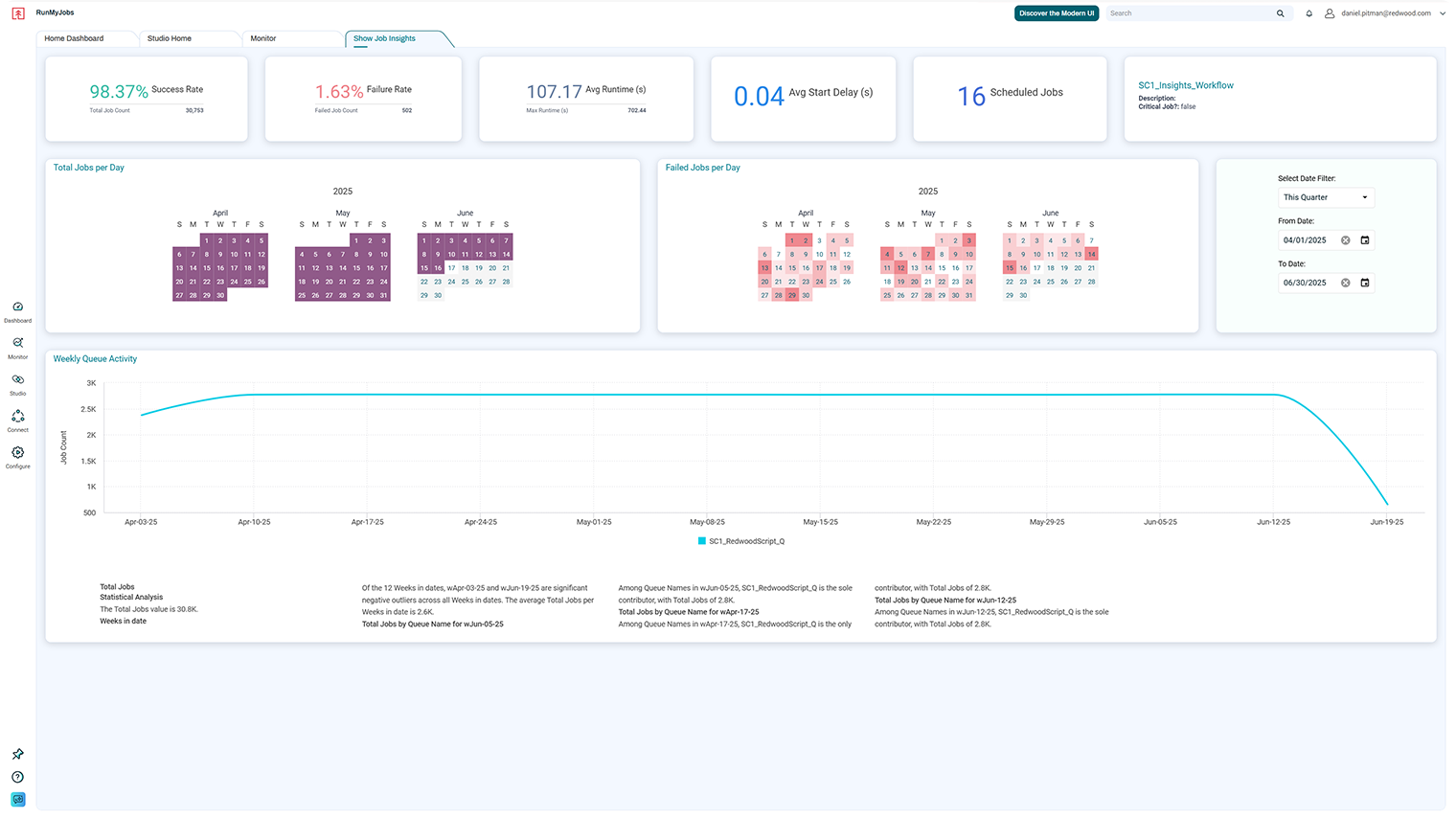
The Job Insights dashboards can be accessed when viewing jobs in the user interface for easy contextual analysis.
You open the Job Insights report for the failed job to get a complete historical view.
You use heat maps to see if failures have ever correlated with this specific date or time of month before, trying to identify patterns.
To determine if this was an infrastructure issue, you switch to the Job Server Analysis dashboard. This allows you to quickly rule out a systemic problem by comparing performance across your environment.
Confident that the infrastructure is sound, you return to the job’s execution data. As you analyze the widgets, you clarify the situation using a smart narrative, powered by AI: a simple, natural-language summary of the data.
The business outcome and ROI:
Action taken: Based on this clear, data-driven context, you can confidently classify the issue. You document the anomaly and close the problem record, avoiding an unnecessary and costly investigation into a one-off event.
Business outcome: This data-driven approach avoids wasting resources chasing ghost issues while ensuring that genuine systemic risks get the attention they deserve.
ROI: This leads to improved long-term service stability, more efficient use of skilled engineering resources (who now solve real problems) and increased business confidence in the automation platform.
2. Solving the recurring problem with data
The process: An end-of-day reporting workflow has been failing intermittently for weeks, creating a backlog of low-priority incidents.
The investigation with Redwood Insights:
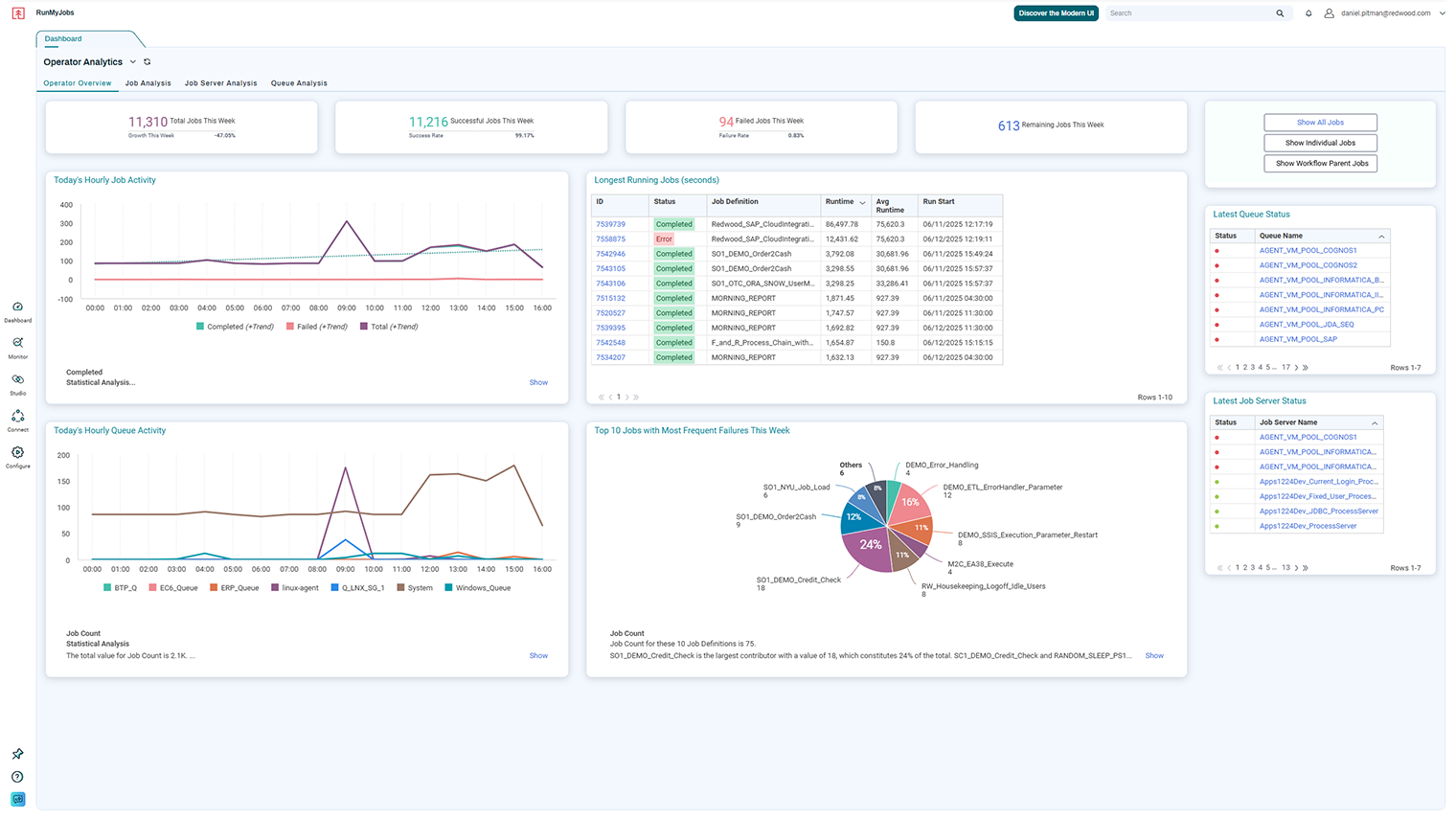
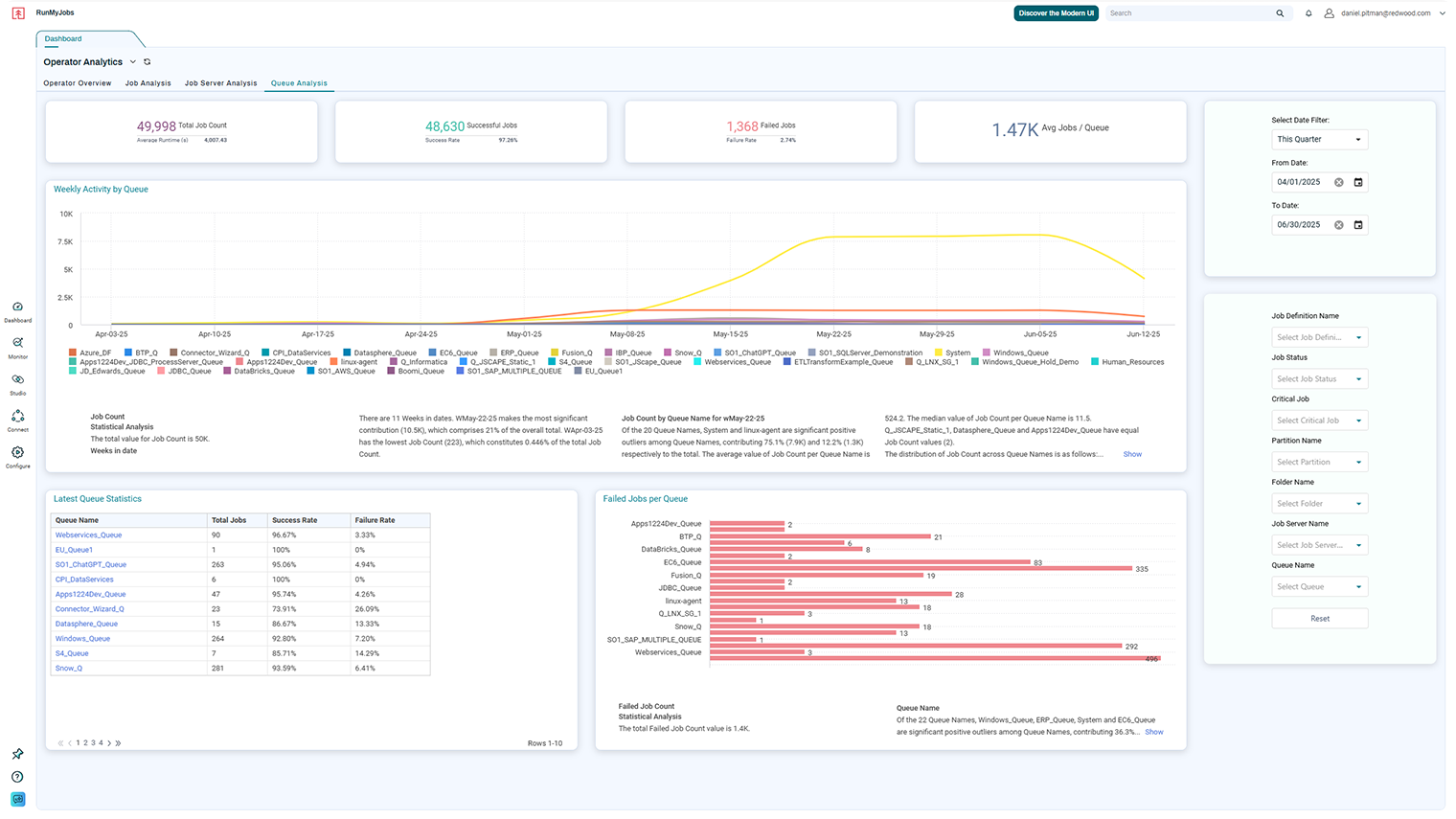
The Operator Overview is your starting point for problem investigations and analysis.
You begin your investigation on the Operator Overview dashboard. Your eyes are immediately drawn to a widget highlighting the “top ten jobs with most frequent failures,” which confirms this reporting job is a chronic offender that needs attention.
You analyze the job’s history and use heat maps to discover a clear pattern: The failures almost always occur on weekday afternoons.
To understand why, you pivot to the Queue Analysis dashboard to drill down into the systems involved. Here, the data clearly shows that when the reporting job fails, queue wait times are consistently high, indicating resource contention is the likely culprit.
The business outcome and ROI:
Action taken: With definitive proof of the root cause, you submit a change request to create a dedicated queue for the reporting workflow, a targeted improvement based on historical data.
Business outcome: The recurring incidents stop completely. The business service becomes reliable, and the stream of low-priority tickets ceases.
ROI: This eliminates the hidden operational cost of repeatedly fixing the same small issue, frees up your Operations team from repetitive tasks and improves the reliability and timeliness of service delivery.
Your toolkit for proactive problem management
The Queue Analysis dashboards provide a system view that enables users to visualize the relationship between performance and platform configurations.
These tools give you the operational visibility and historical context to take IT operations from reactive troubleshooting to a data-driven, intelligent function.
Identify recurring issues: Use the Operator dashboards to prioritize the most impactful, systemic problems by highlighting key metrics, such as the top ten failing jobs.
Correlate failures to find patterns: Use interactive widgets like heat maps to uncover underlying triggers for recurring problems by correlating failures to specific dates or other factors.
Isolate system-specific problems: Use the Job Server Analysis and Queue Analysis dashboards to understand if failures are application-specific or tied to a particular component, which is crucial for problem management.
Drive data-driven improvements: Use the detailed Job Insights and Workflow Insights dashboards to perform targeted analysis, enhancing processes through redesign or resource reallocation based on historical performance data.
From reactive firefighting to strategic reliability
Redwood Insights provides the essential tools for a mature problem management practice. It allows you to move beyond the immediate incident and analyze historical trends to find and permanently eliminate the underlying causes.
The result is a more stable, reliable and optimized automation environment. This leads to fewer outages, more efficient use of IT resources and consistently more timely and reliable service management.
Watch this video preview of Redwood Insights to learn more.
Ready to move beyond firefighting and start solving problems for good? Discover how Redwood Insights can power your problem management process. Book a demo of RunMyJobs today.
In 2024, 39% of public company audits inspected by the Public Company Accounting Oversight Board (PCAOB) had significant deficiencies. That may be down from 46% in 2023, but nearly four in ten audits failing is still a major red flag. These represent substantial enough issues to question the reliability of financial statements, the effectiveness of internal controls and the overall integrity of financial reporting.
It’s tempting to point fingers at external auditors. But let’s not let internal accounting teams off the hook too easily. Audit firms assess the financial information you produce. The root cause of many audit failures isn’t fraud or negligence; it’s a combination of outdated processes, inconsistent procedures and systems that leave too much to chance. Two common culprits are a lack of objectivity and consistency.
These and other accounting principles should be built into your operations, but too often, they remain abstract — something your team relegates to a dusty handbook. Let’s look at how operational gaps undermine objectivity and consistency and how automation can reinforce them when they matter most.
Safeguarding professional judgment with structure
The PCAOB’s 2024 inspection report called out more than procedural issues. It highlighted a relatively widespread breakdown in professional judgment underpinning the audit process. Flawed evaluations, weak skepticism and insufficient support for critical assumptions, in particular.
These aren’t arising because internal auditors and accounting teams lack skill. In many cases, it’s because they’re forced to work with manual inputs, delayed data and undocumented workarounds that make objective judgment nearly impossible. When you’re reconciling accounts in Excel and building forecasts on stale numbers, subjectivity creeps in. Again, this isn’t out of carelessness, but because there’s not a reliable structure to keep judgment grounded.
Automation can’t replace human judgment, but it can reinforce it. With audit trails, workflow approvals and built-in control on data entry, automation operationalizes objectivity. It forces clarity and consistency in the places where human judgment is most vulnerable: under deadline pressure, with incomplete inputs or during handoffs between teams.
When your data is clean and your process is repeatable, your conclusions are clearer. That’s how objectivity holds.
The danger of doing things differently every time
Another principle worth revisiting in the audit conversation: consistency. Discrepancies and audit failures often trace back to inconsistent accounting practices:
Applying different thresholds across business units
Updating assumptions without documenting why
Inconsistent processes make it harder to detect fraud, forecast and audit. One of the biggest contributors? Tribal knowledge — when the “how” behind a task lives in someone’s head instead of in your systems. If one person handles intercompany eliminations a certain way and someone else does it differently, you get completely inconsistent (and unpredictable) outcomes.
Automation helps codify rules and apply them system-wide, remove reliance on institutional memory and ensure every action follows a known, repeatable process. You can still adapt when you need to, but automation forces that adaptation to be intentional rather than accidental.
Breaking the spreadsheet dependency
If 39% of audits are still failing, that’s not just an auditor problem. It’s a signal that objectivity and consistency aren’t being reinforced at the transactional level.
As regulators become more aggressive and public trust continues to erode, companies can’t afford to treat accounting principles like mission statements. There’s too much risk in relying on tools that weren’t built for control or consistency. Spreadsheets are flexible, but flexibility without structure is a liability.
Accounting principles must be enforceable through technology and process design.
If your tools and processes haven’t evolved to match the accounting standards you’re still expected to uphold, your audits will be at risk of failure. But going for just any shiny new tool won’t help. Automation will keep you true to the principles the profession is built upon, if you understand why new tech fails in finance and how to break that pattern.
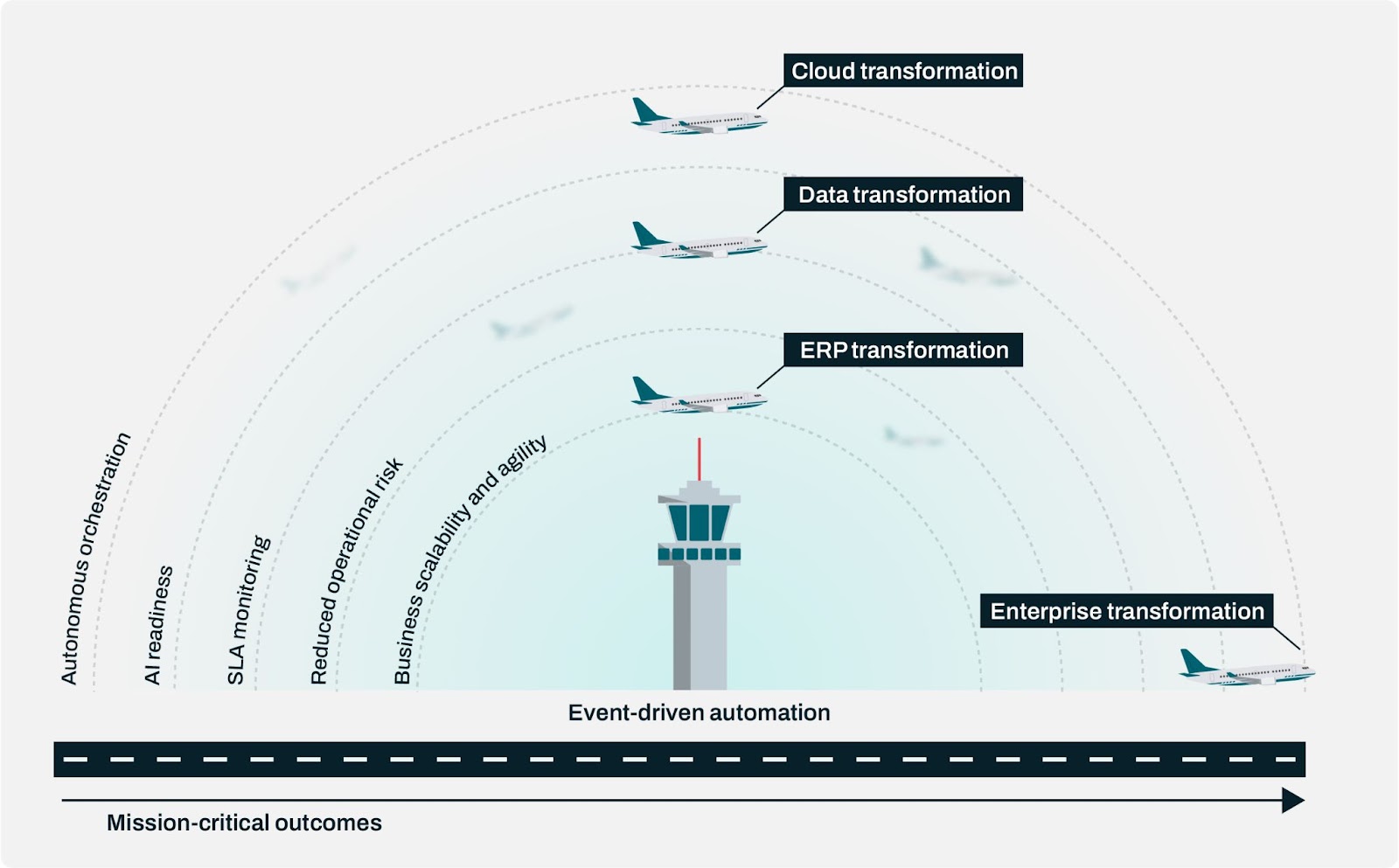
When operations stall at 30,000 feet, it’s rarely the plane’s fault. It’s the tower.
Earlier this year, radar failures at Newark Liberty International Airport grounded flights across the United States, not because the aircraft failed but because coordination broke down. A combination of aging systems, staff shortages and manual overrides created a chain reaction that left passengers stranded and schedules in chaos.
Enterprise IT isn’t so different. Cloud systems, data platforms, ERP modernizations and AI pilots are all taking off, but the control layer that’s supposed to orchestrate them is often still stuck on the ground.
When the automation “tower” fails, everything stops.
Who’s guiding your IT traffic?
CIOs and CTOs are moving fast. They’re focused on cloud-first, generative and agentic AI and workflow automation. Under all that progress is a quiet problem: The automation architecture powering it all hasn’t kept up.
Companies are building smarter systems but still relying on old job schedulers and hard-coded scripts to orchestrate between them. That creates delays, disconnects and blind spots. The sky might look clear now, but storms are coming.
The more systems you modernize, the more complex your operations become. And as this modernization goes faster and faster over time, the harder it is to coordinate workloads with high fidelity, especially across legacy systems that require custom-coded connectors, manual refactoring for continuous integration and automation designed for a different era. While it feels like you’re accelerating, legacy systems beneath the surface are quietly pulling the brakes.
Modernization without orchestration is like asking your control tower to manage new aircraft using equipment they’ve never trained on. The sky is getting more crowded, but the systems guiding the traffic are stuck in the past.
The illusion of progress
The problem with mainframes didn’t begin and end in the early 2000s. It lingered for decades. Even as businesses moved to the cloud in the 2010s, their most critical workloads and data remained locked inside monolithic, closed mainframe applications with no APIs, no agility and shrinking pools of technical talent.
During the COVID-19 crisis in 2020, the issue broke into public view when multiple U.S. states issued emergency calls for COBOL programmers to stabilize aging unemployment systems. Rather than isolated IT issues, these were architectural bottlenecks that made rapid response impossible. No DevOps, no iterative improvement, no access to real-time data. Just batch cycles, manual updates and fragile processes buried under decades of technical debt.
Today, many enterprises are facing the same limitations, just in a different disguise. Legacy job schedulers and automation tools are the modern mainframe, standing in the way of AI adoption, API-driven integration and autonomous orchestration across cloud-native ecosystems.
These schedulers were designed for predictable workflows and tightly coupled environments, not for hybrid cloud, continuous delivery and interconnected platforms like SAP Business Technology Platform (BTP), Salesforce and Snowflake. As a result, they can’t scale, they can’t adapt and they certainly can’t keep pace with AI-driven transformation.
None of that works without modern orchestration via a control center that can coordinate business processes, eliminate human error, trigger event-based workflows and deliver consistent outcomes. Without it, transformation becomes a patchwork of short-term fixes and long-term headaches.
Static scheduling vs. intelligent orchestration
Orchestration requires controlling systems with precision and context, rather than just connecting them. That’s where event-based architecture becomes critical.
Unlike traditional scheduling, which runs on fixed times or batch jobs, event-driven orchestration allows your processes to respond dynamically to business and system events. You react to what’s happening now, not just what’s scheduled. Orders get fulfilled the moment inventory updates. Reports run the second data hits the warehouse. Downtime shrinks. You meet service-level agreements (SLAs).
At Redwood Software, we call this architecture an automation fabric: a unified layer that weaves together cloud and on-premises systems and AI innovation with full visibility, scalability and control. What makes it different?
Built for hybrid: Connect SAP, Oracle, cloud services and custom apps across environments.
Agentless integration: Connect systems without installing or maintaining local agents, so no need for custom scripts. Reduce risk, friction and security vulnerabilities.
AI-powered observability: Identify SLA risks and optimize performance before problems arise.
Unified monitoring: View everything through a single pane of glass.
Why would you custom-code or patch together manual workflows when intelligent orchestration can adapt autonomously?
Avoid a Newark moment: Your flight plan
Let’s say your global energy company is modernizing for sustainability and scale. You’re juggling regulatory demands, transitioning to RISE with SAP, piloting AI in financial planning and managing dozens of custom systems. But your core automation is still dependent on a legacy scheduler designed for batch processing and nightly jobs.
You’re not alone.
This is where modernization breaks down. It’s not in the cloud migration or the AI launch, but in what keeps it all together. By upgrading to a modern orchestration platform, your company could retire fragile custom scripts, slash risk across compliance-heavy processes and move faster with fewer people.
Rather than just picking a tool, it’s essential to choose a partner with a forward-looking vision. RunMyJobs by Redwood is designed to be air traffic control for the modern enterprise. Even if you’re not feeling the turbulence yet, the future is coming faster than you think.
Don’t wait until delays, outages or compliance gaps force your hand. Modern orchestration isn’t optional — it’s foundational.
See it in practice: Read our guide to learn how automation fabrics are helping teams orchestrate SAP and non-SAP data across industries.
When operations stall at 30,000 feet, it’s rarely the plane’s fault. It’s the tower.
Earlier this year, radar failures at Newark Liberty International Airport grounded flights across the United States, not because the aircraft failed but because coordination broke down. A combination of aging systems, staff shortages and manual overrides created a chain reaction that left passengers stranded and schedules in chaos.
Enterprise IT isn’t so different. Cloud systems, data platforms, ERP modernizations and AI pilots are all taking off, but the control layer that’s supposed to orchestrate them is often still stuck on the ground.
When the automation “tower” fails, everything stops.
Who’s guiding your IT traffic?
CIOs and CTOs are moving fast. They’re focused on cloud-first, generative and agentic AI and workflow automation. Under all that progress is a quiet problem: The automation architecture powering it all hasn’t kept up.
Companies are building smarter systems but still relying on old job schedulers and hard-coded scripts to orchestrate between them. That creates delays, disconnects and blind spots. The sky might look clear now, but storms are coming.
The more systems you modernize, the more complex your operations become. And as this modernization goes faster and faster over time, the harder it is to coordinate workloads with high fidelity, especially across legacy systems that require custom-coded connectors, manual refactoring for continuous integration and automation designed for a different era. While it feels like you’re accelerating, legacy systems beneath the surface are quietly pulling the brakes.
Modernization without orchestration is like asking your control tower to manage new aircraft using equipment they’ve never trained on. The sky is getting more crowded, but the systems guiding the traffic are stuck in the past.
The illusion of progress
The problem with mainframes didn’t begin and end in the early 2000s. It lingered for decades. Even as businesses moved to the cloud in the 2010s, their most critical workloads and data remained locked inside monolithic, closed mainframe applications with no APIs, no agility and shrinking pools of technical talent.
During the COVID-19 crisis in 2020, the issue broke into public view when multiple U.S. states issued emergency calls for COBOL programmers to stabilize aging unemployment systems. Rather than isolated IT issues, these were architectural bottlenecks that made rapid response impossible. No DevOps, no iterative improvement, no access to real-time data. Just batch cycles, manual updates and fragile processes buried under decades of technical debt.
Today, many enterprises are facing the same limitations, just in a different disguise. Legacy job schedulers and automation tools are the modern mainframe, standing in the way of AI adoption, API-driven integration and autonomous orchestration across cloud-native ecosystems.
These schedulers were designed for predictable workflows and tightly coupled environments, not for hybrid cloud, continuous delivery and interconnected platforms like SAP Business Technology Platform (BTP), Salesforce and Snowflake. As a result, they can’t scale, they can’t adapt and they certainly can’t keep pace with AI-driven transformation.
None of that works without modern orchestration via a control center that can coordinate business processes, eliminate human error, trigger event-based workflows and deliver consistent outcomes. Without it, transformation becomes a patchwork of short-term fixes and long-term headaches.
Static scheduling vs. intelligent orchestration
Orchestration requires controlling systems with precision and context, rather than just connecting them. That’s where event-based architecture becomes critical.
Unlike traditional scheduling, which runs on fixed times or batch jobs, event-driven orchestration allows your processes to respond dynamically to business and system events. You react to what’s happening now, not just what’s scheduled. Orders get fulfilled the moment inventory updates. Reports run the second data hits the warehouse. Downtime shrinks. You meet service-level agreements (SLAs).
At Redwood Software, we call this architecture an automation fabric: a unified layer that weaves together cloud and on-premises systems and AI innovation with full visibility, scalability and control. What makes it different?
Built for hybrid: Connect SAP, Oracle, cloud services and custom apps across environments.
Agentless integration: Connect systems without installing or maintaining local agents, so no need for custom scripts. Reduce risk, friction and security vulnerabilities.
AI-powered observability: Identify SLA risks and optimize performance before problems arise.
Unified monitoring: View everything through a single pane of glass.
Why would you custom-code or patch together manual workflows when intelligent orchestration can adapt autonomously?
Avoid a Newark moment: Your flight plan
Let’s say your global energy company is modernizing for sustainability and scale. You’re juggling regulatory demands, transitioning to RISE with SAP, piloting AI in financial planning and managing dozens of custom systems. But your core automation is still dependent on a legacy scheduler designed for batch processing and nightly jobs.
You’re not alone.
This is where modernization breaks down. It’s not in the cloud migration or the AI launch, but in what keeps it all together. By upgrading to a modern orchestration platform, your company could retire fragile custom scripts, slash risk across compliance-heavy processes and move faster with fewer people.
Rather than just picking a tool, it’s essential to choose a partner with a forward-looking vision. RunMyJobs by Redwood is designed to be air traffic control for the modern enterprise. Even if you’re not feeling the turbulence yet, the future is coming faster than you think.
Don’t wait until delays, outages or compliance gaps force your hand. Modern orchestration isn’t optional — it’s foundational.
See it in practice: Read our guide to learn how automation fabrics are helping teams orchestrate SAP and non-SAP data across industries.