Revolutionizing Claims Processing: How Expion Health Achieved 600% Growth with AI Automation

Revolutionizing Claims Processing: How Expion Health Achieved 600% Growth with AI Automation


In today’s fast-paced healthcare industry, efficiency and accuracy are paramount. Expion Health, a leader in cost-management solutions, recognized this challenge and took a bold step to transform its claims processing operations. By partnering with qBotica, a trailblazer in intelligent automation solutions, Expion Health achieved a groundbreaking 600% increase in claims processing volume, reaching new heights of productivity and efficiency. 

This blog explores Expion Health’s journey, the challenges they faced, and how qBotica’s AI-driven solutions revolutionized their claims processing operations. 

The Healthcare Claims Challenge

The healthcare industry is one of the most complex and dynamic sectors in the world, valued at a staggering $5.1 trillion in the United States alone. It is an essential part of the economy, but inefficiencies in processes, lack of transparency, and the variability in service pricing create significant barriers to cost control. For example, a single MRI scan could range from $375 in one facility to as high as $5,000 in another. This lack of standardization creates confusion and drives up costs for consumers and insurers alike. 

Expion Health is dedicated to solving this problem by helping its clients—ranging from large insurance organizations to self-insured employers—identify fair pricing through its cost-management solutions. However, their claims processing operations faced major hurdles. Historically, the company relied heavily on manual workflows, including the tedious task of logging claims data from unstructured documents. Employees were required to manually key in data, match it against historical and market data, and return a recommended price. 

This process not only consumed significant time but also limited scalability. With a daily capacity of only 75 claims, Expion found itself constrained by its traditional processes, especially as client demands grew. Furthermore, the heavy reliance on manual data entry increased the potential for errors, reducing overall efficiency and accuracy. 

In this context, automation wasn’t just a luxury—it was a necessity. The healthcare industry’s scale demanded solutions that could keep pace with evolving demands, improve accuracy, and free employees from repetitive, time-consuming tasks. Expion Health recognized this opportunity and took a strategic leap by partnering with qBotica, a leader in intelligent automation. 

For a deeper dive into healthcare automation, visit qBotica’s Intelligent Automation page here. 

Why Expion Chose qBotica

Expion Health’s journey toward automation began with a clear objective: to scale its claims processing capacity without sacrificing accuracy or transparency. After evaluating multiple options, the organization partnered with qBotica, a trusted UiPath partner known for delivering cutting-edge automation solutions tailored to complex industries like healthcare. 

qBotica’s Expertise 

qBotica brought a wealth of expertise to the table, leveraging UiPath’s advanced tools such as Document Understanding, AI Center, and Action Center. These technologies enable organizations to process unstructured documents with unparalleled accuracy, seamlessly integrating human intervention where necessary. By combining intelligent automation with predictive intelligence, qBotica ensured that Expion’s solution was not only efficient but also aligned with the company’s long-term goals. 

Strategic Collaboration 

The partnership between Expion Health and qBotica went beyond deploying off-the-shelf solutions. Instead, qBotica worked closely with Expion’s team to understand their pain points, map out workflows, and design a customized automation strategy. This approach ensured that the solution addressed both immediate challenges and future scalability. 

For organizations considering automation, qBotica’s expertise in tailoring solutions is a game-changer. Learn how they can transform your business here. 

The Transformation Process

The transformation at Expion Health was anchored in a structured, four-step process that optimized claims processing end-to-end. Here’s a closer look at each phase: 

Automated Claim Downloads 

UiPath robots were deployed to automate the downloading of claims in PDF format from payer systems. This eliminated the need for manual data collection, significantly reducing time and effort. 

Data Extraction and Validation 

Using UiPath’s Document Understanding, unstructured claims documents were processed to extract critical data points. This AI-powered tool not only classified and validated claims but also ensured high accuracy, even with complex formats. 

Human-Robot Collaboration 

For claims with extraction issues, Expion employees used UiPath’s Action Center to review and correct errors. This human-in-the-loop approach maintained quality control, ensuring that no claim was processed incorrectly. 

Final Processing and Reconciliation 

Once validated, the data was sent to Expion’s proprietary Expion platform, where it was analyzed and reconciled to determine fair pricing. 

This intelligent integration of automation and human expertise enabled Expion to move from a labor-intensive workflow to a streamlined, highly efficient system. 

How qBotica Redefined Claims Processing for Expion Health

Expion Health’s transformation began with a strategic partnership with qBotica, a leader in UiPath-powered automation solutions. Together, they devised a comprehensive plan to streamline claims processing, leveraging advanced technologies to automate data extraction, validation, and reconciliation. 

The Four-Step Process: 

Automated Claim Downloads 

UiPath robots automated the collection of claims from payer systems, eliminating the need for manual downloads. 

AI-Powered Data Extraction 

Using UiPath Document Understanding, Expion extracted critical data points from unstructured claims documents. This ensured accuracy and reduced processing time significantly. 

Human-Robot Collaboration 

UiPath’s Action Center allowed Expion employees to review and correct data where necessary, maintaining quality control while maximizing automation benefits. 

Final Reconciliation 

The cleaned data was fed into ExpionIQ, Expion’s proprietary platform, for pricing and reconciliation. 

This intelligent integration of automation and human expertise enabled Expion to handle up to 710 claims per day, a stark contrast to its previous capacity of 75 claims. 

Explore more about qBotica’s tailored solutions here. 

Results That Speak for Themselves

The impact of qBotica’s automation solution on Expion Health’s operations has been nothing short of revolutionary. Here are some of the key outcomes: 

  • 600% Increase in Claims Processed 

Before automation, Expion could handle only 75 claims daily. After deploying qBotica’s solution, the company consistently processed 148 claims per day on average, with peak days reaching 710 claims. This remarkable growth underscores the scalability of intelligent automation. 

  • Enhanced Productivity 

The 97% increase in overall productivity has freed up employees to focus on strategic initiatives rather than repetitive data entry tasks. This shift has not only improved job satisfaction but also allowed Expion to deliver faster, more reliable results to its clients. 

  • Unprecedented Accuracy 

Achieving a 99% success rate in claims processing, the solution ensures minimal errors, boosting client confidence and satisfaction. 

  • Faster Speed to Market 

By significantly reducing the time taken to process and price claims, Expion has enhanced its ability to meet client demands in a competitive market. 

These results illustrate how qBotica’s automation expertise can drive meaningful, measurable outcomes. For more success stories, visit qBotica’s Case Studies here. 

Lessons from Expion’s Journey

The success of Expion Health’s automation initiative provides valuable insights for other organizations looking to streamline operations: 

1. The Importance of Partnering with Experts 

Choosing a partner like qBotica, with deep expertise in UiPath’s ecosystem, ensures smooth implementation and optimal results. Their tailored approach allowed Expion to address specific challenges without overhauling existing systems entirely. 

2. Balancing Automation with Human Oversight 

While automation can handle repetitive tasks with precision, human oversight remains essential for maintaining quality and addressing anomalies. UiPath’s Action Center facilitated seamless collaboration between AI and human teams. 

3. Scalability and Adaptability 

The automation framework designed by qBotica is not only efficient but also scalable, allowing Expion to adapt to future demands and explore new areas for automation. 

4. Demonstrating ROI 

Automation initiatives often face skepticism about their costs and benefits. Expion’s results—a 600% increase in claims capacity and a 97% productivity boost—demonstrate the clear ROI that intelligent automation can deliver. 

For more insights, visit qBotica’s Success Stories here. 

The Impact of Automation on Expion’s Operations

The results of this automation initiative have been nothing short of transformative. By automating repetitive tasks and streamlining workflows, Expion achieved: 

  • 600% Increase in Claims Processed 

Claims processing capacity surged from 75 claims per day to an average of 148, with peak performance reaching 710 claims in a single day. 

  • Enhanced Productivity 

Automation led to a 97% productivity increase, freeing employees to focus on strategic, value-added tasks. 

  • Improved Accuracy 

With a 99% success rate in claims processing, errors were drastically reduced, boosting client satisfaction and operational efficiency. 

Broader Implications for Healthcare 

These achievements set a benchmark for the healthcare industry, highlighting the transformative potential of intelligent automation. By addressing inefficiencies in claims management, organizations like Expion and qBotica are paving the way for a more transparent and cost-effective healthcare system. 

Future Opportunities for Automation in Healthcare

As Expion Health continues its automation journey, new opportunities for innovation are emerging. Future initiatives could include: 

  • Advanced Predictive Analytics 

Leveraging AI to predict trends in medical pricing and claims patterns, enabling proactive decision-making. 

  • Integration with Other Platforms 

Expanding automation to cover end-to-end workflows, including client-facing portals and real-time data analysis. 

  • AI-Driven Insights for Cost Management 

Using machine learning models to optimize pricing strategies further and identify cost-saving opportunities for clients. 

The collaboration with qBotica has positioned Expion as a pioneer in healthcare automation, inspiring other organizations to embrace similar transformations. 

The Road Ahead 

Expion Health’s journey with qBotica is just the beginning. With its claims processing system now optimized, the company is exploring additional automation opportunities, including advanced analytics and predictive modeling. This forward-thinking approach positions Expion as a leader in healthcare cost management and serves as a blueprint for other organizations. 

Conclusion

Expion Health’s partnership with qBotica showcases the transformative potential of automation in healthcare. From processing 75 claims daily to achieving a 600% increase in volume, Expion’s success underscores the value of intelligent automation in driving efficiency, accuracy, and scalability. 

If your organization is ready to revolutionize its operations, partner with qBotica today. Explore their solutions here. 

The post Revolutionizing Claims Processing: How Expion Health Achieved 600% Growth with qBotica’s AI Automation first appeared.


Case Study: Automating Social Media Content Creation with ChatGPT 4.0

Case Study: Automating Social Media Content Creation with ChatGPT 4.0

Case Study:


Case Study: Automating Social Media Content Creation with ChatGPT 4.0

Objective:
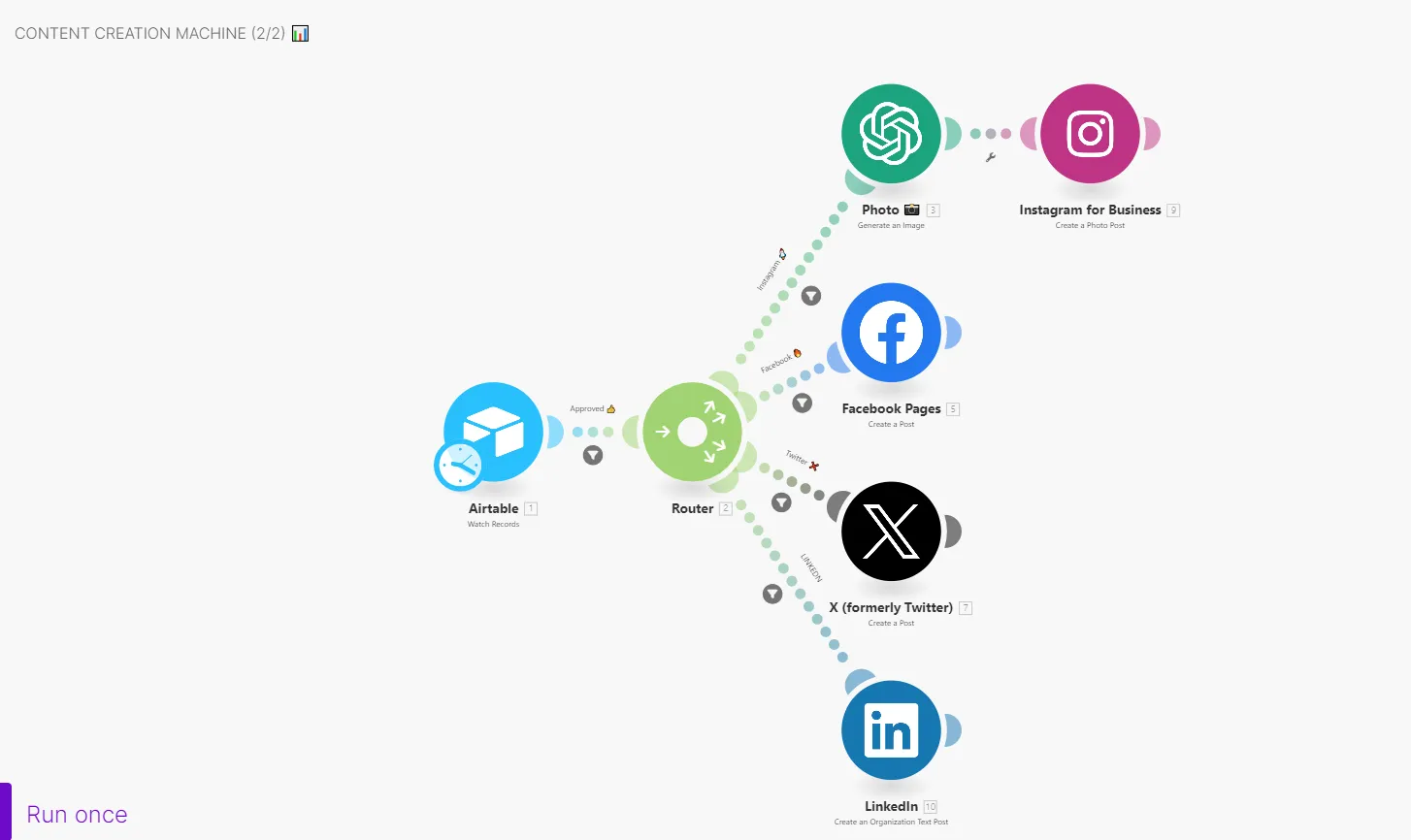
To create a streamlined system for generating engaging social media content for platforms like Instagram, Facebook, LinkedIn, Twitter, and TikTok. This system automates content ideation, creation, and optimization using ChatGPT 4.0 and AI-powered agents for analyzing viral trends.

Overview of the Automation System

Challenge:
Social media content creation is often tedious and requires constant adaptation to trends and audience preferences. Businesses need a solution to deliver high-quality, engaging posts that resonate with their target audience and save time.

Solution:
A system powered by ChatGPT 4.0 and AI agents that automates the following:

  • 🌟 Generating content for Instagram, Facebook, LinkedIn, and Twitter in platform-specific formats.
  • 🎥 Creating short-form scripts for TikTok and Instagram Reels.
  • 📈 Tracking viral trends using AI agents to stay relevant.
  • 🕒 Scheduling posts at optimal times for better engagement.
airtable
maek.com

Content Creation Machine 🃏

Step-by-Step Implementation

1. Setting Up ChatGPT 4.0 for Content Generation

  • Input Prompt Design: Develop specific prompts to instruct ChatGPT to create posts tailored to each platform.
    • Example for Instagram: “Write a carousel post caption about [topic] with a call-to-action for engagement.”
    • Example for TikTok: “Create a 15-second viral script about [topic] using humor.”
  • Output Customization: Structure outputs to include hooks, body text, hashtags, and emojis for each platform.

2. Automating Viral Trend Analysis

  • Use AI agents to scrape data from tools like BuzzSumo, TrendHunter, or Twitter Trending.
  • Automate trend monitoring with Python scripts or Zapier integrations, feeding the most relevant data into ChatGPT for contextual content creation.
  • Example: An agent tracks the top 10 viral hashtags in the fitness niche and feeds them to ChatGPT for integration into captions.

3. Streamlining Multi-Platform Content Distribution

  • Batch Creation: Generate content for all platforms in a single session, ensuring coherence across posts.
  • Formatting Adjustments: Tailor text lengths and tones for professional platforms like LinkedIn versus casual platforms like TikTok.

4. Generating Hooks and Scripts for Reels and TikToks

  • Prompt ChatGPT to create attention-grabbing hooks:
    • Example: “What if you could achieve X in just 5 minutes a day?”
  • Generate short, punchy scripts designed for visual storytelling. Include suggestions for pacing and visuals.

5. Reviewing and Scheduling Content

  • Use AI tools like Grammarly or Hemingway for polishing text before publishing.
  • Automate scheduling with tools like Buffer, Hootsuite, or SocialBee to post at optimal times.

Results

  1. Time Saved: Reduced content creation time by 60%.
  2. Increased Engagement: Viral hooks and optimized captions resulted in a 30% increase in average engagement rates.
  3. Scalability: The system allowed consistent posting across four platforms without additional manual effort.

Key Takeaways

  • Leveraging ChatGPT 4.0 enables quick generation of diverse, engaging social media content.
  • AI agents enhance relevancy by identifying trending topics and patterns in real-time.
  • This automated workflow is ideal for creators looking to maintain a consistent and impactful presence across multiple platforms.

Tools Used:

  • ChatGPT 4.0: For content generation and scriptwriting.
  • BuzzSumo and TrendHunter: For identifying viral topics and trends.
  • Hootsuite/Buffer: For scheduling and publishing.

This case study highlights the effectiveness of AI-driven systems in transforming social media strategies, making it easier for businesses and creators to thrive in the digital space.

You said:
use professional looking emoji
ChatGPT said:
GPT

Case Study: Automating Social Media Content Creation with ChatGPT 4.0

Objective:
To develop a professional and automated system for creating engaging social media content tailored for Instagram, Facebook, LinkedIn, Twitter, and TikTok. This automation ensures viral hooks, optimized captions, and consistent posting across platforms with minimal manual effort.


Overview of the Automation System

Challenge:
Social media content creation is often tedious and requires constant adaptation to trends and audience preferences. Businesses need a solution to deliver high-quality, engaging posts that resonate with their target audience and save time.

Solution:
A system powered by ChatGPT 4.0 and AI agents that automates the following:

  • 🌟 Generating content for Instagram, Facebook, LinkedIn, and Twitter in platform-specific formats.
  • 🎥 Creating short-form scripts for TikTok and Instagram Reels.
  • 📈 Tracking viral trends using AI agents to stay relevant.
  • 🕒 Scheduling posts at optimal times for better engagement.

Step-by-Step Implementation

1. Setting Up ChatGPT 4.0 for Content Generation

  • 🖋️ Custom Prompts: Develop detailed prompts for ChatGPT to generate content tailored to specific platforms.
    • Example for Instagram: “Write a carousel post caption for [topic] with emojis and a strong CTA.”
    • Example for LinkedIn: “Create a professional LinkedIn post for [topic] with a focus on thought leadership.”
  • 🎯 Keyword Optimization: Integrate trending keywords and hashtags for each platform to boost visibility.

2. Automating Viral Trend Analysis

  • 🔍 AI Trend Agents: Use tools like BuzzSumo or Twitter API to monitor viral content in your niche.
  • 🤖 Data Automation: Feed real-time trending topics and hashtags directly into ChatGPT for dynamic content creation.
    • Example: An AI agent scrapes the top hashtags in the fitness industry and suggests: #FitLife #MotivationMonday.

3. Multi-Platform Content Distribution

  • 📤 Batch Content Creation: Use ChatGPT to generate posts for all platforms at once, adapting tone and length for each.
  • ✂️ Formatting Adjustments: Optimize captions for Twitter’s character limits and LinkedIn’s professional tone.

4. Crafting Viral Hooks and Scripts for TikTok & Reels

  • 🚀 Viral Hooks:
    • Example: “What if I told you [X solution] could save you 10 hours a week?”
  • 🎬 Short Scripts: Use ChatGPT to create concise and engaging scripts that align with visual storytelling.

5. Scheduling and Review Process

  • 📆 Automation Tools: Integrate with Hootsuite or Buffer for seamless scheduling.
  • Quality Assurance: Use Grammarly or Hemingway to refine language and ensure professional tone.

Results Achieved

  1. Time Efficiency: Reduced content creation time by 60%.
  2. 🚀 Improved Engagement: Viral hooks and trend-driven captions boosted average engagement rates by 35%.
  3. 📊 Scalability: Enabled consistent, high-quality content delivery across multiple platforms.

Key Benefits of the System

  • 🌐 Centralized content creation and management.
  • 🔥 Trend-driven posts to maximize visibility.
  • 🤝 Better alignment with audience preferences through platform-specific formats.

Tools Used

  • 🧠 ChatGPT 4.0: For generating content and scripts.
  • 📊 BuzzSumo: For analyzing viral trends.
  • 📅 Hootsuite/Buffer: For scheduling and posting.

This automated system for social media content creation ensures efficiency and consistency, empowering businesses to thrive in the competitive digital landscape. With ChatGPT 4.0, creators can focus on strategy while AI handles the heavy lifting! 💼✨

Transform Your Customer Experience by Upgrading Your Contact Center Tech Stack

Transform Your Customer Experience by Upgrading Your Contact Center Tech Stack

In today’s competitive landscape, the importance of customer experience (CX) cannot be overstated. A superior CX is imperative for business success, directly influencing customer loyalty and brand reputation. 

Contact centers play a crucial role in enhancing CX, serving as the frontline for customer interactions. Upgrading your contact center tech stack is crucial. By closing the gaps in these technologies, you ensure optimal performance and seamless customer interactions. This investment not only elevates CX but also aligns operational goals with customer satisfaction metrics, setting your business apart in the market. 

However, it’s not just about upgrading technology; it’s also about streamlining processes. Identifying which business processes should be automated can significantly improve efficiency and performance. 

For instance, the State of California’s Department of Motor Vehicles has successfully automated several of its processes with the help of qBotica, resulting in more efficient handling of around 50,000 MCP renewals per year, which were previously paper-based and manually processed. 

Such examples highlight how a strategic approach to automation can transform customer interactions and overall business performance.

Understanding the Current Landscape of Contact Center Technologies

Contact centers often struggle with isolated technologies that create disconnected systems. These separate solutions can lead to inefficiencies and communication breakdowns, negatively affecting customer experience. 

To tackle these issues, integration becomes crucial. By smoothly connecting different technologies, contact centers can make processes more efficient and improve collaboration among various systems. This integration not only enhances operational workflows but also ensures consistent customer interactions across multiple channels. 

Moreover, using Automation as a Service can greatly improve these integration efforts. By implementing such automation solutions, contact centers can optimize their operations, reduce manual errors, and ultimately enhance service delivery. 

Data unification is also important in these efforts, providing several benefits: 

Consistent Customer Interactions: Unified data ensures that agents have access to complete customer profiles, enabling more personalized and consistent service. 

Reduced Wait Times: A centralized database allows for quicker retrieval of information, minimizing customer wait times and frustration during interactions. 

Enhanced Decision-Making: Access to unified data empowers agents and managers to make informed decisions quickly, improving overall service quality. 

By overcoming the limitations of disconnected systems through integration and data unification, along with the implementation of strategic automation solutions, contact centers can significantly improve their customer service offerings. 

This approach is not limited to contact centers alone; similar strategies are being used in other industries like healthcare. The Revenue Cycle Management in healthcare is a prime example of how integrating technology and automating processes can lead to improved efficiency and better patient care. 

The Role of Automation in Contact Centers

Automation technologies are changing the game for contact centers by making operations more efficient and improving the customer experience. At the heart of this change is the automation tech stack, which includes tools such as software robots and self-service tools. These technologies give customers more control while also lightening the workload for agents. 

Effective Automation Tools 

Here are some effective automation tools used in contact centers: 

Chatbots: Provide instant responses to common queries, allowing agents to focus on more complex issues. 

Interactive Voice Response (IVR): Guides callers through automated menus, improving call routing efficiency. 

Benefits of Automation 

Automation brings several benefits to contact centers: 

Improved operational efficiency: By reducing manual tasks, automation leads to quicker response times and greater accuracy. 

Enhanced compliance: Standardized processes ensure adherence to regulations, minimizing compliance risks. 

Scalability: Integrating automation tools within the tech stack allows contact centers to expand their operations while maintaining high service standards. 

The impact of automation goes beyond just contact centers. For example, Robotic Process Automation (RPA) has shown impressive results in various industries including manufacturing. This technology boosts efficiency and productivity by automating repetitive tasks. 

Moreover, automation is not merely a passing trend but rather a significant shift towards redefining business operations. As highlighted in a recent report, companies like qBotica are at the forefront with their innovative automation solutions. In fact, they were recently recognized in the 2022 Gartner Market Guide for Intelligent Document Processing Solutions, underscoring the growing significance of Intelligent Document Processing within the automation landscape. 

Furthermore, qBotica’s remarkable growth trajectory has been acknowledged as they were ranked as one of the fastest-growing companies in North America on the 2023 Deloitte Technology Fast 500, showcasing the transformative power of their automation solutions across various sectors. 

Bridging the Perception Gaps in Customer Experience with AI and Human Skills

Perception gaps between customers and agents can create friction and dissatisfaction, impacting the overall customer experience. Customers may fear that AI will replace human jobs, while agents might feel threatened by automation technologies like chatbots. Understanding these perception gaps is crucial for organizations aiming to elevate CX by closing the gaps in your contact center tech stack. 

Blending AI Capabilities with Human Interaction 

To bridge these divides, consider blending AI capabilities with human interaction. This combination allows businesses to harness the efficiency of AI while maintaining a personal touch. For instance, AI’s evolution from basic conversational tools to a driving force in business can be leveraged effectively. Utilizing AI for handling routine inquiries enables agents to focus on complex issues requiring human insight and empathy. 

The Importance of Empathy in Customer Service 

Empathy in customer service is paramount for delivering personalized experiences. Agents equipped with emotional intelligence tools can better understand customer emotions and tailor responses accordingly. By emphasizing empathy, companies ensure that technology enhances rather than detracts from human connections, creating a balanced approach that resonates with both customers and employees alike. 

Improving Operational Efficiency with AI 

Moreover, AI can significantly improve operational efficiency in areas such as email processing, which has become a major bottleneck for many businesses due to the sheer volume of emails sent daily. Automation can help streamline this process, reducing substantial losses in productivity and money. 

In addition to email processing, there are other areas where AI can make a significant impact. For example, in the billing and statements sector, RPA can automate the time-consuming and error-prone process of issuing bills and statements to customers. This allows staff to focus on higher-level customer relations tasks. 

Furthermore, qBotica’s DoqumentAI product showcases how smart machine learning powered software can intelligently read through emails and relevant information, thereby enhancing productivity in sectors such as transportation and supply chain management. 

Addressing Concerns Related to AI, Automation, and Privacy in Contact Centers

Addressing concerns surrounding AI and automation is crucial for modernizing contact centers. One common misconception is the fear that AI will replace human jobs. In reality, automation often handles repetitive tasks, allowing agents to focus on complex issues that require human empathy and creativity. For instance, intelligent automation can transform businesses by optimizing repetitive processes, similar to its application in the medical field where it enhances patient outcomes. 

Reassuring Customers About Technology Use 

Reassuring customers about technology use involves transparency and education. Clearly communicating how AI enhances service without compromising human interaction can alleviate fears. For instance, providing examples of automation improving service speed without losing personal touch can be persuasive. This is akin to how qBotica helped a Fortune 500 technology products company process 1 million invoices each year, showcasing the efficiency of intelligent automation. 

Addressing Privacy Concerns and Potential Biases 

Privacy concerns and potential biases in data are also significant barriers. Implementing robust security measures ensures customer data is protected, while regularly auditing algorithms helps minimize biases. By addressing these issues head-on, contact centers can create an environment where both customers and agents feel secure and valued. This balance is key to building trust and enhancing the overall customer experience. 

Moreover, as enterprises switch focus from automating tasks to end-to-end processes, the demand for niche automation services is growing. Therefore, adopting intelligent automation in contact centers not only addresses job replacement fears but also significantly improves operational efficiency while ensuring data privacy and security

Leveraging Advanced Technologies to Enhance CX: Generative AI, Predictive Analytics, Real-Time Insights

Generative AI Technologies 

Generative AI significantly enhances customer interactions by providing intelligent, context-sensitive responses. These suggested responses are tailored to customer queries and preferences, fostering a more personalized engagement. For example, chatbots equipped with generative AI can simulate human-like conversations, offering immediate assistance while maintaining the nuances of natural dialogue. 

Predictive Analytics 

Predictive analytics plays a pivotal role in understanding and mapping the customer journey. By analyzing historical data and identifying patterns, businesses can anticipate customer needs and preferences. This insight allows companies to tailor their marketing strategies and service offerings, ensuring that each interaction is relevant and timely. 

Real-Time Insights 

Real-time insights are crucial for delivering proactive service. By continuously monitoring customer interactions and behaviors, organizations can swiftly address issues before they escalate. This not only reduces response times but also enhances the overall customer experience by demonstrating attentiveness and commitment to quality service. 

However, the implementation of these advanced technologies is not limited to one industry. For instance, qBotica helped a global top 10 bank reduce processing time by 75% and errors by 90% through intelligent automation. Similarly, in the real estate sector, marketing automation has revolutionized lead generation and client follow-ups. 

Moreover, the healthcare industry is also experiencing a transformation with automation, which allows healthcare providers to focus more on patient care rather than repetitive tasks. In specialty healthcare, AI and automation are driving operational efficiencies and superior service delivery. 

Best Practices for Upgrading Your Contact Center Tech Stack: Effective Solutions and Workforce Optimization Strategies

Selecting the right contact center platform is crucial for delivering a smooth customer experience. Here are some best practices to consider when upgrading your tech stack: 

  1. Prioritize AI integration
    Look for platforms that offer advanced features such as: 
  • Robust data analytics: Analyze customer interactions and agent performance to gain insights into areas for improvement.
  • Real-time reporting: Monitor key metrics in real-time to make data-driven decisions on resource allocation and performance management.
  • AI-driven insights: Leverage artificial intelligence to identify patterns, predict customer behavior, and personalize interactions.
  1. Optimize workforce management
    Efficient scheduling, skill-based routing, and performance tracking are essential for maximizing the potential of your workforce. Consider implementing tools that support these functions: 
  • Workforce optimization solutions: Invest in software that enables you to create optimized schedules based on demand forecasts, employee availability, and skill requirements. 
  • Training and development opportunities: Empower your agents by providing them with access to training programs, workshops, and mentorship opportunities. 

By equipping your team with the right skills and knowledge, you can foster a culture of continuous improvement. 

  1. Ensure a unified approach to communication
    Integrating systems across channels is key to delivering consistent service experiences. Here are some strategies to achieve this: 
  • Omnichannel communications: Implement a contact center solution that supports multiple channels such as phone, email, chat, and social media. This way, customers can reach out through their preferred channel without having to repeat themselves. 
  • Cohesive brand voice: Establish guidelines for tone of voice, messaging style, and brand personality across all communication channels. Train your agents to adhere to these guidelines in every interaction. 

By providing seamless transitions between channels and maintaining a consistent brand image, you can build trust and loyalty among your customers. 

  1. Enhance efficiency with robotic process automation (RPA)
    Incorporating robotic process automation into your contact center can significantly improve efficiency while reducing costs. These intelligent automation tools streamline repetitive tasks such as data entry, ticketing, and reporting. 
  • Benefits of RPA include:
    Increased speed: Bots can perform tasks much faster than humans, resulting in quicker response times and resolution rates. 

Reduced errors: Automation minimizes the risk of human error, ensuring accuracy in data handling and compliance with regulations. 

Cost savings: By automating low-value tasks, you can free up your agents’ time to focus on more complex issues that require human empathy and problem-solving skills. 

  1. Transform your business with managed automation services
    Partnering with a certified provider like qBotica can take your automation efforts to the next level. As a featured UiPath partner, qBotica offers tailored solutions that combine on-premises or cloud-based deployments with ongoing support.


    With managed automation services from qBotica:
    * You gain access to industry-leading expertise in designing and implementing automation workflows.
    * You benefit from flexible deployment options that suit your specific business needs.
    * You receive continuous monitoring and optimization of automated processes for optimal performance. 

By leveraging qBotica’s capabilities as an UiPath partner, you can maximize the value of your technology investment while ensuring seamless integration between automation tools and existing systems. 

  1. Close gaps in your tech stack with effective solutions
    Elevate customer experience (CX) by identifying areas where your current contact center technology falls short.

    Here are some common gaps to look out for:Lack of self-service options:

    If customers frequently reach out for basic inquiries or requests that could be easily resolved through self-service channels (e.g., FAQs, chatbots), consider implementing these solutions to empower customers and reduce agent workload.

    Inconsistent service quality: If you notice variations in service quality across different channels or agents, it may be due to lack of standardized processes or inadequate training resources. Invest in process documentation tools (e.g., knowledge bases) and training platforms (e.g., LMS) to ensure consistency in service delivery.

    Limited scalability: If your current tech stack struggles to handle peak seasons or sudden spikes in demand (e.g., product launches), explore scalable solutions such as cloud-based contact center software or pay-per-use pricing models. 

Remember that upgrading your tech stack is not just about replacing existing tools; it’s also about filling gaps that hinder optimal performance. 

  1. Embrace scalable automation tools
    As businesses grow, so do their operational needs. However, expanding resources such as hiring more employees may not always be feasible due to budget constraints or logistical challenges. 

This is where scalable automation tools come into play – they provide an efficient way to accommodate increasing workloads without compromising quality or incurring significant costs. 

Benefits of scalable automation include: 


Flexibility: Automation solutions can be easily adjusted based on changing business requirements (e.g., adding new processes). 

Cost-effectiveness: Compared to hiring additional staff members who require salaries/benefits/training expenses etc., investing in automation tends to yield higher ROI over time. 

Minimal disruption: Unlike traditional expansion methods which may involve disruptions during onboarding/training periods etc., automated processes seamlessly integrate into existing workflows minimizing downtime impacts. 

By leveraging scalable automation alongside other growth strategies (e.g., improving marketing efforts), businesses can achieve sustainable growth while maintaining operational efficiency. 

Remember that upgrading your tech stack is an ongoing process – regularly assess your technology landscape against evolving customer expectations/industry trends/best practices etc., making necessary adjustments along the wa

Conclusion

Transforming your contact center technology is not just a trend but a necessity for businesses aiming to improve customer experience (CX). By integrating advanced technologies and combining them with human skills, you can transform customer experience from ordinary to exceptional. 

This digital transformation fills the gaps in your contact center technology, ensuring that every customer interaction is smooth and personalized. Investing in the right tools and strategies helps in elevating CX, creating a customer-focused culture that drives success and strengthens brand loyalty. 

Frequently Asked Questions

Upgrading the contact center tech stack is crucial in today’s competitive landscape as it enhances customer experience, improves operational efficiency, and enables better integration of advanced technologies like AI and automation. 

Automation technologies are transforming contact centers by streamlining processes, reducing response times, and allowing agents to focus on more complex customer interactions. This leads to improved service delivery and customer satisfaction. 

Blending AI capabilities with human interaction involves utilizing AI for routine inquiries while ensuring that human agents are available for more complex issues. This approach helps bridge perception gaps between customers and agents, enhancing overall customer experience. 

Automation brings several benefits to contact centers, including improved efficiency, reduced operational costs, enhanced accuracy in data handling, and the ability to provide faster responses to customer queries. 

Businesses should prioritize AI integration, optimize workforce management, ensure unified communication across channels, enhance efficiency with robotic process automation (RPA), and embrace scalable automation tools to meet growing operational needs. 

Companies can address privacy concerns by being transparent about technology use, implementing robust data protection measures, and actively working to mitigate potential biases in data handling. This reassures customers that their information is handled responsibly. 

The post Transform Your Customer Experience by Upgrading Your Contact Center Tech Stack first appeared on qBotica | Intelligent Automation for your Enterprise | Featured UiPath Platinum Partner.

How the 2024.10 Release Enhances UiPath’s Core Automation Capabilities

How the 2024.10 Release Enhances UiPath’s Core Automation Capabilities

he 2024.10 release of UiPath marks a significant milestone in the evolution of automation technology, focusing on transitioning towards agentic automation while enhancing core functionalities. This update introduces advanced capabilities designed to automate complex workflows through intelligent decision-making and self-optimizing processes. Key enhancements include a new process diagram canvas, improved workforce management features, and the unveiling of UiPath Autopilot, which collectively aim to boost operational efficiency. 

By strengthening its core automation capabilities, UiPath empowers organizations to achieve true agentic automation at scale, catering to diverse operational needs. For instance, QBotica’s partnership with a global top 10 bank resulted in a remarkable 75% reduction in processing time and a 90% decrease in errors. Such outcomes exemplify the potential of intelligent automation in optimizing operations. 

Furthermore, the role of intelligent automation in ensuring product quality and compliance cannot be overstated. It streamlines quality assurance processes, making them less error-prone and more efficient. 

In sectors like healthcare, automation is transforming the industry, managing repetitive tasks such as patient data input and appointment scheduling, thereby allowing healthcare providers to focus more on patient care. This aligns with UiPath’s vision to deliver a fully automated enterprise. 

Moreover, intelligent automation is revolutionizing healthcare by minimizing administrative tasks and optimizing work processes amidst increasing consumer demands. 

Understanding Agentic Automation

Agentic automation is a game-changer in workflow management, revolutionizing the way complex processes are automated. This method utilizes Agentic AI, which plays a crucial role in automating intricate workflows through its smart decision-making and self-improving abilities. 

What is Agentic Automation? 

Agentic automation refers to the system’s ability to autonomously handle tasks from start to finish, adapting and optimizing without human intervention. This involves the integration of machine learning algorithms that allow systems to learn and improve over time. 

How does Agentic Automation work? 

With Agentic AI, the transition from task-based automation to comprehensive process automation becomes seamless. This is achieved through sophisticated algorithms that interpret data, make informed decisions, and optimize processes dynamically. The result is a robust system capable of handling complex workflows efficiently. 

Why is Process Intelligence important? 

The incorporation of process intelligence is critical in enabling end-to-end automation. By enhancing process management features, UiPath 2024.10 ensures that workflows not only run smoothly but adapt intelligently to changing conditions and requirements. 

These advancements position UiPath at the forefront of automation technology, offering organizations tools that enhance operational efficiency and foster innovative solutions tailored to evolving business needs. 

Moreover, Intelligent Document Processing (IDP), a rapidly growing segment within the automation space, has been recognized in the 2022 Gartner® Market Guide for Intelligent Document Processing Solutions. This recognition underscores the significant impact IDP can have on automating document-heavy processes. 

In specific sectors like manufacturing and insurance, Robotic Process Automation (RPA) has shown remarkable results by streamlining operations and increasing productivity. Similarly, RPA in insurance has enhanced efficiency while reducing costs. 

Furthermore, the potential of intelligent automation in healthcare is immense. It not only transforms businesses but also significantly improves patient outcomes by streamlining medical diagnosis and research processes. 

Key Features of Agentic Automation in 2024.10

The 2024.10 release of UiPath Studio introduces a new process diagram canvas, a pivotal tool for visualizing and designing agentic automation workflows. This enhancement enables users to construct intricate automation sequences with greater ease, enhancing clarity and precision in task design. 

Enhancements in workforce and task management features further propel UiPath toward agentic automation. These updates support dynamic resource allocation, allowing for intelligent workload distribution across various tasks. By integrating these capabilities, organizations can efficiently manage resources, ensuring optimal utilization and minimizing downtime. 

Adopting agentic automation yields significant benefits: 

  • Improved operational efficiency: Streamlined processes reduce manual interventions, saving time and minimizing errors. 
  • Faster time-to-value: Organizations can rapidly deploy automated solutions, accelerating return on investment. 

These advancements illustrate how the 2024.10 release is moving UiPath toward agentic automation by reinforcing its core functionalities and introducing innovative features that cater to evolving business needs. Through these enhancements, businesses are better equipped to handle complex workflows, ultimately driving success and growth in today’s competitive landscape. 

However, the journey towards successful implementation of intelligent automation is not without its challenges. It’s essential for businesses to identify areas that could be optimized, especially those involving high levels of repetitiveness. For insights into overcoming these hurdles, you may find this guide on adopting intelligent automation in manufacturing helpful. 

Moreover, as enterprises shift focus from automating individual tasks to end-to-end processes, the need for specialized automation service providers is on the rise. qBotica is scaling up its ecosystem approach to assist enterprises in building their own automation services platforms. More about this initiative can be found in our recent newsroom update. 

In the realm of supply chain management, automation has the potential to redefine IT’s role from merely addressing issues to fostering innovation. To explore how this transformation can occur, we invite you to read our collection of white papers on supply chain automation. 

Lastly, it’s crucial for organizations to determine which business processes are ripe for automation. For guidance on identifying these processes across various departments such as sales, marketing, human resources, and accounting, refer to our insightful article on what business processes should your organization automate. 

Introducing UiPath Autopilot

UiPath Autopilot is a game-changing tool in the field of test automation, taking it to new levels of efficiency and scalability. This feature, part of the 2024.10 release, plays a crucial role in UiPath’s journey towards agentic automation while improving its core functions. 

Key Features: 

  • Fast and Dependable Test Automation: UiPath Autopilot allows for quick transformation of manual test scripts into automated ones. It uses cutting-edge algorithms and machine learning methods to ensure these transformations are highly accurate and dependable. 
  • User-Friendly Test Automation: The platform supports low-code environments, making it easier for users with different technical skills to effectively participate in test automation. 

How Large Language Models Are Used: 

  • Generating Test Data: Large language models (LLMs) are essential in this process as they create synthetic test data. This data closely resembles real-world situations, providing a strong basis for testing that reflects actual user interactions. 

By combining these features, UiPath Autopilot not only improves the speed and precision of testing but also simplifies the entire process, making it accessible and effective for organizations looking to implement agentic automation on a larger scale. 

This innovation perfectly aligns with the broader goals of the 2024.10 release, reinforcing UiPath’s dedication to advancing automation technology. A prime example of using such advanced technology is seen in qBotica’s partnership with UiPath. Through this collaboration, qBotica has been able to provide managed automation services that significantly transform business operations for large enterprises. 

Moreover, qBotica’s innovative solutions such as their DoqumentAI product, which employs smart machine learning to process vast amounts of documents swiftly, exemplify how automation can streamline operational workflows. 

The evolution of AI from basic tools to becoming a strategic business partner has further enhanced the capabilities of automation technologies like UiPath Autopilot. Additionally, in sectors like healthcare where specialty providers are being transformed through AI and automation, we are witnessing firsthand the profound impact these advancements are having across various industries. 

Natural Language Search Capabilities

Introducing natural language search across artifacts is a significant advancement in the UiPath ecosystem. This feature is instrumental for intuitive navigation, allowing users to efficiently retrieve information within complex automation environments. The integration of natural language processing eliminates the need for intricate query syntax, making the search process more accessible and user-friendly. 

This innovation enhances user experience by streamlining automation tasks and simplifying how users interact with the system. As a result, productivity soars as employees can focus on higher-value activities rather than deciphering complex queries. 

Key benefits include: 

  • Ease of Use: Users can leverage simple, conversational language to execute searches, aligning with everyday communication practices. 
  • Increased Efficiency: Rapid access to relevant artifacts accelerates workflow processes. 
  • User Empowerment: Reduces dependency on technical expertise, democratizing access to necessary information. 

By transforming how users engage with data, natural language search capabilities play a crucial role in enhancing productivity and user satisfaction within the automation landscape. 

Developer Enhancements in 2024.10 Release

The 2024.10 release of UiPath introduces significant developer enhancements aimed at streamlining automation processes and improving integration capabilities. 

Improved API Automation Support 

A key highlight is the improved API automation support, which now handles a diverse range of HTTP request types such as RESTful APIs and SOAP services. This feature enables developers to create more flexible and robust connectors, enhancing their ability to interact with a variety of web services seamlessly. 

Enhancements in Data Mapping and Transformation Features 

Additionally, the release brings enhancements in data mapping and transformation features within UiPath Studio Web. These improvements facilitate smoother integration with external systems, allowing developers to handle data exchanges across different formats like JSON, XML, and beyond. By simplifying these complex tasks, developers can focus on crafting efficient automation solutions without getting bogged down by intricate data handling processes. 

Empowering Developers with Enhanced Tools 

These updates empower developers with tools that enhance their productivity and broaden the scope of potential automation projects. For instance, companies like a Fortune 500 Technology Products Company have benefited immensely from such enhancements, automating their invoice processing to handle over a million invoices each year. 

A More Intuitive Development Environment 

The result is a more intuitive development environment that supports advanced automation needs while reducing the complexity traditionally associated with integrating disparate systems. This release exemplifies UiPath’s commitment to providing developer-friendly tools that foster innovation and efficiency in automation workflows. 

Flexible Delivery Options with Automation Suite 24.10

The 2024.10 release introduces a cloud-first model within the Automation Suite, changing how enterprises can expand their automation efforts. This model gives organizations the power to fully utilize cloud environments, providing unmatched scalability and flexibility. With the addition of customer-managed keys (CMK), companies have strong control over their data, ensuring compliance with strict security protocols. 

For businesses with specific compliance or performance needs, self-hosting options offer a customized solution. Organizations can deploy on-premises while still enjoying the advanced features of UiPath’s automation capabilities. This flexibility guarantees that enterprises can meet particular regulatory or operational requirements without sacrificing innovation. 

Key benefits include: 

  • Agility: Rapid deployment and updates in dynamic environments. 
  • Data Control: Enhanced security through CMK for sensitive data management. 
  • Customization: Tailored hosting solutions for compliance-critical industries. 

These flexible delivery options not only improve core functionalities but also align with UiPath’s vision of moving towards agentic automation, enabling businesses to optimize processes efficiently and securely. The combination of cloud-first advancements and self-hosting capabilities positions UiPath as a leader in adaptable automation solutions. 

Moreover, these advancements are not limited to any specific industry. For instance, in the healthcare sector, Revenue Cycle Management is being transformed through automation, leading to improved efficiency and productivity. Similarly, automation is playing a crucial role in streamlining operations across various sectors by providing comprehensive solutions that maximize return on investment. 

Furthermore, the number of emails processed globally is staggering, with more than 3 billion emails sent out every 24 hours. This influx can clog internal processes if not managed properly. However, with scalable automation tools from UiPath, businesses can improve email processing efficiency while also reducing potential health issues arising from excessive workload. 

Connectivity Options and Scalability Enhancements

The 2024.10 release of UiPath introduces additional connectivity options that broaden the integration landscape for enterprises. These new options include expanded support for industry-standard protocols such as MQTT and AMQP. 

  1. MQTT (Message Queuing Telemetry Transport)
    A lightweight messaging protocol ideal for connecting IoT devices, enabling seamless data exchange in environments with limited bandwidth. 
  1. AMQP (Advanced Message Queuing Protocol)
    A robust protocol designed to facilitate reliable communication between applications, supporting complex message broker scenarios. 

By incorporating these protocols, UiPath enhances its ability to integrate with a diverse range of systems, empowering businesses to leverage the full potential of IoT devices and sophisticated messaging infrastructures. This expanded connectivity fosters the development of distributed architectures, allowing enterprises to scale their operations efficiently. 

The enhancements also support hybrid deployment scenarios, where organizations can combine on-premises resources with cloud-based solutions. This flexibility ensures that businesses can tailor their automation environments to meet specific operational requirements and strategic goals, achieving optimal performance and adaptability in an ever-evolving technological landscape. 

Enhancements for Enterprise Customers

The 2024.10 release offers targeted enhancements for enterprise customers, including those in the U.S. public sector. Recognizing the unique needs of these organizations, UiPath has introduced new capabilities that align with government regulations and enhance security features. These improvements ensure that public sector entities can leverage automation while maintaining compliance and safeguarding sensitive data. 

Regular updates to the Automation Cloud play a significant role in optimizing resource utilization within multi-tenant environments. One notable feature is the introduction of tenant trimming functionality, designed to streamline operations by efficiently managing resources across multiple tenants. This capability is crucial for organizations seeking to maximize their cloud infrastructure’s efficiency and performance. 

Key Features for Enterprise Customers: 

  • Enhanced security measures tailored for U.S. public sector compliance 
  • Tenant trimming functionality for efficient resource management in multi-tenant setups 

These enhancements reflect UiPath’s commitment to addressing the specific requirements of enterprise clients, providing them with robust tools and features that support both operational excellence and regulatory adherence. By integrating these capabilities into their automation strategies, enterprise customers can achieve greater flexibility and scalability, ensuring that their unique business needs are met effectively. 

For instance, CDW, a Fortune 500 company with multinational capabilities, leveraged RPA tools to streamline its operations significantly. Moreover, many enterprises face challenges in issuing numerous bills and statements to customers every month—a process that can be time-consuming and error-prone when done manually. However, with the help of RPA, these processes can be automated ensuring quick and accurate billing while allowing staff to focus on higher-level customer relations. Such use cases exemplify the transformative potential of automation in enhancing operational efficiency across various sectors. 

Conclusion

The 2024.10 release marks a significant step forward for UiPath, moving towards agentic automation while enhancing core functionalities. Organizations are empowered with automation through: 

  • Innovative solutions like UiPath Autopilot, enabling rapid and reliable test automation. 
  • Developer-friendly tools that streamline complex workflows and API integrations. 
  • Flexible delivery options, including cloud-first models and self-hosting solutions. 
  • Improved connectivity features enhancing scalability and integration capabilities. 
  • Enterprise-focused enhancements, such as CMK support, meeting diverse customer needs. 

This release paves the way to achieve true agentic automation at scale, offering flexibility in operations. Such advancements in automation are reflected in the success of companies like qBotica, which was recently recognized as a fastest-growing company in North America on the 2023 Deloitte Technology Fast 500. The ranking, attributed to their innovative automation solutions and strategic client collaborations, underscores the transformative power of advanced automation technologies. 

Frequently Asked Questions

The 2024.10 release of UiPath marks a significant milestone in enhancing core automation capabilities, introducing features like Agentic Automation and UiPath Autopilot, which streamline workflow management and improve overall efficiency. 

Agentic automation refers to the system’s ability to autonomously manage workflows, enabling a transition from task-based automation to more intelligent, self-driven processes that adapt to changing needs. 

With Agentic AI, Agentic Automation transforms traditional task-based automation into a more dynamic approach by leveraging artificial intelligence to make decisions and optimize workflows without human intervention. 

UiPath Autopilot offers fast and dependable test automation, generating test data using large language models (LLMs), and introducing natural language search capabilities across various artifacts to enhance user experience. 

The 2024.10 release introduces significant developer enhancements, including improved API automation support, better data mapping and transformation features, and a more intuitive development environment that empowers developers with enhanced tools. 

The 2024.10 release introduces additional connectivity options such as MQTT (Message Queuing Telemetry Transport) for IoT devices and AMQP (Advanced Message Queuing Protocol) for reliable communication, enhancing scalability for enterprise customers. 

The post How the 2024.10 Release Enhances UiPath’s Core Automation Capabilities first appeared on qBotica | Intelligent Automation for your Enterprise | Featured UiPath Platinum Partner.

The Business Impact of AI: What You Need to Know

The Business Impact of AI: What You Need to Know

Artificial Intelligence (AI) is rapidly reshaping the business landscape. The importance of AI in driving competitive advantage cannot be overstated. As organizations strive to harness the business impact of AI, the mantra “slow and steady won’t win the race to build enterprise AI” rings true. 

AI’s transformational potential lies in its ability to automate processes, enhance decision-making, and foster innovation. By adopting AI, businesses can unlock new revenue streams, optimize operations, and deliver personalized customer experiences. For instance, qBotica, a leader in intelligent automation, has been instrumental in transforming IT departments from reactive to proactive, thereby redefining their agenda for a new era. 

Key statistics highlight this shift: 93% of executives acknowledge that AI is crucial for their future success. However, they face challenges with implementation due to skill shortages. Despite these hurdles, there is a pressing need for businesses to strategically deploy AI technologies to remain competitive. This necessity is underscored by qBotica’s recent recognition as one of the fastest-growing companies in North America on the 2023 Deloitte Technology Fast 500, attributed to their innovative automation solutions. 

Engagement with AI is not just an option but a necessity for sustainable growth in today’s dynamic market environment. The ability of AI to streamline operations is exemplified by qBotica’s successful implementation of their DoqumentAI product for a transportation supply chain software company, allowing them to process 500 documents in a day. Similarly, their work with the State of California Department of Motor Vehicles showcased how automation can drastically improve efficiency in handling large volumes of paperwork. 

The Current Landscape of AI in Business

As companies race to use artificial intelligence (AI) for an edge over competitors, the competition in enterprise AI is heating up. This surge in AI development is driven by the technology’s ability to bring about significant change, but it also presents its own set of challenges. 

Challenges in AI Adoption 

When businesses try to integrate AI solutions, they often face major obstacles. While the idea of increased efficiency and innovation is attractive, actually implementing AI successfully comes with its own difficulties. Here are some key challenges: 

  • Data Management: Making sure that the data used for training AI models is of high quality and relevant is crucial. 
  • Integration Complexity: Adding AI seamlessly into existing systems usually requires a strong IT infrastructure. 
  • Cost Constraints: Creating and maintaining AI solutions can be expensive. 

Despite these challenges, business leaders remain hopeful about the future of AI. However, their excitement is tempered by practical worries, especially regarding skill shortages. 

Understanding the Skill Gap 

One major barrier to effectively using AI is the lack of skilled workers in data science and AI fields. Statistics show a stark reality: while 93% of executives see AI as critical for future success, 73% report facing severe skill shortages that hinder progress. 

Overview of Talent Shortage 

The demand for data science professionals has outpaced supply, creating a significant skills gap. Organizations are struggling to find qualified individuals who can design, implement, and manage complex AI systems. This scarcity has several implications: 

  • Delayed Projects: A lack of expertise can stall initiatives. 
  • Increased Costs: Scarcity drives up salaries and recruitment expenses. 
  • Suboptimal Performance: Inadequately skilled teams may not fully harness AI’s potential. 

For businesses lacking extensive AI capabilities, this skill shortage presents a daunting challenge. The need for customized solutions tailored to specific business needs further complicates matters, emphasizing the importance of developing or acquiring specialized talent. 

One potential solution to some of these challenges lies in intelligent automation, which not only transforms businesses and saves costs but also has significant implications in various sectors such as healthcare. Additionally, companies like qBotica are making strides in areas like Intelligent Document Processing, which was recognized in the 2022 Gartner Market Guide for Intelligent Document Processing Solutions. This underscores the growing importance and market potential of intelligent automation within the broader automation space. 

While enterprise businesses acknowledge how powerful AI can be—from simple chatbots to becoming vital partners—they still struggle with finding enough skilled workers. Fixing this issue will be key for companies looking to create successful long-term strategies using artificial intelligence. 

The Importance of Customization in AI Models for Business Success

Custom AI models are vital for businesses aiming to achieve accuracy in AI deployment. The race to build enterprise AI is fierce, and relying on generic AI models might not suffice. 

When considering the implementation of custom AI solutions, two main approaches emerge: 

  1. Leveraging Prebuilt Models Offered by Vendors (AI as a Service) 
  2. Assembling Dedicated Teams for Model Creation (Custom AI Services) 

1. Leveraging Prebuilt Models Offered by Vendors (AI as a Service) 

AI as a Service allows organizations to access prebuilt models created by established vendors. These models offer several advantages: 

  • Faster Deployment Timelines: Utilizing prebuilt models accelerates the deployment process, providing quicker time-to-value. 
  • Access to Industry-Specific Expertise: Vendors often have specialized knowledge that can be crucial for developing industry-specific applications. 
  • Reduced Need for Technical Resources: Organizations do not need extensive internal technical expertise, making this option appealing for companies with limited resources. 

Data labeling plays a significant role in enhancing the customization and efficiency of these prebuilt models. By tailoring them with business-specific data, you increase their relevance and effectiveness, ensuring they meet unique operational requirements. 

However, there are instances where leveraging prebuilt models has significantly transformed businesses. For example, a global top 10 investment bank managed to reduce processing time by 75% and errors by 90% through effective utilization of such services. 

 2. Assembling Dedicated Teams for Model Creation (Custom AI Services)

Creating custom AI models requires a tailored approach that begins with assembling dedicated teams, known as model factories. These teams provide organizations with comprehensive support throughout the AI development lifecycle, from data collection to model training and evaluation. 

1. End-to-End Model Creation 

Custom AI Services enable businesses to develop models specifically designed to address unique challenges and goals. Unlike generic foundational models, tailor-made solutions ensure high accuracy in business processes, crucial for the successful implementation and adoption of AI solutions. 

2. Cross-Functional Collaboration 

An essential aspect of assembling dedicated teams is the involvement of cross-functional stakeholders. Engaging various departments — such as IT, operations, and management — enhances the effectiveness and reliability of custom-built models. This collaboration ensures that the AI systems are aligned with organizational objectives and can adapt to evolving business needs. 

3. High Accuracy in Deployment 

The precision required in enterprise environments cannot be understated. Slow and steady won’t win the race to build enterprise AI; instead, deploying game-changing AI demands meticulous attention to accuracy and performance. By leveraging Custom AI Services, organizations can avoid the pitfalls of prebuilt models that may fall short in meeting specific business requirements. 

4. Benefits Over Prebuilt Models 

While prebuilt models offer faster deployment timelines, they might not provide the bespoke solutions necessary for intricate business problems. Custom AI Services present an opportunity to develop tailored solutions that align closely with an organization’s strategic priorities. 

For instance, CDW, a Fortune 500 company, benefited from partnering with qBotica for their RPA needs, showcasing how dedicated teams can significantly enhance model creation processes. 

Assembling dedicated teams for model creation provides businesses with a robust framework for developing highly customized AI applications that meet specific organizational needs while ensuring long-term success in their AI endeavors. Such customization can also extend to areas like improving email processing efficiency through automation or even revolutionizing sectors like healthcare via intelligent automation. These examples underline the vast potential and adaptability of custom AI services across different industries. 

Why Custom AI Services Matter
 

The main advantage of these custom AI services is their ability to tackle specific business challenges and goals that generic foundational models may not be able to address effectively. High accuracy is critical in business operations, and tailored models offer this level of precision, improving both the success of implementation and the acceptance of these solutions within organizations.

The Importance of Collaboration

Collaborative model development is essential for achieving these results. By involving stakeholders from different functions throughout the entire process, model factories enhance the effectiveness and reliability of custom-built models. This collaboration ensures that various viewpoints contribute to a comprehensive design, aligning AI capabilities with business objectives. 

The Limitations of Generic Models 

While using generic foundational models may seem like a faster option, they often fail to provide the accuracy needed for important business functions, requiring extensive manual intervention. Slow and steady won’t win the race to build enterprise AI; instead, using dedicated teams can speed up your journey towards achieving human-level AI efficiency. 

A Case Study: UiPath IDP Model Factory 

The UiPath IDP Model Factory exemplifies this approach by offering businesses structured pathways to develop highly accurate AI solutions tailored to their domain-specific requirements. Whether through GenAI models or other advanced techniques, the focus remains on delivering precise and impactful results that drive sustainable growth. 

Choosing Custom Over Prebuilt Solutions 

By prioritizing custom AI services over prebuilt options like AI as a Service, organizations position themselves to harness AI’s full potential effectively. This strategy is further enhanced by qBotica’s ecosystem approach, which aids enterprises in building their own automation services platforms. 

Automation in Healthcare: A Real-World Application 

Moreover, the application of automation in sectors like healthcare can significantly improve operational efficiency. For instance, with Robotic Process Automation (RPA) managing repetitive tasks such as patient data input and appointment scheduling, healthcare providers can focus more on delivering better patient care.

Measuring the Business Impact of Customized AI Solutions

Evaluating the business transformation through AI requires a strategic approach to measure its effects on key performance indicators. Organizations looking to leverage customized solutions must focus on several critical metrics:

  1. Revenue Growth
    Customized AI solutions can identify new revenue streams by analyzing market trends and consumer behavior. By predicting customer needs, businesses can tailor their offerings, leading to increased sales and market share. For instance, in the healthcare sector, implementing an AI-powered diagnostic tool can significantly improve revenue cycle management, resulting in better treatment outcomes and patient satisfaction. 
  1. Cost Reduction
    AI-driven automation reduces operational costs by streamlining processes and minimizing human error. For example, Robotic Process Automation (RPA) in insurance can enhance efficiency and reduce costs, optimizing various operational facets. 
  1. Operational Efficiency
    Implementing AI enhances productivity by automating repetitive tasks. This allows human resources to focus on more strategic initiatives, boosting overall efficiency. In manufacturing, for instance, RPA can revolutionize operations by increasing efficiency and productivity. 

Real-world examples highlight these benefits: 

  1. Healthcare Industry: A leading hospital implemented an AI-powered diagnostic tool that reduced patient diagnosis time by 30%, improving treatment outcomes and patient satisfaction. 
  2. Retail Sector: A major retailer deployed a customized recommendation system that increased online sales by 20% through personalized marketing strategies.
  3. Manufacturing: An automotive manufacturer utilized predictive maintenance AI models, decreasing equipment downtime by 40%, thereby enhancing production efficiency. 

These examples demonstrate the tangible ROI from customized solutions across various sectors. By aligning AI initiatives with organizational goals, companies can achieve substantial improvements in performance and competitiveness. 

Organizations must continuously monitor these metrics to ensure sustained success. Engaging with industry experts and utilizing advanced analytics tools can provide insights into the evolving impact of AI on business outcomes. Moreover, embracing scalable automation tools allows businesses to streamline operations, improve productivity, and grow their operations with little to no downtime. 

Conclusion: Embracing Strategic Approaches for Harnessing the Power of Artificial Intelligence in Business

The future of enterprise AI hinges on strategic implementation. Organizations that effectively integrate AI into their operations achieve not only immediate benefits but also lay the groundwork for sustainable business growth. Slow and steady won’t win the race to build enterprise AI; agility and foresight are essential. 

To leverage AI’s full potential, companies must: 

  • Adopt a forward-thinking mindset: Stay ahead of industry trends and technological advancements. 
  • Invest in skill development: Address talent shortages by training existing staff and attracting new expertise. 
  • Utilize tailored AI solutions: Customize AI models to align with specific business objectives. 
  • Automate business processes: Identify which tasks may be better suited for automation, streamlining workflows across various departments such as sales, marketing, human resources, and accounting. This not only enhances efficiency but also allows for more focus on strategic initiatives. 

Engaging with experts and exploring additional resources can empower businesses on their journey to becoming AI-driven enterprises. By strategically harnessing AI, organizations position themselves at the forefront of innovation, ready to capitalize on emerging opportunities. 

Frequently Asked Questions

Artificial Intelligence (AI) is rapidly reshaping the business environment as companies race to adopt AI technologies to enhance their operations, improve customer experiences, and gain competitive advantages. 

When integrating AI solutions, businesses often encounter several challenges, including a lack of skilled personnel, resistance to change within the organization, and difficulties in aligning AI strategies with business goals. 

The demand for data science professionals has significantly outpaced supply, creating a talent shortage that hinders organizations’ ability to effectively implement and leverage AI technologies. 

Custom AI models are vital for achieving specific business objectives. They provide tailored solutions that can better address unique operational needs, leading to improved accuracy and effectiveness compared to generic models. 

Collaboration is essential in assembling dedicated teams for model creation. Cross-functional collaboration ensures diverse perspectives are included, enhancing innovation and increasing the likelihood of successful outcomes in model deployment. 

To evaluate the business transformation through customized AI solutions, organizations should consider metrics such as revenue growth from new streams identified by AI, cost reductions achieved through automation, and overall operational efficiency improvements resulting from streamlined processes. 

The post The Business Impact of AI: What You Need to Know first appeared on qBotica | Intelligent Automation for your Enterprise | Featured UiPath Platinum Partner.