What mission-critical process doesn’t require analytics automation? None!
Analytics power nearly every strategic business decision, but only when they’re delivered in context, on time and aligned with the end-to-end processes and stakeholders they’re meant to inform. That’s why forward-looking insights are no longer optional.
Whether you need to spot cash flow risks before they affect liquidity, adjust production plans before disruptions ripple downstream or re-forecast inventory before you notice a sales dip, your ability to predict and respond depends on analytics that move with your operations.
SAP Analytics Cloud (SAC) was built for exactly this kind of intelligent analysis, forecasting and agile planning. It brings together business intelligence, planning and predictive analytics in one place so you can always know where you stand and model future scenarios to be ready for what’s coming instead of what has just occurred.
But insights alone don’t create outcomes. Unless they’re integrated into an operational process, even the most advanced insights can’t drive impact. Worst case, they could guide you to wrong decisions and negative consequences.
The hidden liability of siloed analytics
Even in a powerful, cloud-based platform, analytics can still fall out of step with the business. Your systems might be automatically refreshing and publishing dashboards or verifying outputs, but if they’re doing so while disconnected from your end-to-end processes, you won’t be able to apply these outputs meaningfully to your role.
You shouldn’t have to wonder whether your numbers reflect just a small snapshot of what’s happening or the full sequence of updates across systems. That uncertainty chips away at trust, and it’s more than frustrating. It’s costly.
Take a high-stakes industry like manufacturing, in which a day-old production forecast can misalign plant operations with actual demand. Or healthcare, where even brief gaps in staffing or patient volume data can impact care and compliance. Siloed analytics workflows aren’t useful or timely in supporting complex, mission-critical processes that need to run continuously.
SAP Analytics Cloud: Built for insights, ready for orchestration
SAC is already a strategic hub for business insights. It connects natively to SAP S/4HANA, SAP Datasphere, SAP BusinessObjects and Databricks. It helps unify planning and analysis across departments and roles. But what transforms SAC from a great tool into an essential one is where it fits in the big picture of your business.
Think about it this way: SAC tells you what’s happening or what’s about to happen. It can publish dashboards and refresh models on a schedule, but to act on those insights in time, you need analytics to match the continuous rhythm of your operations instead of sitting still.
Orchestration with an advanced workload automation platform can embed those steps inside complex, multi-step job chains that include dozens of tasks, from ETL and ERP updates to file transfers, reconciliations, condition checks or even alert triggers. Reports can be triggered by events, conditions or thresholds from within SAP or external systems, then distributed, published or escalated based on logic.
Instead of standalone data, you get analytics in motion. What does this look like in the real world?
A multi-step financial close process automatically refreshes and publishes the appropriate dashboards at each stage as part of the normal process chain of the closing cycle — without needing to be managed in a separate analytics workstream
A disruption in supply chain data from SAP S/4HANA or SAP Datasphere triggers a refresh of demand forecast models in SAC as part of your continuous supply chain processes
Executive dashboards are scheduled within a larger workstream to update nightly and adjust to special schedules around holidays, peak seasons or system maintenance windows
These reports don’t stay isolated. They’re embedded in your broader business workflows and reacting to real-world conditions. In other words, they align with your operational priorities.
What full automation delivers
With SAC jobs built into your end-to-end business processes, you see the value compound across your organization.
There won’t be a need for separate analytics workstreams anymore. Dashboards and models, connected to your end-to-end processes, will update based on the logic you define at the cadence your business needs.
Analytics will follow the pace of your business, not the other way around. That means your leadership team can get ahead of issues and make proactive decisions. Everyone will see the same numbers, which are built on the same trusted foundation.
Instead of ad-hoc report refreshes or support tickets, your analytics will run as part of a monitored, auditable job chain, giving your key stakeholders insights as they happen in the everyday flow of business.
Ultimately, you’ll be automating business readiness — not just accurate or timely reporting.
Making insights flow: SAP Analytics Cloud + RunMyJobs by Redwood
The new RunMyJobs connector for SAP Analytics Cloud makes it easy to orchestrate your analytics processes within broader, mission-critical job chains without adding complexity or rework.
With the connector, you can:
Include SAC alongside ETL jobs, S/4HANA transactions, file transfers or external alerts
Monitor your analytics within each complete job chain from a single pane of glass
Refresh and publish reports automatically as tasks in end-to-end process rather than siloed triggers
Tie analytics tasks to business events, conditions or schedules from SAP and non-SAP systems
There’s no need to replace SAC’s native scheduling functionality. With RunMyJobs, you elevate its capabilities by embedding them into more complex and interdependent processes. SAC gives you top-notch insight, and RunMyJobs makes sure it’s delivered at the tempo you need and as part of the complete picture.
I remember walking out of our final finance transformation project meeting and thinking, “We did it.” Months of requirements gathering, vendor demos, late-night testing and change management efforts behind us.
We had gone live. Our systems were talking to each other. Teams weren’t buried in spreadsheets anymore. It felt like reaching the summit. But after the celebration faded, a quiet realization crept in: This wasn’t the finish line. It was the starting gate.
Once the systems are humming and close cycles are faster, the real question becomes: Now what?
You don’t invest in digital transformation just to do the same tasks faster. You do it to elevate the role of finance from task execution to strategic partner. Here’s how to make that shift — and realize the full return on your investment.
The dawn of a new finance function
Once automation is implemented, the most visible benefits come quickly: faster close cycles, streamlined reconciliations and a noticeable drop in manual errors. These are all crucial, well-earned wins, but they’re only the beginning.
With rote tasks off their plates, your Finance team finally has the time and mental space to think, analyze and engage. This is the moment to pivot from transaction management to strategic contribution. It starts with redefining what “value” looks like in the modern finance function.
No longer burdened by data wrangling and rework, your team can step into a more collaborative role. They can become internal consultants shaping the decisions that key numbers inform.
Imagine what’s possible when finance professionals are empowered to:
Break down the financial impact of complex concepts like tax strategies, depreciation and regulatory credits instead of simply recording the results. They can help operational leaders understand the “why” behind bottom-line changes and where there’s room to optimize.
Offer suggestions to reduce expenses, not just track them. Through detailed cost analysis, benchmarking and comparative reviews, they can identify areas of savings that directly support business health and profitability.
Analyze the revenue effect of pricing changes before they roll out. Finance can help model what a small price adjustment means for revenue, customer churn and margins.
Help business leaders understand customer-level profitability. Teams can then prioritize sustainable, high-margin growth.
Equip product managers with unit economics insights. These help enormously with budgeting, product redesign and rationalization.
This is the kind of work that elevates the finance organization, but it won’t happen unless you have a structure, sponsorship and a plan after your new tech is in place.
Start with strategic pairing
Assigning Finance team members to support various departments takes more than a quick shuffle of names. Random assignments won’t work; you have to match business units and Finance team members intentionally.
Some staff have natural communication skills. Others are more analytical. Align those competencies with the business strategy of each department. Got a Product team that’s working on a margin turnaround? Pair them with an FP&A professional who has deep data analytics skills. Is your supply chain under cost pressure? Assign someone who’s skilled in performance review and standardization.
Support from CFOs and senior leaders is critical here. When business partners see this shift as part of the broader operating model, they’re more likely to lean in and collaborate.
Set the stage with clear communication
Any transformation requires clarity. That’s especially true for cross-functional initiatives like this.
To your Finance team, communicate that this is about more than just expanding their scope. They’re going to have greater influence, stronger business relationships and more impact on the company’s direction.
To your operational teams, emphasize how this new model brings faster answers and better insights. This isn’t “extra finance.” It’s the embedded, ongoing expertise that helps them hit their goals.
Make data more accessible — and more useful
Even with automation, the path to insight isn’t automatic. The challenge is empowering your team to deliver information that supports real-time decision-making.
Here’s how to make that happen:
Train them to segment reports and move beyond surface-level metrics. Break down results by customer segment, region, channel or product line.
Focus on action, not just observation. What changed? Why? What can the business do about it? Delivering answers is far more valuable than just showing numbers.
Use visual tools to communicate. Dashboards, graphs and interactive visualizations simplify complex data and make it more digestible for non-financial stakeholders.
If your team doesn’t yet have access to customer data, campaign performance or supply chain inputs, now’s the time to open those doors. These insights are often what unlock the biggest contributions to business performance.
Provide a partnership playbook
Most finance operations are built around structured periods like close, review and report. Business partnering requires more dynamic interaction. To succeed, your team needs a roadmap. Give them tools and templates to launch effectively.
Recommend an initial cadence (monthly check-ins work well) and flexible timing based on the partner’s role and current goals.
Share templates for meeting agendas, forecast review and KPI updates.
Offer reporting frameworks that include commentary, risk assessments and recommendations.
Help your team transition from reporting outputs to driving business outcomes.
Coach by showing up
This is where leadership matters. If you want your team to shift their identity, they need to see you model that shift. Join early conversations and observe how your team interacts. Offer feedback in a supportive, mentoring tone. Are they asking the right questions? Are they tying insights back to what the business cares about?
Your involvement sends a clear message: This isn’t just a side experiment but part of your larger finance strategy and how the function will deliver business value in the future.
The transformation journey doesn’t end at go-live. It begins there.
By empowering your Finance team to move closer to the business, you turn process improvement into a strategic advantage and go from cost center to value driver.
If you’ve invested in digital technologies, automation and an updated finance operating model, now is the time to double down on how those tools get used and who gets to use them.
Want to see how others are doing it? Explore how real finance organizations are turning efficiency into influence: Read the case studies.
A large United States-based manufacturer recently approached Redwood Software with a high-stakes decision to make: Renew their legacy workload automation (WLA) contract at five times the cost or modernize and move to the cloud. Their IT leadership had already committed to a cloud-first strategy aligned with their broader digital transformation goals. Renewing with their vendor would have meant staying tethered to costly on-premises infrastructure and putting off much-needed modernization.
The business case was clear for moving to a cloud-native WLA solution. But the clock was ticking. With just three months before their existing contract expired, the company needed to evaluate new platforms, prepare for migration and go live in that tight timeframe without disrupting critical business operations.
That’s when they turned to Redwood.
Our team of migration experts quickly mobilized, leaning on Redwood’s proven methodology, cloud-native platform and proprietary migration tools. We helped this company not only meet their deadline, migrating from a legacy platform in just 14 weeks, but also use the migration as a strategic opportunity to improve automation processes, retire technical debt and set the stage for long-term success in the cloud.
This isn’t an edge case. Whether you’re facing similar licensing deadlines, preparing for a RISE with SAP transformation or simply looking to modernize a fragmented automation landscape, you’re not alone — and you don’t have to start from scratch.
At Redwood, we understand that migration isn’t just a technical change. It’s your chance to rethink how automation supports your business and make sure you’re ready for what the future brings.
Speed is essential — but so is strategy
Time constraints are common in these scenarios. Redwood frequently works with organizations facing license renewals that force a go/no-go decision, RISE with SAP transitions that require cloud-readiness and/or internal mandates for tool consolidation and legacy system modernization.
These deadlines create urgency, but a rushed migration without strategy leads to risk. It can carry over inefficiencies and complications into your next-generation platform. Too often, we see companies fall into the trap of replatforming without rethinking.
In our experience, there are two primary mindsets when it comes to WLA migration:
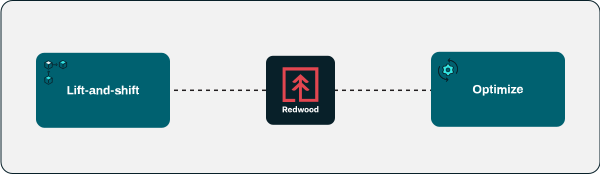
Lift-and-shift first, optimize later: Move jobs as-is to meet tight deadlines, with plans to modernize after go-live.
Modernize as you move: Take the opportunity to streamline architecture, remove redundancies and improve process logic as you migrate.
Most organizations fall somewhere in between, and that’s exactly why Redwood approaches migration by tailoring it to your environment, not a one-size-fits-all script.
Migration as momentum: Essential considerations
What kind of change are you driving? Are you simply replicating jobs or using this transition to streamline, modernize and reduce complexity?
How will you optimize the new platform? Are you planning for better performance and improved reliability from the start?
Is your automation strategy aligned with broader goals? Will the migration support larger initiatives like cloud adoption, tool consolidation or SAP transformation?
Who needs to be involved: Are departments, service providers or external teams part of the process, and are they looped in early?
Redwood evaluates your:
Source platform and job volume
Critical business processes and dependencies
Timeline flexibility and go-live constraints
Appetite for technical debt cleanup
This ensures we don’t just recreate your existing environment but deliver a better one.
Rather than thinking of migration as a one-time event, consider it the start of a smarter operating model. Redwood’s Professional Services team brings decades of experience helping enterprises like yours transition from legacy WLA platforms to our modern, cloud-native solution, RunMyJobs by Redwood. Here’s what that means for your business.
IT infrastructure savings
Migrating off legacy systems sooner lets you decommission outdated infrastructure, eliminate those redundant support contracts and reduce operational overhead. This is especially important if you’re heading toward hybrid or full cloud adoption.
Business process improvements
We don’t just move your jobs; we evaluate them. During migration, we help you identify inefficiencies, unnecessary handoffs and outdated dependencies. This is your chance to streamline.
Operational efficiencies
Redwood provides pre-built templates, connectors and industry best practices to fast-track implementation. These accelerators and our unique testing frameworks help you get to production faster.
The groundwork for long-term gains
One of the most overlooked benefits of a well-executed migration is how quickly you can begin realizing value, and not just from the software itself. Value comes from removing friction. Thus, you need a team with a track record of doing just that.
With Redwood, you begin seeing results almost immediately:
Noticeably stronger stability: Our migration process is designed to minimize disruption and deliver a stable production environment from day one. You don’t need weeks or months of post-migration troubleshooting to feel the benefits.
Improved visibility: Instead of toggling between tools and spreadsheets, you have a single source of truth for managing jobs enterprise-wide. Thus, fewer blind spots and better operational alignment.
Reduced manual effort: With intelligent automation and reusable templates, your teams spend less time on repetitive tasks and more time on process improvement.
Accelerated business outcomes: Faster financial closes, improved service availability … whatever you’re after, Redwood removes the bottlenecks and gets you there quickly.
Greater agility: Once you’re on a modern, cloud-native platform, you can scale, adapt and evolve your automation environment in lockstep with your business. Adding new systems or integrating third-party tools becomes significantly easier.
Modernize on your terms
Migrating to a new WLA solution involves much more than moving scripts or job chains. Your goal should be to enable a new level of orchestration across your enterprise. That’s why it pays to work with a partner who specializes in this exact domain.
Redwood’s Professional Services team is focused solely on successful automation implementations. We offer:
Proven methodologies for assessment, migration and rollout
Proprietary tools to streamline job mapping, testing and cutover
Flexibility to adjust your scope in real time
Risk mitigation with detailed validation and go-live readiness
Post-migration services to keep advancing your automation maturity
At Redwood, we don’t just bring technology. We also offer unmatched focus, tools and experience. Organizations across industries have trusted Redwood to help them leave behind legacy WLA platforms.
If you’re feeling the pressure of an expiring contract, a cloud deadline or a business that’s outgrown your current WLA solution, Redwood’s proven migration approach is here to move you forward with a clear vision.
Hear directly from Daniel Sivar, Technologist at American Water, about how Redwood guided the largest regulated water and wastewater utility company in the United States through “managed waves” to ensure a successful migration.
Imagine a brand-new, high-efficiency car. It’s got all the latest tech, promising to get you from point A to point B faster and more smoothly than ever.
Now, imagine you’re only using the basic functions — driving, accelerating, braking. You’re getting where you need to go, but you’re not using cruise control, lane assist or advanced navigation. That’s what it’s like when a team adopts a powerful automation platform without fully investing in training.
The car (the software) is fantastic, and it’s working, but there’s so much more it can do. A team of admins may have created basic automated tasks, transferred essential files and set up fundamental reports. But are they leveraging all the features that will help them achieve their goals? How much valuable time was spent setting up those rudimentary processes, and how often did they need to reach out to support or success teams to gain even minimal traction?
This is where a “learning champion” can shift things into high gear.
Learning champion: An individual who proactively seeks and shares software knowledge and best practices with their team, fostering a culture of continuous learning and improvement and driving increased productivity and efficiency
We’ll explore how becoming a learning champion boosts your individual productivity and career and amplifies that effect across your team and organization, especially if you’re in the process of adopting automation.
Taking control: Why become a learning champion?
According to the Customer Education Trends in 2025 report from Skilljar, the modern learner has been thrown into an “everything, everywhere, all at once” environment, consuming self-paced content, articles, documentation and live support on their own terms and at their own pace.
While the flexibility to find information in the format that makes sense to you and without waiting to be assigned a course can feel empowering, it also adds complexity. When you consider the number of people who must learn a given skillset or platform, you can understand the nth-degree potential for confusion or frustration — an undesirable and non-scalable state.
Individual ownership matters, especially when you’re adopting complex or evolving tools like automation platforms. A learning champion becomes a catalyst for team efficiency and organizational progress.
Elevate personal productivity
Proactive learners make fewer basic errors, reduce support tickets and implement automation faster. Plus, upskilling a team contributes to business agility. As BytePlus notes, “Employees with diverse, updated skills can adapt more quickly to technological and market changes.”
Quick tip: Gauge your starting point. How long does it take you to complete a process? How often are you asking for help? Once you complete training, measure again. You’ll see tangible signs of your growth, and so will others. Share these insights with your team and manager to make the case for upskilling.
Advance your career with certification
Becoming a learning champion isn’t just about helping your team; it’s a smart career move. Achieving certification, especially in complex automation software, validates your expertise and positions you as a subject matter expert. It signals to your organization (and future employers) that you’re not just using the tool but owning it.
Certifications in automation software demonstrate that you can do more than execute tasks: You can understand workflows, configure processes and lead others. For example, the Automation Developer Specialist Certification from Redwood University challenges your understanding of advanced functions, complex workflow automation and process scheduling best practices. Users with this certification leverage their deep knowledge of the software to drive transformation instead of just reacting to the tool.
The initiative can start during your onboarding: Learning champions don’t wait for permission to explore new things, and proactiveness is a quality your current leaders and future employers seek.
Quick tip: Ask about learning paths that align with your team and career goals, then dive in and get started. Share feedback with your immediate team on how the material helped you. Post your new credential on LinkedIn for wider reach.
Share what you learn
Knowledge is best when shared widely and in ways that are digestible. As Skilljar puts it, “Educators are curating, not just creating.” Software vendors can offer a full library of content (like what you’ll find in Redwood University), but it’s up to learners to enroll, complete lessons and share their knowledge.
Whether you’re forwarding helpful documentation, recommending training courses or showing a colleague how to fix a recurring issue, you become the go-to person. Don’t stop there. Your goal should be to elevate yourself AND others. A lone learning champion is a great start, but real efficiency comes when your whole team levels up.
Quick tip: Create a “Top 3 takeaways” list after every course you complete and email them to your team. Keep it light, useful and actionable.
The impact of software education on team productivity
A well-trained team is a fast team. When many users understand how to leverage automation software fully, you get better data, fewer bottlenecks and less reliance on external support.
In other words, you’re making the most of your investment.
According to TSIA, product adoption is a key business metric. Leaders expect returns on software purchases, and ongoing, quality training is how you get there.
The real power of education becomes clear when users go beyond the fundamentals of process automation. Too often, users are taught just enough to complete their tasks. But it’s essential to go deeper: to grasp why a process works the way it does, where automation eliminates inefficiencies and how to extend those benefits across other business processes.
This level of knowledge comes from hands-on experience — working through real use cases, experimenting in a safe environment and applying lessons immediately to daily work. If you discover a faster way to automate a handoff between departments, for example, you’re building consistency and making sure everyone is working from the same playbook.
Build a culture of curiosity
When one person steps up, others follow. A team that values education creates a ripple effect. Questions become learning moments, and continuous improvement becomes the norm.
That kind of culture pays off.
BytePlus emphasizes an SHRM stat: Replacing a single employee can cost up to 200% of their salary. Investing in learning reduces turnover and keeps your best people engaged and growing.
Bonus: Training builds loyalty. A team that learns together stays together.
User to influencer: How to lead the learning revolution
Whether you’re in leadership and setting up a flexible, comprehensive learning environment for your team or an individual looking to influence your peers, use the following steps to influence other automation software users.
Blaze the trail: Ask your vendor what training they offer and which courses fit your role. Choose the format that works best for you — live, self-paced, etc.
Elevate your team: Recommend key features or tricks your team can use today and encourage them to explore help centers, learning academies and documentation.
Look outward: In many enterprises, different teams use different tools for similar goals. Your experiences can help standardize education, in turn consolidating spend and scaling success.
Share your team’s gains: Are you submitting fewer support tickets? Are processes faster? Are you automating more? Compare your pre-training and post-training metrics.
Be the spark
Investing time in learning pays off at every level, from your own growth to company-wide productivity.
You gain:
The confidence to navigate the software
Mastery of tools that drive automation
Speed and accuracy in your day-to-day work
Recognition as a subject matter expert
Momentum to shape your career path
Your organization gains:
Stronger product adoption rates
Greater ROI
A lesser need for IT intervention and manual workarounds
Faster onboarding for new team members
Reduced turnover due to better engagement and support for each role
Become a learning champion for your team’s Redwood Software products by utilizing Redwood University. It’s free and open to all customers and partners. Sign up today.
A cross-functional team of researchers has spent months developing a next-generation machine learning (ML) model designed to predict how a new compound behaves across multiple biological targets. It’s the kind of computational power that can accelerate drug discovery by weeks or months and bring life-saving therapies to market faster.
Despite an optimized IT infrastructure and cloud environment, the simulation doesn’t start because the latest compound batch data hasn’t been validated in SAP. The experiment metadata is still siloed in spreadsheets, and the model can’t ingest incomplete or inconsistent values. In other words, the fluid connection required between systems isn’t there.
As you may well know if you work in this industry, this isn’t a hypothetical delay. Data readiness can’t be treated as a side task, although it too often is. In which case, it doesn’t matter how advanced an AI model you have. With regulatory pressures high, the cost of a subtle misalignment is steep.
Because this applies whether you’re simulating compounds, ensuring patient records are anonymized and audit-ready or forecasting inventory, critical processes break down when data stays disconnected. Leading healthcare and pharmaceutical organizations are attempting to solve this common problem by rethinking how data moves from SAP to ML platforms to analytics and back.
Life science’s parallel pipelines: Innovation and execution
In life sciences organizations like yours, innovation happens on two fronts. On one side, your R&D teams use AI and massive datasets to accelerate discovery. ML models in AWS SageMaker or Schrödinger Suite predict promising compound structures, while simulation platforms test toxicity and efficacy before running a single experiment.
On the other side, your clinical and supply chain teams ensure those discoveries reach patients safely and cost-effectively while following all compliance regulations. They manage everything from patient enrollment to cold chain logistics to regulatory filing, with each process powered by SAP supply chain and life sciences solutions and custom platforms.
These processes live in very different domains, but they share a common dependency: structured, timely, accurate data. And in too many organizations, that data still moves manually or asynchronously between systems.
Where the cracks appear
When SAP data isn’t orchestrated, critical handoffs break down and molecular data must be manually pulled from SAP R&D Management to feed AI pipelines. Trial operations build forecasts on outdated enrollment data. Lab results live in one system and regulatory documentation in another, with no feedback loop. Business users wait on IT to reconcile siloed datasets and generate reports.
Drug discovery is increasingly computational, but that doesn’t mean the work is fully automated. Whether you’re managing experiments or kits, the pain is the same: unreliable flow, lost time and elevated risk. Without intelligent orchestration, pipelines either fall apart or deliver fragmented, stale information. This directly undermines the performance of AI models and introduces bias or neglects to provide key correlations. Essentially, you end up making decisions with outdated datasets — or worse, hallucinations. Predictive models built to accelerate discovery or optimize trial logistics can quickly fall out of compliance with data lineage and validation requirements.
Meanwhile, if you cling to these fragmented or manually stitched data pipelines, you face another growing disadvantage: You can’t match the speed of your competitors. Those who are investing in intelligent, adaptive data orchestration are moving faster while proving the trustworthiness of their AI-driven insights.
High-fidelity orchestration is the foundation of competitive agility and relevance in your industry.
Research, meet orchestration
Orchestration is what makes AI scale in R&D. Your SAP environment becomes the launchpad for faster, smarter research, enabling you to:
Continuously extract experimental and batch data from SAP R&D Management and SAP Analytics Cloud
Send compound specs to AWS SageMaker or Schrödinger Suite for modeling
Coordinate modeling jobs and return results to Databricks for consolidation
Push insight summaries about ranked candiddates back into SAP
Trigger alerts for research leads of successful outcomes or red flags and send validated results to SAP Datasphere
Clinical delivery, intelligently aligned
On the delivery side, timing is everything. Clinical trial operations depend on up-to-date patient enrollment data, trial protocols and inventory levels across distributed trial sites. If systems aren’t aligned, sites risk running out of supplies or holding expired stock.
With proper orchestration:
Enrollment data from SAP Intelligent Clinical Supply Management flows into forecasting tools
ML models in Azure ML or Databricks predict site-specific demand
Stock levels in SAP Integrated Business Planning (IBP) or S/4HANA Materials Management (MM) are cross-checked automatically
If risk is flagged, replenishment is triggered and stakeholders are notified
Trial performance metrics update automatically in SAP Analytics Cloud
All data is centralized in SAP Business Data Cloud (BDC) for regulatory compliance and real-time insight
Data-driven defense against disruption
When the unexpected hits, data orchestration is the difference between rerouting and reacting.
Take supply chain disruptions, which are a matter of when, not if, in pharma. A shortage of active ingredients, a vendor backlog, a shipping delay — any of these can jeopardize production schedules or trial timelines.
The real risk isn’t the event itself but what happens when your systems can’t respond in time. With orchestrated data pipelines between SAP S/4HANA, SAP IBP and platforms like Databricks or Azure Synapse, you can spot shortages early, simulate impacts and initiate contingency plans.
A research-to-treatment automation fabric
True transformation comes when discovery and delivery are both orchestrated from end to end. Here’s what a real automation fabric looks like.
Forecasting clinical and manufacturing needs
Export enrollment or order data from SAP S/4HANA
Clean and enrich using SAP Datasphere
Run predictive models via Databricks, Azure ML or SageMaker
Feed outputs into SAP IBP for dynamic planning
Managing research and validation
Extract compound data from SAP R&D Management
Coordinate modeling jobs in Schrödinger Suite
Score and validate candidates in Databricks
Trigger SAP updates and notify research teams automatically
Controlling inventory and site logistics
Pull inventory positions from S/4HANA
Reconcile with forecasted site needs from SAP IBP and ML pipelines
Generate and dispatch replenishment orders
Publish everything in SAP Analytics Cloud for transparency
Keeping teams informed and aligned
Push alerts to supply, clinical or research leads based on process outcomes
Route structured datasets to reporting dashboards and compliance archives
Automate audit trails, approvals and next-step triggers
With every step validated, timestamped and secure thanks to RunMyJobs by Redwood, your data flows continuously, allowing you to be proactive instead of reactive.
Audit-ready AI depends on orchestrated data
The rise of AI in life sciences is helping to optimize molecule screening and clinical trial site selection and even personalize patient communications. With that power comes increasing scrutiny.
Regulators are watching closely. Health authorities in the United States, European Union and beyond are issuing new guidelines around AI in clinical decision-making, digital therapeutics and research applications. They want to know: Where did the data come from? Was it anonymized? Who validated it? And can you prove it?
If your data pipelines are fragmented, those answers may simply not exist. But orchestration changes that. When you automate your data moving from SAP modules to Azure ML or from SAP Datasphere to regulatory systems, you also create a system of record. Every dataset has a timestamp, and every transformation is traceable. This strategically enables AI innovation.
The next wave of advancement will hinge on more than modeling accuracy; you’ll need to be able to explain how your model was built or prove the integrity of the data behind it. With the right orchestration solution, you don’t have to choose between speed and control. You can stay audit-ready and future-ready.
Develop a resilient nervous system
Think of your systems like organs. Each one serves a distinct purpose, but they communicate via signals that travel through connective tissue. These signals are orchestration in action!
Want to know more about orchestrating SAP data with RunMyJobs? Read more about using the SAP Analytics Cloud connector.