IKEA’s new Matter-over-Thread devices work natively with SmartThings, expanding Matter offerings for one of the largest open smart home ecosystem At CES 2026, SmartThings announced that IKEA’s new lineup of Matter-over-Thread smart home products now work out of the box with the platform. SmartThings’ industry-leading Matter support gives both beginner and experienced users confidence that […]
As the first smart home ecosystem to support Matter 1.5 compatible cameras, SmartThings is partnering with Aqara, Eve and Xthings, to bring users comprehensive security and safety monitoring features. SmartThings, Samsung’s AI Home platform, is the first global smart home platform to support Matter-compatible cameras as a fully supported device category, enabling users access to […]
When orchestration works, no one talks about it. Files are arriving and systems are updating without anyone thinking twice. But what feels seamless to business users is often a result of carefully coordinated automation across dozens of tools and environments. Some are scheduled, some are reactive and many are barely documented.
Few organizations achieve that kind of orchestration consistently, because their automation is fragmented. One team might manage batch jobs, and another might script data pipelines. A third could rely on manual interventions and shared inboxes to keep business processes moving.
The value of a Service Orchestration and Automation Platform (SOAP) lies in its ability to unify these silos and support the workflows that actually run the business. In its 2025 Critical Capabilities for SOAPs report, Gartner® outlines five Use Cases that demonstrate this value in action. Here’s how, in my interpretation, those capabilities show up in real operations across industries.
IT workload automation: Still essential
No matter how much technology evolves, the reliance on routine workloads never really goes away. Nightly ERP updates, hourly job chains and critical data movements between systems are fundamental processes that keep your business running.
But those workloads aren’t confined to a single mainframe or on-premises scheduler anymore. They span hybrid environments, connect to cloud-based APIs and carry tighter service-level agreement (SLA) expectations than ever before. The hard part isn’t the workload itself but the web of dependencies and recovery paths that stretch across different systems.
A robust SOAP solution lets you orchestrate all these elements in one place: SAP jobs, custom scripts, data movements and file transfers, for instance. You gain centralized control with distributed execution — the perfect balance for hybrid IT environments. I feel Gartner points to this as a foundational Use Case because it tests how well a platform performs under enterprise pressure — securely, reliably and with minimal manual intervention.
What this unlocks: With dependable workload automation, your IT teams can start each day with confidence that core batch processes ran cleanly and dependencies resolved in the right order. Not to mention, any failures were isolated and didn’t cause unwanted ripple effects. Your operational tone can shift from checking for surprises to reviewing a clean audit trail and planning ahead.
Workflow orchestration: Running the business, not just jobs
Behind every business outcome is a complex chain of tasks, approvals and exceptions that span multiple systems and departments. Take the month-end financial close: it happens thanks to finance systems, spreadsheets, validations and cross-departmental collaboration. Or consider onboarding a new hire. Beyond provisioning accounts, it requires scheduling training, initiating background checks and activating access across multiple systems.
With a SOAP platform, these workflows can be orchestrated end to end. Instead of managing each step separately, you create a unified process that flows across boundaries. You get steadier execution and cleaner handoffs, which cuts down on the small errors that tend to compound over time.
It seems Gartner emphasizes this Use Case as a marker of maturity: it’s not about more automation, but using the right automation to move the business forward. By linking actions into cohesive workflows with decision points and exception handling, you transform fragmented activities into streamlined business processes.
What this unlocks: If your workflows run end to end, you’ll feel the difference immediately. Approvals and handoffs will happen without manual nudges, and any exceptions will surface early. The work is to oversee processes instead of managing dozens of micro tasks.
Data orchestration: Automating movement and storage
Analytics live or die on the reliability of the pipeline behind the dashboard. At 3 AM, your retail data might need to move from SAP to Snowflake, be validated, then trigger an update to executive dashboards before the morning meeting. That kind of flow can’t rely on spreadsheets, email notifications or ad hoc scripts — it requires systematic orchestration.
SOAPs plug into managed file transfer (MFT) solutions, ETL tools and data lakes to manage the full lifecycle of data movement: ingestion, transformation, validation and delivery. You can build flows that validate data quality, handle exceptions and ensure downstream systems receive accurate, timely information.
I believe Gartner calls out data orchestration because the stakes are high. Poor data hygiene slows decisions, introduces risk and devalues analytics investments. With proper orchestration, your data pipeline becomes a strategic asset rather than a constant challenge.
What this unlocks:Reliable data flows remove the daily uncertainty that slows decision-making. Your analysts don’t have to wonder whether today’s numbers are safe to use. And by the time business users open a dashboard, the underlying pipeline has already done the hard work.
DevOps: Coordinating pipelines across teams
It’s relatively easy to automate a deployment, but it’s much harder to orchestrate everything that comes before and after. When your infrastructure team needs to provision environments, QA needs to run tests and compliance needs to log every step, a simple webhook or CI/CD pipeline isn’t sufficient.
SOAPs can coordinate across your entire development lifecycle, trigger event-based actions and integrate with ITSM and monitoring tools. This coordination is especially valuable when different teams use different tools but need to work together seamlessly.
In my view, Gartner includes this as a distinct Use Case because orchestration here is a force multiplier: it aligns developers, operations and compliance without slowing velocity. By automating handoffs between teams and tools, you reduce waiting time, eliminate manual coordination and maintain an audit trail of all activities.
What this unlocks: Orchestration that supports the DevOps lifecycle ensures your release cadence reflects your engineering velocity. Your dev team doesn’t have to worry whether upstream tasks are complete, and your operations team gets predictable workflows they can trust.
Citizen automation: Putting control in the right hands
Not every routine workflow warrants an IT ticket. An HR manager initiating onboarding or a supply chain planner adjusting inventory levels need their workflows to be accessible without sacrificing governance. As your organization scales, the ability to distribute automation capabilities becomes crucial.
SOAPs support low-code interaction, reusable templates and full audit trails. Users get what they need when they need it, and IT maintains oversight of the entire automation ecosystem. Gartner likely highlights this Use Case because it balances empowerment and control: you reduce shadow IT while still enabling business agility.
What this unlocks:Governed self-service changes how work gets done. You can move faster without losing control because every action runs through the same orchestrated backbone with full visibility.
Your SOAP unifies it all
Every Use Case in the Gartner report points back to a simple truth: orchestration is how you scale automation without multiplying complexity. The best SOAP platforms make that orchestration real across jobs, data, workflows and teams, providing the connective tissue that binds your digital ecosystem together.
As you evaluate your options, look for platforms that support all five Use Cases with equal strength. Your business doesn’t operate in silos, and your orchestration platform shouldn’t either. The right solution will grow with your needs, adapt to new technologies and continuously deliver value as your organization evolves.
RunMyJobs by Redwood offers comprehensive, enterprise-wide orchestration, with deep integration into SAP environments and support for hybrid cloud architectures. Download the full Critical Capabilities report to see an extended analysis of the Gartner Magic Quadrant™ and learn why Redwood was recognized as a SOAP Leader two years in a row.
As 2025 comes to a close, we would like to take a moment to express our sincere gratitude to you, our Redwood Software customers, for your incredible support this year. Your dedication is the driving force behind Redwood, and together, we have achieved remarkable milestones.
This year, we have proudly welcomed over 100 new customers to Redwood. Our partnerships span the globe, as we collectively now serve over 7,600 customers in more than 150 countries. This growth highlights how organizations are embracing true end-to-end automation, and we believe the success our customers have achieved has played a significant part in this growth.
We’re inspired by the commitment our customers show in helping others realize the power of full stack automation. Filled with numerous speaking engagements, webinars and insightful conversations that made our shared vision a worldwide reality, this year has been exceptional.
Let’s take a look back at some of the most memorable moments of 2025.
Center stage: Event speakers
Sharing your success stories at major industry events provides invaluable, authentic insight. The customer sessions this year detailing the real-world business impact achieved with Redwood were truly inspiring.
Eugene Water & Electric Board
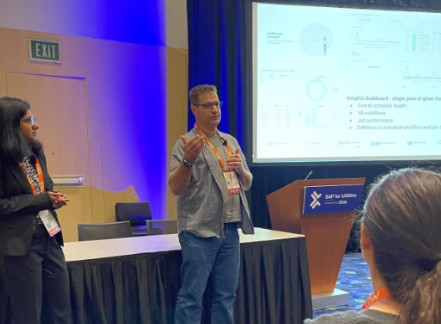
At the SAP for Utilities event in Denver, Leif Utterstrom and Prita Mani from Eugene Water & Electric Board (EWEB) detailed how RunMyJobs is enabling autonomous execution of complex processes like meter-to-cash while strengthening their core operations. They explained how they transformed resource-intensive work into faster execution and better business outcomes.
Leif and Prita described RunMyJobs’ impact on their meter-to-cash process.
RS Group
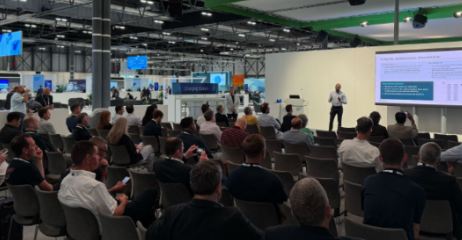
Dharmesh Patel spoke at SAP Sapphire Madrid about how RS Group now manages over one million global customers using RunMyJobs by Redwood for supply chain optimization on SAP via Amazon Web Services (AWS). The company runs approximately 150,000 executions per day to cater to its key SAP business processes.
The packed house was captivated by Dharmesh’s success story.
Schneider Electric
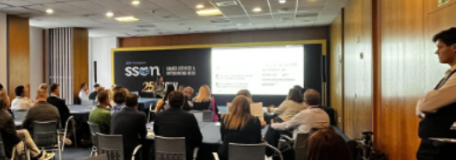
Schneider Electric showed us how to reshape the financial close and what an 80% reduction in manual effort looks like. Stefano Oliveri hosted a workshop at Shared Services and Outsourcing Week (SSOW) Europe, where he shared how the company moved from fragmented record-to-report (R2R) processes to integrated automation strategies. With Finance Automation by Redwood at the center, they saw 86% faster close tasks and increased compliance without increasing workload.
Redwood customers brought their expertise straight to the community this year through enlightening webinars and user group sessions. The major takeaway for 2025? It’s all about cost reduction and shifting focus from manual tasks to high-value strategy.
Sabari Swaminathan of Energy Transfer detailed how Finance Automation saved their accountants 45,000 hours annually, freeing them up for strategic analysis instead of time-consuming data entry. Watch the on-demand webinar here.
In a similar vein, Mary Shiena Johnson from Siemens Global Business Services showed exactly how Finance Automation cuts labor costs and accelerates the R2R close, proving the tangible financial impact for Siemens.
Our user groups were filled with practical insights from the true experts — the people using Redwood products every day. We saw great contributions from Srikanth Nellutla (CONA Services), Srinivas Udata (Corebridge Financial) and Sumit Sinha (HHS Technology Group) at the RunMyJobs and JSCAPE by Redwood sessions, helping the community learn best practices and accelerate their own automation journeys.
Don’t miss out on this collective wisdom — learn more about joining a user group.
A special thanks to our most engaged advocates
While every advocate’s effort makes a difference, we want to give a special nod to those who participated in an exceptional number of activities this year.
🏆Top advocates of 2025
Charles Sheefel from International Paper: Charles was deeply engaged this year, participating in multiple Customer Advisory Board meetings, speaking at our global kick-off and offering his insight in numerous conversations with customers and industry experts alike. Thank you!
Daniel Sivar from American Water Works: Daniel engaged in Customer Advisory Board meetings, spoke on the panel at our global kick-off, recorded a video testimonial and even took last-minute reference calls. We can’t thank you enough for the time and effort you’ve put in, thank you!
Darrin Ward from Energizer: Darrin has graciously lent his time and expertise for multiple reference calls and industry analyst conversations, plus internal feedback meetings that will help shape the future of Redwood. Thank you!
We are so grateful to all of our advocates for sharing their expertise and automation journeys this year. A heartfelt thank-you to all!
Join the movement in 2026
Your incredible efforts directly help other organizations see how Redwood’s automation fabric solutions can empower them to orchestrate, manage and monitor their mission-critical workflows.
We’re already planning for 2026, and we want you to be a part of it. Whether it’s in the form of a brief reference call, a quick case study interview or speaking on stage, every contribution makes a difference. Interested in sharing your Redwood success in 2026?
Siloed point solutions are just patching the cracks. It’s time for a platform-first strategy.
Your finance and accounting SaaS tools were supposed to make finance more efficient. Instead, they’ve created complexity, disconnected workflows and competing systems that are time-consuming and don’t talk to each other. You may have adopted reconciliation, journal entry and intercompany software, but none of them address the full scope of end-to-end automation. Instead, they create the need for additional automation tools and more manual effort.
It’s time to rethink the patchwork. Learn how a platform-first strategy solution like Finance Automation by Redwood offers something different: true automation that executes your accounting and finance functions, not just tracks them.
The trap of fixing problems one tool at a time
You likely didn’t set out to build a fragmented tech stack. But when you look at your finance automation tools today, do you see a streamlined process or a collection of isolated fixes?
This happens when teams search for a solution for a problem, not a solution to the problem. You need to automate account reconciliations, so you buy a tool. Then you add another tool or module for journal entries and additional automation tools for the unaddressed manual effort. It’s logical in the moment — but over time, it creates silos.
Instead of simplifying your financial close, this approach leads to disconnected systems, inconsistent validation and more complicated audits that require constant oversight.
According to the 2025 SSON R2R automation playbook, 76% of finance leaders say automation is critical to transformation, yet only 33% have strong executive support to scale it. The results? Projects stall. ROI suffers. And finance ends up stuck in a loop of disconnected tools that never quite deliver.
It’s a familiar pattern where good intentions lead to a pile of shelfware, disconnected workflows and a finance tech stack that resembles more of a SaaS graveyard than a unified strategy.
The SaaS graveyard: When financial point tools create more problems than they solve
Most SaaS tools promise to eliminate manual work. In reality, many just shift the burden elsewhere and require you to manage handoffs between them. You might use one system for reconciliations, another to validate journals and a third to execute SAP closing tasks. But without orchestration, you’re the one bridging the gaps.
SSON’s research highlights the disconnect: 81% of finance leaders believe journal entries are highly automatable, yet just 54% have made progress. Even more telling is that only 13% are satisfied with the ROI of their financial automation solutions.
So, what’s missing? Many of these tools were built for compliance, not execution. They track approvals or store documentation but don’t handle the actual work. They weren’t designed for seamless integration or built to automate end-to-end processes across the close. That’s what sets Finance Automation apart. The platform executes tasks inside your SAP systems and minimizes your reliance on separate systems to enable faster, more accurate decision-making and capacity release to support your business needs.
When tools don’t talk to each other, finance loses visibility
Each tool introduces a new data model, interface and set of permissions. You might reconcile account balances in one system, prepare reports in another and track their status in a standalone checklist. Meanwhile, your SAP contains the truth, but your dashboards aren’t in sync.
Disconnected tools create data silos and force your accounting and finance teams to align information manually across systems. This delays reporting, increases risk and undermines confidence in your numbers.
Finance Automation eliminates this fragmentation by embedding execution and validation inside your accounting and finance systems to provide a consistent, audit-ready view of every close task and its current status.
The longer you try to squeeze more value out of disconnected tools, the deeper your organization sinks into its own SaaS graveyard.
The costs you didn’t budget for
Task-level point solutions may seem cost-effective, but their hidden costs add up fast:
Building and maintaining custom integrations
Continuous onboarding and training across platforms
Delays in processing time and misaligned dependencies
Duplicate effort from manual data entry and rework
Inconsistent data and risk exposure across disconnected systems
SSON’s 2025 data confirms it. 88% of organizations report moderate or lower satisfaction with their automation ROI. Fragmented tools are a major reason why. However, Finance Automation avoids this spiral by offering a scalable automation model — no per-user fees and no per-task charges — just unified, coordinated execution across your accounting and financial processes.
What a platform-first strategy really looks like
A true automation platform doesn’t just plug gaps. It optimizes how you run finance. Finance Automation unifies fragmented business processes across your people, processes and technology, encompassing the entire record-to-report (R2R) process, into one connected solution.
Here’s what that looks like in real time:
Configurable controls to support multi-entity, multi-region finance teams
Coordinated, rules-based workflows that link one step to the next
Live views that show current status, bottlenecks and ownership
Native SAP execution
One shared data model for financial operations, tasks and compliance records
Instead of managing work, Finance Automation completes it. Instead of tracking outcomes, it delivers them.
Move from tactical fixes to strategic execution
Some accounting and finance teams confuse adoption with impact. If your automation is still dependent on people to push it forward by having them launch jobs, confirm steps and update dashboards, you’re still running the process manually. You’ve just added more interfaces.
Finance Automation takes a different approach. It removes manual intervention by design. The platform handles execution in SAP, tracks validation and results automatically and empowers your team to focus on what matters: analysis, strategy and making faster, smarter strategic decisions.
Instead of plugging gaps with more tools, Finance Automation helps you orchestrate your tech stack across people and processes to streamline your R2R operations with consistency and clarity.
Ready to push beyond the SaaS graveyard?
If your tech stack is full of disconnected financial and accounting software and your results still depend on manual processes, it’s time for a new approach. Finance Automation’s platform-first strategy gives you the execution power and scalability that task-level point tools can’t.
Instead of reacting to inefficiencies, you can start removing them. Instead of working around delays, you can eliminate them. And instead of managing a graveyard of SaaS, you can finally build the foundation for modern, connected finance.
Curious what your tech stack is really costing you? Explore the ROI of an end-to-end finance automation platform built to scale.