In healthcare, every second counts. From electronic health records (EHR) to patient portals and claims processing systems, secure digital communication is the backbone of delivering care and protecting sensitive patient information. That security relies on SSL/TLS certificates—and the rules governing them are about to change in a big way.
The CA/Browser Forum has approved a timeline to shorten SSL/TLS certificate validity to just 47 days by 2029, with the first reduction to 200 days starting in March 2026. For healthcare providers already struggling with certificate sprawl, outages, and manual renewals, this shift could multiply today’s problems sevenfold.
PacificSource, a not-for-profit health insurance provider in the Pacific Northwest of the United States, faced exactly these challenges—and their journey shows why preparing now is critical.
The Challenges of Manual Certificate Management
PacificSource’s IT team was stuck in a manual cycle:
No centralized visibility into certificates across the environment
Expirations tracked in personal calendars, leading to 3–4 outages a month
No standardized issuance process, creating orphaned and undocumented certificates
Certificate deployments that consumed entire workdays
In healthcare, outages are more than just an inconvenience—they disrupt patient access and create compliance risks. PacificSource realized that manual, ad-hoc certificate management was no longer sustainable.
Transforming Certificate Lifecycle Management with Automation
To move from firefighting to future-proofing, PacificSource adopted AppViewX AVX ONE CLM, an automated certificate lifecycle management platform. With end-to-end automation, centralized inventory, and policy enforcement, AVX ONE CLM transformed certificate management from a reactive burden into a proactive strength.
Since using AVX ONE CLM, the PacificSource team has already reported:
Complete visibility into all certificates across their infrastructure
End-to-end automation of renewals, issuance, and deployments
Zero certificate-related outages (down from multiple to zero per month)
Certificate deployment time cut from a full day to just 15 minutes
97% reduction in effort spent on certificate management
Full audit readiness and compliance reporting
As certificate lifespans shrink, AVX ONE CLM ensures that renewals happen automatically, at scale, eliminating the risk of missed expirations and downtime.
How PacificSource Transformed Certificate Management with AppViewX
If yearly certificate renewals were a struggle, imagine doing it every 47 days. For an organization with 1,500 public and private trust certificates, that means going from 1,500 renewals per year to nearly 18,000 under the 47-day TLS mandate.
PacificSource’s decision to automate with AppViewX AVX ONE CLM didn’t just solve their immediate problems—it positioned them to thrive as certificate lifespans shrink. With policy-driven automation and centralized visibility, the IT team can handle short-lived certificates at scale without disruption, downtime, or compliance risk.
Future-Proofing Digital Trust in Healthcare
The move to 47-day TLS certificates is inevitable. The only question for all organizations across all industries is whether they will be ready. PacificSource’s journey demonstrates the value of acting early— replacing manual work with automation, eliminating outages, and building resilience into their security operations.
Download the full PacificSource case study to see how they transformed certificate management and prepared for the future of short-lived certificates with AppViewX AVX ONE CLM.
I believe these #1 rankings are a powerful validation of our product strategy and investments. In our opinion, they reflect our singular focus on building automation fabrics that deliver transformative results for our customers, no matter the challenge.
Redwood’s recognition in the Gartner Critical Capabilities report
“As an essential companion to the Gartner Magic Quadrant, this methodology provides deeper insight into providers’ product and service offerings by extending the Magic Quadrant analysis. Use this research to further investigate product and service ratings based on key capabilities set to important, differentiating use cases.”*
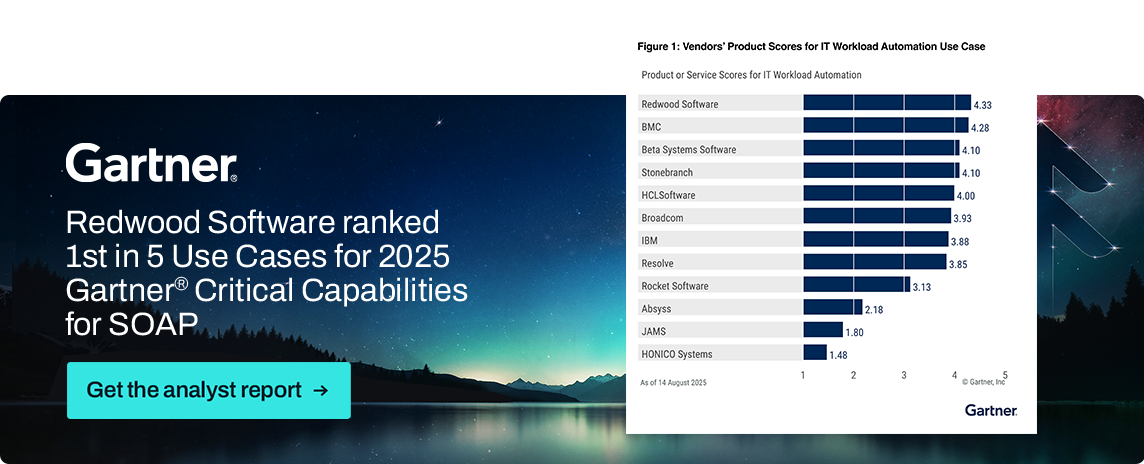
The Critical Capabilities research includes rankings for Use Cases: IT Workload Automation, IT Workflow Orchestration, Data Orchestration, Citizen Automation and DevOps Automation.
Redwood ranked first in five out of five Use Cases.
IT workload automation
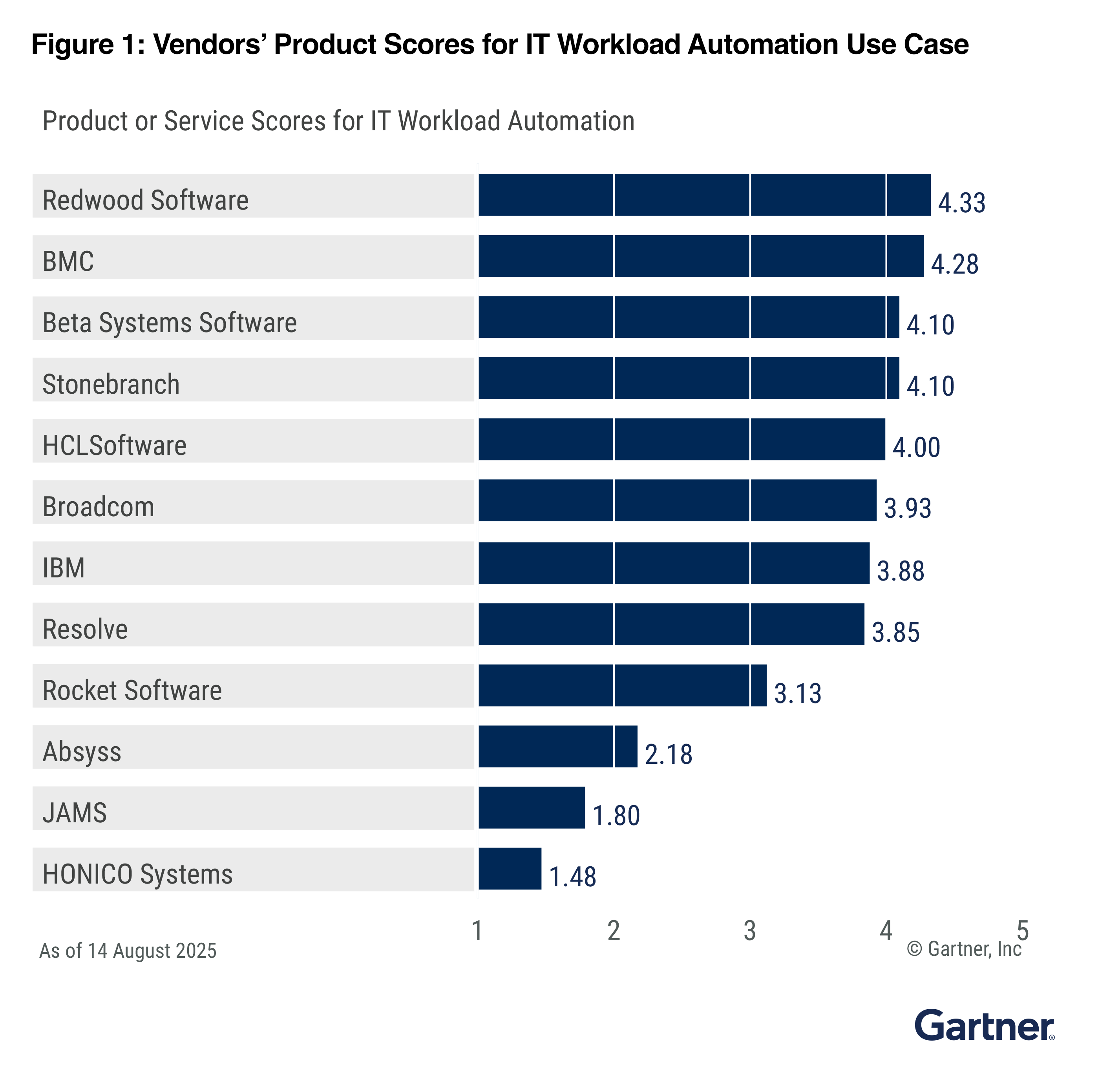
For the second year in a row, Redwood received the highest score in this Use Case: 4.33 out of 5.
Gartner defines IT workload automation (IT operations persona) as follows: “Automating planning, execution, management and reporting of IT workloads across enterprise systems.”
We believe this ranking reflects the broad power of our composable automation platform to integrate and manage diverse technologies across the hybrid enterprise. Available as native SaaS for the lowest total cost of ownership (TCO) or self-hosted on-premises or in the cloud, Redwood’s flagship workload automation platform delivers the deployment flexibility enterprise customers require. Extensive auditing capabilities, an expansive connector catalog and comprehensive APIs ensure unmatched reliability and business continuity for even the most complex workloads.
IT workflow orchestration
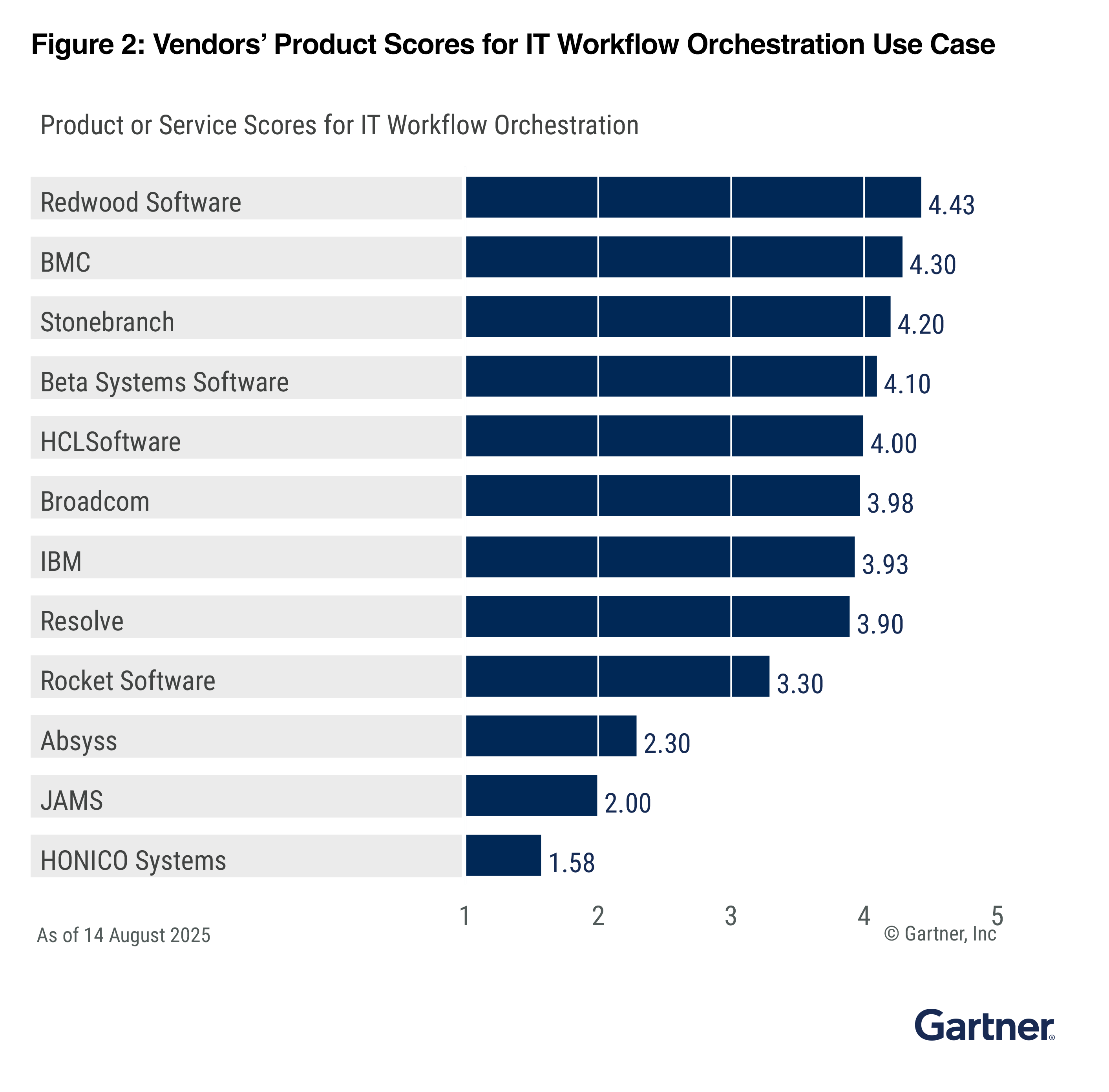
For the second year in a row, Redwood received the highest score in this Use Case: 4.43 out of 5.
Gartner defines IT workflow orchestration (IT operations persona) as follows: “Defining, executing and reporting on IT workflows across diverse IT and enterprise systems.”
We feel this score highlights our strength in orchestrating intricate dependencies across disparate systems. Redwood’s extensive library of pre-built certified connectors eliminates custom scripting, enabling users to visually build and manage complex, end-to-end workflows while centralizing control and visibility. This is further enhanced by the advanced monitoring and observability capabilities: a unified view of process health and performance with built-in AI troubleshooting. Extending this functionality via Redwood Insights, teams can view their entire orchestration ecosystem, from performance to configuration, to diagnose root causes, optimize workflows and track compliance. The result: seamless service delivery and optimal operational control.
Data orchestration
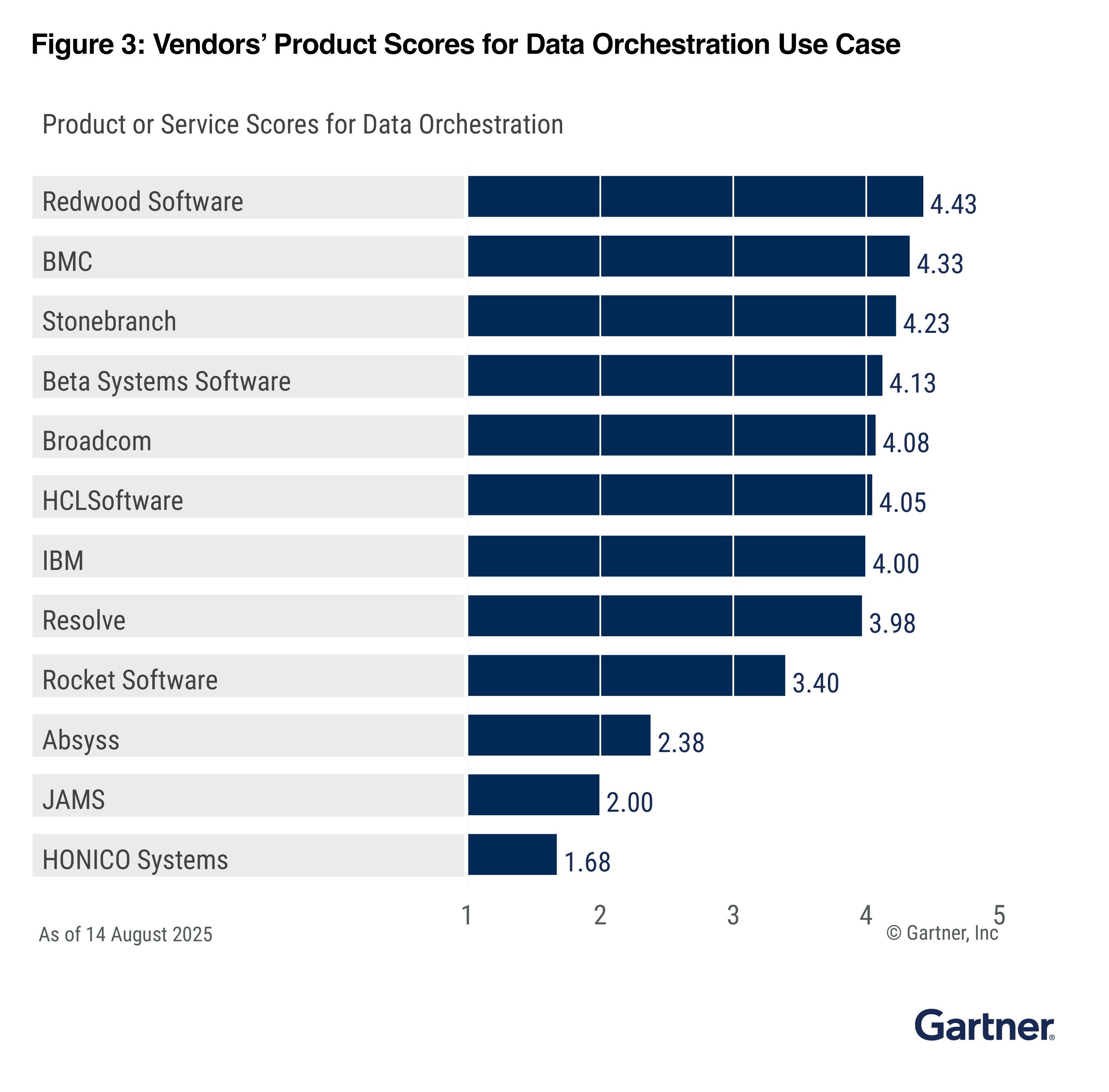
Redwood received the highest score in this Use Case: 4.43 out of 5.
Gartner defines data orchestration (DataOps persona) as follows: “Planning, executing, managing and reporting on data-focused workloads like ETL/ELT and reporting for data use cases.”
We believe our #1 score in this Use Case demonstrates the power of Redwood solutions to unify and manage complex data pipelines from ingestion to reporting. Redwood provides the flexibility to connect to any data source or application and gives DataOps teams the end-to-end visibility required to ensure effective data management and that key information is timely, accurate and readily available for the business.
Citizen automation
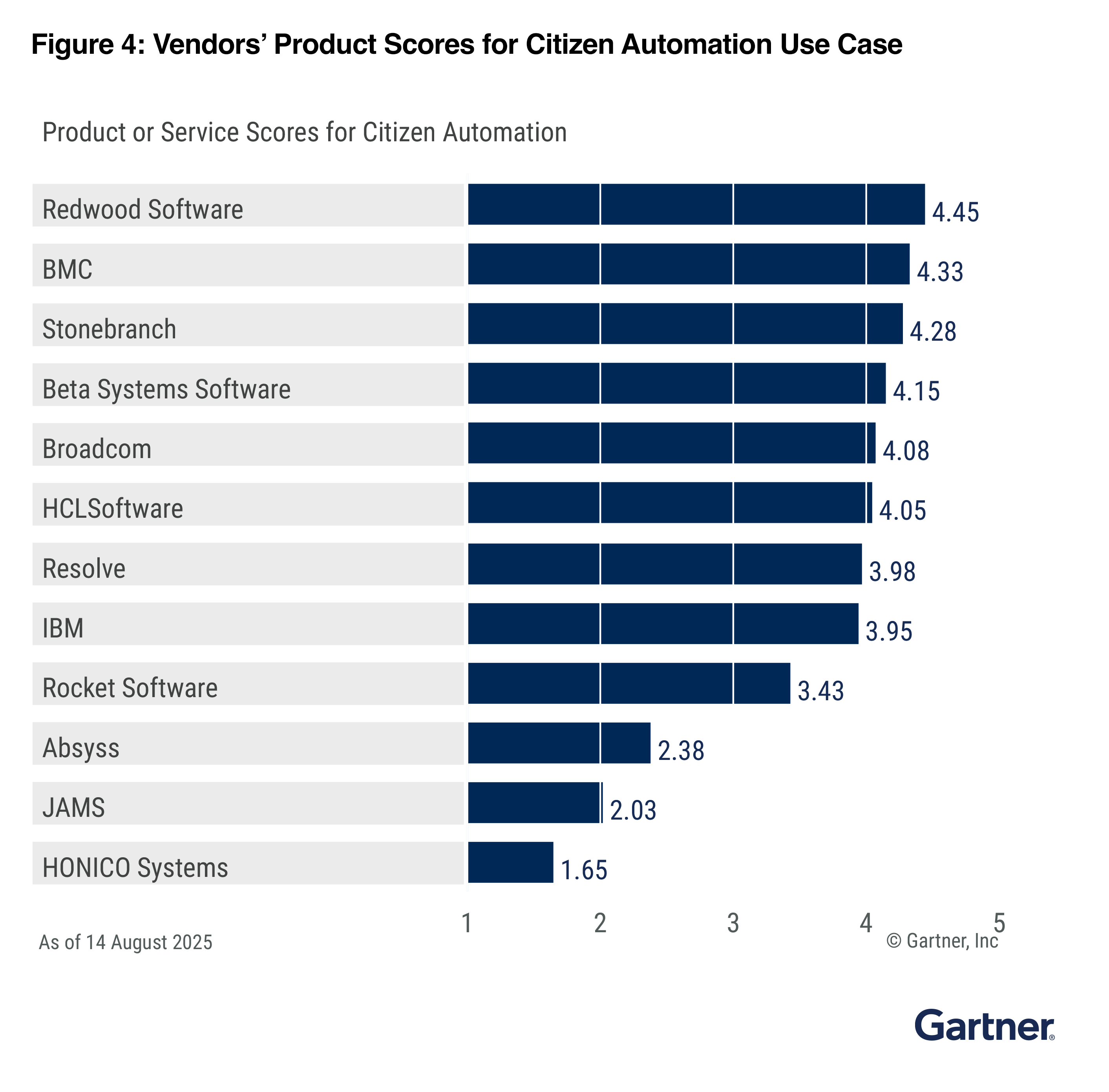
For the second year in a row, Redwood received the highest score in this Use Case: 4.45 out of 5.
Gartner defines citizen automation (business user persona) as follows: “Enabling end-users to develop and execute curated automations under IT governance.”
We feel this score represents Redwood’s commitment to empowering business teams and subject-matter experts to create and manage their own automation solutions safely. Our customizable and intuitive user interface includes a visual, low-code automation design studio, which allows teams to abstract away complexity, while centralized IT governance ensures every user-built automation is secure and reliable. To further accelerate this process, Redwood’s new AI assistant provides instant, context-aware guidance, allowing users to find answers and build processes faster than ever.
DevOps automation
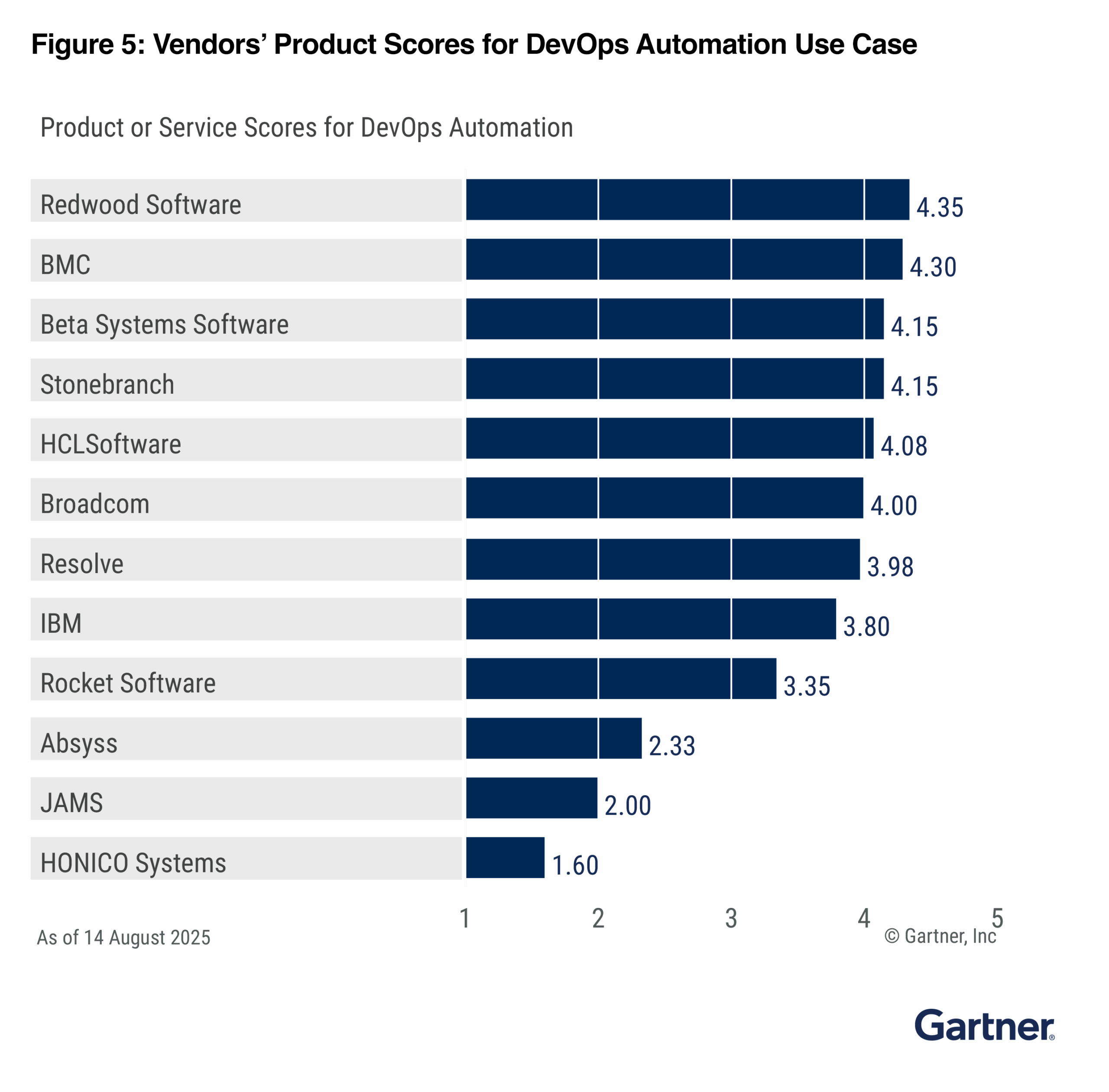
Redwood received the highest score in this Use Case: 4.35 out of 5.
Gartner defines DevOps automation (DevOps/SRE persona) as follows: “Developing and testing automation workflows to support product delivery via DevOps tools and practices.”
We believe this recognition highlights how seamlessly Redwood integrates into the software development lifecycle (SDLC). DevOps teams can define, version, test and promote automation workflows just like any other application code, accelerating release cycles and improving collaboration between development and operations.
Boost your digital transformation strategy: Get your copy of the full analyst report here to empower your decision-making process. Demo our suite of workload automation, file transfer and finance automation solutions to start unleashing the human potential in your organization.
Gartner, Inc. Magic Quadrant for Service Orchestration and Automation Platforms. Hassan Ennaciri, Daniel Betts, Cameron Haight, Chris Saunderson, etl. 26 Aug 2025.
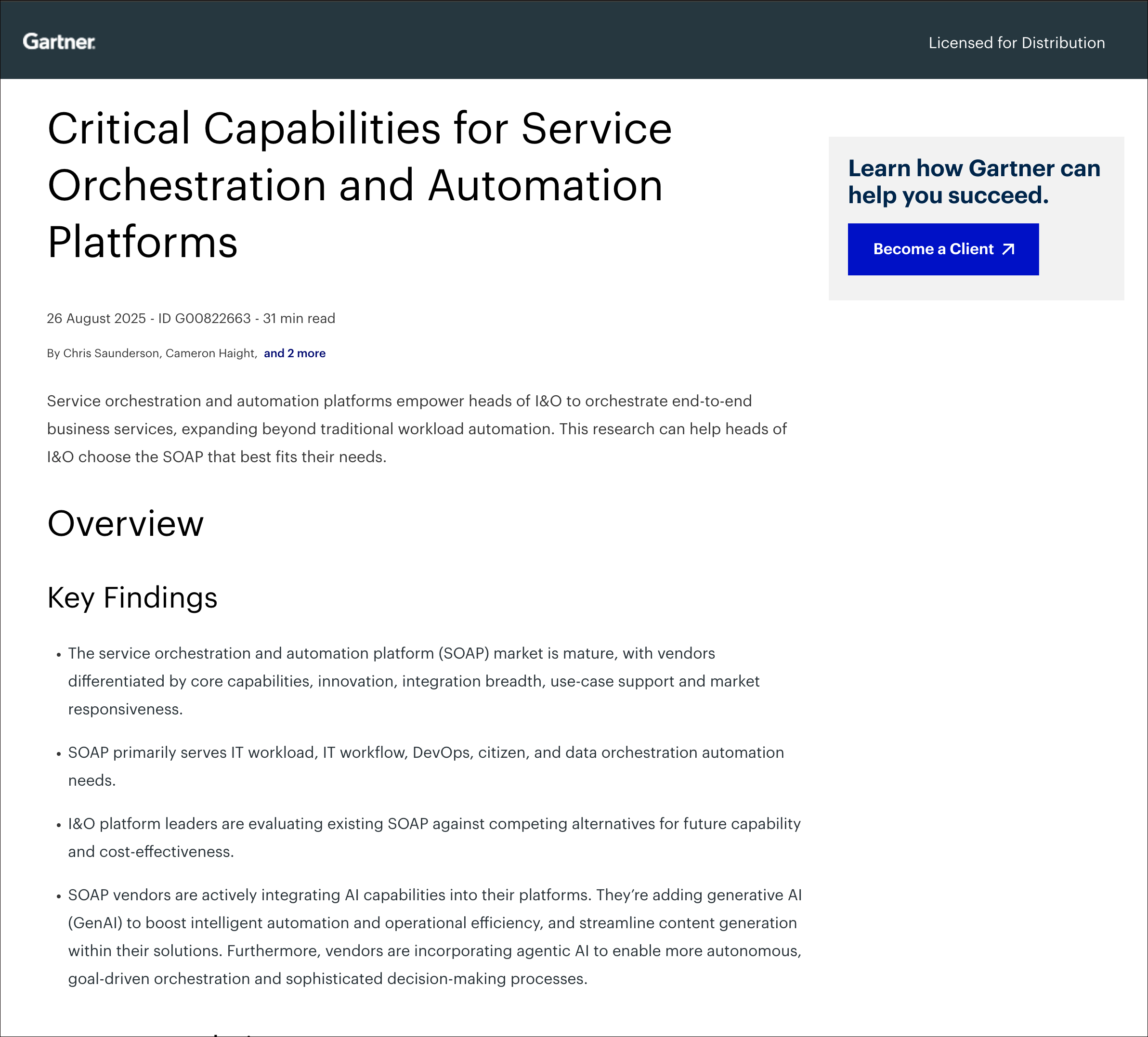
Gartner, Inc. Critical Capabilities for Service Orchestration and Automation Platforms. Chris Saunderson, Cameron Haight, Daniel Betts, Hassan Ennaciri, etl. 26 Aug 2025.
GARTNER is a registered trademark and service mark of Gartner, Inc. and/or its affiliates in the U.S. and internationally, and MAGIC QUADRANT is a registered trademark of Gartner, Inc. and/or its affiliates and are used herein with permission. All rights reserved.
Gartner does not endorse any vendor, product or service depicted in its research publications, and does not advise technology users to select only those vendors with the highest ratings or other designation. Gartner research publications consist of the opinions of Gartner’s research organization and should not be construed as statements of fact. Gartner disclaims all warranties, expressed or implied, with respect to this research, including any warranties of merchantability or fitness for a particular purpose.These graphics were published by Gartner, Inc. as part of a larger research document and should be evaluated in the context of the entire document. The Gartner document is available upon request from https://www.redwood.com/resource/gartner-critical-capabilities-soaps/.
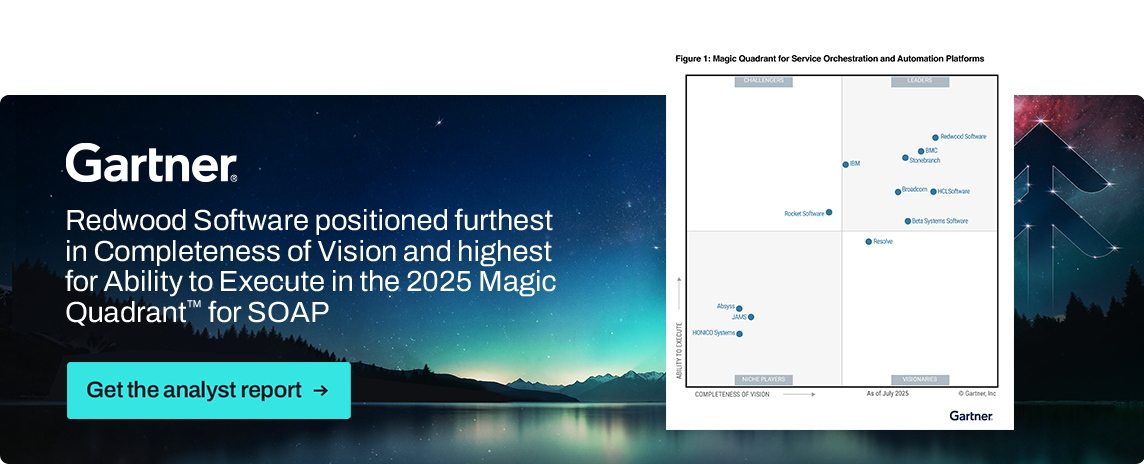
I’m thrilled to announce that, for the second consecutive year, Gartner has named Redwood Software a Leader in its 2025 Magic Quadrant™ for Service Orchestration and Automation Platforms (SOAP) report. This year, we are proud to be positioned furthest in Completeness of Vision and highest for Ability to Execute.
We believe this consistent recognition validates our strategy and the immense value of our automation fabric solutions. Our mission is to unleash human potential by empowering customers with end-to-end automation for their mission-critical business processes, enabling them to maximize efficiency, enhance agility and build a future-ready enterprise.
We see lights-out automation as the engine for continuous growth and success for our customers. This acknowledgment from Gartner further energizes our team as we continue to support enterprises globally.
Understanding the Gartner Magic Quadrant™ for SOAP
The Gartner Magic Quadrant™ is a culmination of research in a specific market, providing a wide-angle view of the relative positions of the market’s competitors. By applying a graphical treatment and a uniform set of evaluation criteria, a Magic Quadrant™ helps you quickly ascertain how well technology providers are executing their stated visions and how well they are performing against Gartner’s market view.
“Leaders execute well against their current vision and are well-positioned for tomorrow.”
“Service orchestration and automation platforms are essential for delivering business services through complex workloads. SOAPs unify workflow orchestration, workload automation and resource provisioning, extending across data pipelines and cloud-native architectures.”
Ability to Execute: How well does the vendor deliver today?
Gartner positioned Redwood highest for Ability to Execute. Redwood feels the Ability to Execute axis assesses the “here and now,” measuring the tangible quality of the vendor’s products and services today.
Our view is that it’s a holistic measure of the entire customer experience and the vendor’s organizational maturity. It’s not just “Does the product work?” but “Is this a well-run company that is easy and reliable to do business with?”
Gartner evaluates Ability to Execute based on seven criteria:
Product or Service
Overall Viability
Sales Execution/Pricing
Market Responsiveness and Track Record
Marketing Execution
Customer Experience
Operations
Completeness of Vision: Does the vendor have a plan for tomorrow?
Gartner positioned Redwood furthest in Completeness of Vision for the second year in a row. In our view this category assesses the “what’s next.” It evaluates the vendor’s strategy, innovation, understanding of the market’s future and if the product will evolve to meet your future needs.
For Redwood, this category is not just about ideas; it’s about the credibility and plausibility of the vendor’s strategy. We believe a “complete” vision is one that is not only forward-thinking but also grounded in a realistic plan that the vendor is capable of executing.
The evaluation scrutinized whether the vendor has the foundational ability to deliver on its promises by assessing their product architecture, financial model and track record of past innovation.
Gartner evaluates Completeness of Vision based on eight criteria:
Market Understanding
Marketing Strategy
Sales Strategy
Offering (Product) Strategy
Business Model
Vertical/Industry Strategy
Innovation
Geographic Strategy
Vision and execution: Why Redwood was named a Leader
Redwood believes being named a Leader doesn’t happen by accident. It’s the result of a clear formula: listen to customers, build for the future and execute flawlessly. We feel this reflects our singular focus on automation fabrics, fueled by innovation and a deep customer obsession. Our strategic roadmap isn’t created in a vacuum; it’s forged in partnership with our customers through advisory boards and user groups.
We deliver on that formula with our enterprise SOAP solutions, available self-hosted, on-premises or through a highly reliable, true-SaaS platform. We believe our position as a Leader speaks to the maturity of our workload automation (WLA) solutions, which offer composable automation purpose-built for the hybrid enterprise. We deliver a unified platform that gives customers the strategic advantage to adapt faster and outpace change.
Redwood feels our forward-thinking approach empowers customers to move beyond simple, custom scripting and siloed tools. They can embrace a fully governed business and IT automation platform that prioritizes the entire digital infrastructure, managing everything from core job scheduling and complex data pipelines to orchestrating event-driven workflows and integrating with DevOps tools. This ensures their critical operations and IT automations run without interruption, meeting the needs of their organization.
We believe our commitment to innovation is clear in our latest platform advancements, which demonstrate a relentless focus on creating a more powerful, intuitive and intelligent automation experience enabling customers’ automation strategies:
Redwood Insights: We’re moving beyond simple monitoring to provide true orchestration observability, turning complex data into actionable knowledge that helps users predict and prevent issues.
AI assistants and co-pilots: Our embedded AI tools are already saving users hours by accelerating development and troubleshooting.
Modern UI: A completely redesigned user interface makes the platform more intuitive and powerful for all users.
Continuous integration and connectivity: We’re constantly expanding our library of pre-built connectors and advanced no-code wizards, making it easier than ever to create custom integrations and automate any process across the enterprise. Redwood offers unmatched integration with SAP applications and technologies, validated by RunMyJobs by Redwood’s SAP Endorsed App Premium certification.
Redwood believes our position in the Gartner Magic Quadrant™ for SOAP is a testament to our commitment to turning cutting-edge technology, from multi-cloud orchestration to AI-driven insights, into real-world results for our customers.
Insights from the 2025 Gartner Magic Quadrant™ for SOAP report
In our opinion, the 2025 Magic Quadrant™ for SOAP report offers an in-depth analysis of the SOAP landscape and highlights the critical role of process automation in driving digital transformation. The report notes that,
“By 2029, 90% of organizations currently delivering workload automation will be using service orchestration and automation platforms (SOAPs) to orchestrate workloads and data pipelines in hybrid environments across IT and business domains.”
Get your copy of the full report here, and demo our suite of solutions to envision what your business could achieve with Redwood behind you.
Gartner, Inc. Magic Quadrant for Service Orchestration and Automation Platforms. Hassan Ennaciri, Daniel Betts, Cameron Haight, Chris Saunderson, etl. 26 Aug 2025.
GARTNER is a registered trademark and service mark of Gartner, Inc. and/or its affiliates in the U.S. and internationally, and MAGIC QUADRANT is a registered trademark of Gartner, Inc. and/or its affiliates and are used herein with permission. All rights reserved.
Gartner does not endorse any vendor, product or service depicted in its research publications, and does not advise technology users to select only those vendors with the highest ratings or other designation. Gartner research publications consist of the opinions of Gartner’s research organization and should not be construed as statements of fact. Gartner disclaims all warranties, expressed or implied, with respect to this research, including any warranties of merchantability or fitness for a particular purpose.
These graphics were published by Gartner, Inc. as part of a larger research document and should be evaluated in the context of the entire document. The Gartner document is available upon request from https://www.redwood.com/resource/gartner-soaps-mq/.
Basic accounting principles exist for a reason. They are neither optional nor vague. They’re meant to give us a consistent, trustworthy foundation for financial reporting, especially when accuracy matters most.
But even now, spreadsheets continue to dominate processes for way too many finance teams. They’re used for accruals, revenue recognition, allocations, reconciliations and other critical functions. And all of this is happening in spreadsheets, outside the systems that are actually built to handle this data. We expect our reports to align with standards like Generally Accepted Accounting Principles (GAAP) or International Financial Reporting Standards (IFRS), yet we’re relying on manual tools that were never designed for this level of complexity.
We all want to uphold principles like reliability and consistency. But the truth is, spreadsheets quietly chip away at both. And they’re so familiar, it’s easy not to notice until something breaks.
Let’s explore the less obvious ways spreadsheets can undermine accounting integrity and what finance automation can do to help.
The silent killer of accounting integrity
At first glance, spreadsheets feel harmless. They’re fast, flexible and the tool most professionals first learned to use. But that same flexibility is exactly what makes them hard to control.
No version control: Anyone can tweak a cell, save a new copy or email the wrong file. There could be six versions of the same schedule floating around.
No audit trail: Adjustments happen, but unless someone manually annotates a journal entry or leaves a note — a step that is often skipped, there’s no method for tracing what changed.
No guarantee of accuracy: Formulas break, references get outdated, links go bad. And if no one catches it, the numbers roll forward.
Now imagine that across dozens of schedules, teams and entities. You’ve essentially built a shadow system outside your ERP — a significant audit exposure. Worse, leadership ends up relying on those numbers. Decisions are made based on the financial information in those files.
One bad cell: Unknowingly compromising reliability
The principle of reliability says our numbers should be verifiable and backed by objective evidence. But in spreadsheet world, “evidence” is often a file path and a line item copied from somewhere else. That’s not a system of record; it’s just a folder on someone’s desktop.
You could have a perfectly valid entry, but if you can’t trace how you got there — or explain why it changed — it’s not really reliable. And in many cases, even the person who made the update would have to dig to remember what they did.
Automation changes that. It builds logic into the process. You’re pulling live values from your ERP, not referencing a hard-coded number from three weeks ago. Documentation lives in the system, not in someone’s email. If something changes, you know who changed it, when and why. That’s what makes information reliable. And that’s what auditors (and leadership) expect.
Consistency is a team sport
Consistency is one of those principles that sounds simple: treat the same financial transactions the same way, every time. Yet, in practice, it gets messy.
Every finance team I’ve worked with has some version of this: one person does it their way, another has their own spreadsheet and over time, the logic starts to drift. Revenue deferrals, expense accruals and intercompany recharges all start off aligned, then slowly diverge based on who’s doing the prep work. That’s not anyone’s fault; it’s just what happens when we rely on tools that don’t enforce consistency.
Automation fixes this by turning those “ways of working” into actual, repeatable processes. You define the logic once, and the system applies it every time across accounting periods, teams and regions. Everyone starts with the same playbook.
Adhering to the consistency principle doesn’t just make audits easier. It makes your reporting more useful. It gives your team confidence in the numbers. And it makes analysis possible because you’re comparing apples to apples.
Invisible knowledge: A liability
Then, there’s the hero problem. Every finance team has one: that person who knows how everything works — the macros, the tabs, the quirks. This individual is often indispensable, holding the entire manual process together. But when they go on vacation, leave the company or just get reassigned, that knowledge goes with them.
This represents a huge risk, even though it isn’t often discussed. If your month-end close depends on one person’s memory of how the spreadsheet works, that’s not a process but a dependency.
Automation helps you get that knowledge out of someone’s head and into a shared system. It turns invisible logic into visible steps. It builds documentation into the workflow. That way, new team members can ramp faster, and no one’s irreplaceable because the process doesn’t live in a file; it lives in the system.
This is how a scalable team is built.
A stronger foundation for modern finance
Accounting concepts haven’t changed much, but everything around them has. We’re moving faster, dealing with more data, experimenting with new accounting methods and being asked to add value beyond the basics, but we still have to get the basics right.
For many organizations, spreadsheets have effectively become the primary system for managing financial processes, operating as a kind of shadow ERP. Even with dedicated enterprise software in place, the most critical accounting work often falls back on a collection of manual, disconnected files. While valuable for quick analysis, spreadsheets cannot provide the integrity and control required to be the backbone of your financial position. The work traditionally performed in these files must be migrated to a centralized system built for scale and auditability.
Finance automation can reduce spreadsheet risk and help your team uphold the accounting principles that matter most — from the matching principle to GAAP compliance. Request a demo of Finance Automation by Redwood today.
Your company is spending more on automation than ever, yet you’re barely seeing a return. It’s a frustrating paradox revealed in the new “Enterprise automation index 2025” from Redwood Software.
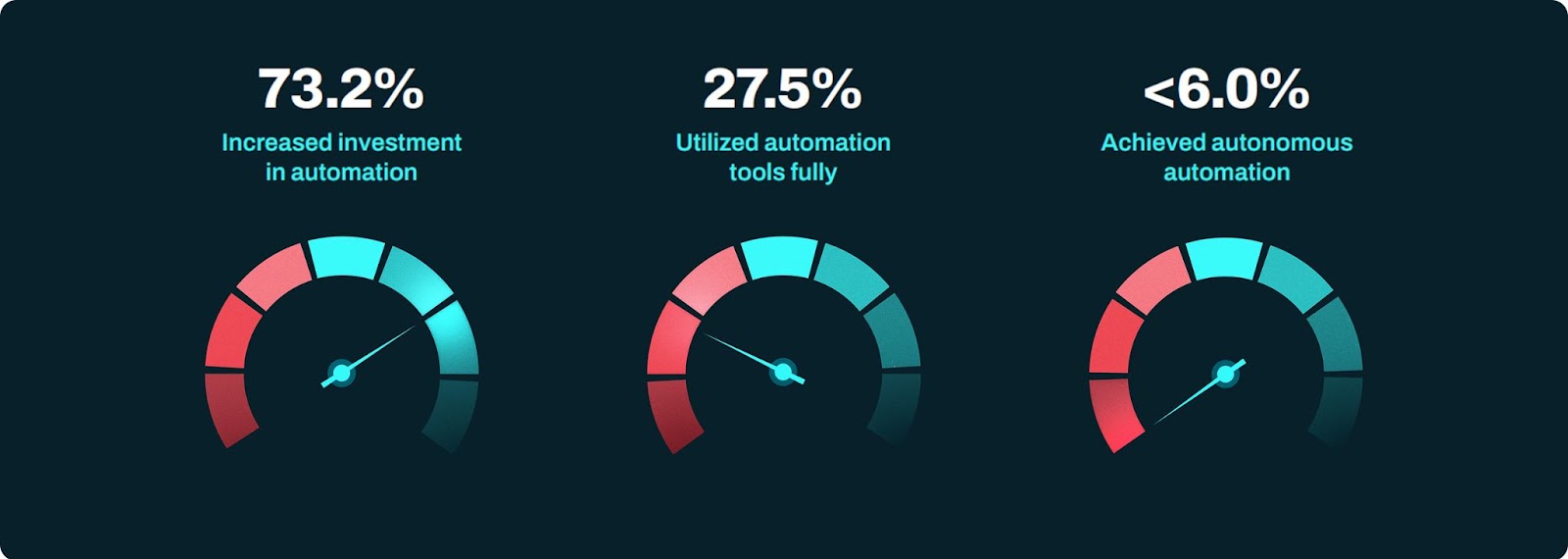
While 73% of companies increased their automation spend last year, less than 30% are fully utilizing their tools. The data is clear: the issue isn’t a lack of investment or technology — it’s a stubborn execution gap.
In a climate where every budget line is under the microscope, automation is still getting the green light. That’s because the business case is solid.
37% of organizations report that automation reduced costs by over 25%
43% have cut manual workloads by at least a quarter
49% say it increased efficiency by the same amount
Those are meaningful results, but they’re not the norm. The data also reveals a widespread failure to scale.
73% of companies increased automation spend last year, but only 28% fully utilize their tools. Less than 6% have achieved autonomous automation for any core business process.Source: “Enterprise automation index 2025”
From where I sit, working alongside enterprise teams on automation migration and orchestration every day, I can tell you this isn’t a technology issue. It’s a stubborn execution gap.
The 4 traps of underperforming automation
Too many organizations treat automation like an arms race, adding new tools to plug gaps and hoping for the best. My team sees the consequences of this approach daily, typically in these four traps:
Ad hoc tool sprawl: Marketing, Finance and IT all buy their own automation tools, creating “shadow automation.” These siloed, ungoverned processes don’t share data, follow security protocols or align with a larger strategy, undermining enterprise-wide visibility.
Stopping at the task level: Teams often automate the simplest, low-hanging fruit and then declare victory, ignoring the cross-functional processes where the real value lies. This technical debt accrues until a critical process, like month-end close or supply chain fulfillment, inevitably breaks, leading to frantic, manual interventions.
Legacy tech dependency: Many enterprises still run their most important processes on outdated schedulers or basic scripts. These tools lack the visibility, error handling and security features required for today’s business. When they fail (and they do), the business impact is immediate and severe, but migrating off them is perceived as too difficult.
No automation strategy: Without a plan to consolidate, migrate and optimize, the collection of tools becomes a digital junkyard. The organization has technically invested in automation, but operationally, nothing has changed. The tools are there, but they’re underutilized, misaligned or completely isolated.
These execution pitfalls are symptoms of a deeper issue, one that consistently derails even well-funded automation projects.
Complexity: The #1 blocker to automation ROI
According to Redwood’s research, the top challenge isn’t budget, talent or tools — it’s complexity. Nearly 20% of professionals point to complex workflows as their number-one barrier to scaling automation.
That echoes what I see in the field. Enterprises are sitting on decades of custom scripts, legacy architecture, fragile integrations and undocumented processes. And every time someone says “We’ll automate that later,” the mess grows.
When you delay migration or fail to redesign around orchestration, you lose the ability to scale. You automate the easy stuff and stall out at the first sign of friction. If you want automation to deliver, you need to:
Standardize before you automate. Don’t just pave the path. A chaotic manual process will only become a faster chaotic automated process. Take the time to map, simplify and standardize workflows first. This initial investment pays dividends in scalability and resilience.
Migrate strategically. A simple “lift-and-shift” of old jobs to a new platform just moves the problem. Strategic migration involves analyzing, consolidating and redesigning workflows to take full advantage of a modern orchestration platform’s capabilities.
Orchestrate across systems. True value is unlocked when you manage processes end to end, from the mainframe to the cloud and across all applications. This breaks down the silos between IT operations, data pipelines and business applications, which the report identifies as a key challenge for industries like finance.
Align to business outcomes. The goal isn’t just to run jobs successfully; it’s to reduce costs, accelerate innovation and improve data visibility — the top three business priorities cited in the research. Frame every automation initiative around these goals.
The path to mature automation: A call to action
If your automation investment isn’t delivering, it’s a critical warning sign. Don’t fall into the trap of simply adding more tools. The path forward requires a shift in mindset: focus on orchestration, elevate automation to a C-suite priority and build a cohesive strategy. It’s the only way to transform it from a tactical fix to a genuine growth lever for your entire organization.
Record-to-report (R2R) remains one of the most critical, yet under-automated, areas of finance. And while workloads in finance and accounting are projected to increase by 4.1% this year, staffing levels and operating budgets are shrinking. That creates a dangerous gap — one that many finance leaders assume automation has already closed.
But assumptions can be costly.
If you’ve implemented automation tools, shifted away from paper or added templates and trackers, it’s easy to believe your R2R process is modernized. In reality, many organizations are still relying on fragmented workflows, disconnected systems and outdated practices masked as progress. The result? Unnecessary manual effort, slower closes, limited visibility and rising risk exposure.
Use this article and Redwood Software’s R2R automation maturity assessment to gauge whether your R2R automation strategy is keeping pace. You’ll see what to measure, how to interpret your automation maturity and how to shift from tactical improvements to scalable, strategic transformation. Benchmark both your operational and strategic maturity in a way that reflects the real complexity of the financial close.
R2R automation maturity: Perception vs. reality
91% of finance leaders say R2R automation is essential, but only 58% have automated even one key process. That gap isn’t just operational — it’s perceptual. Too often, spreadsheets, offline uploads and ad hoc workflows are labeled “automated” when they’re really just digitized versions of manual processes.
Many accounting teams rely on email approvals, ungoverned trackers and data pulled from various sources to patch together close checklists. These stopgaps introduce risk and prevent true visibility across general ledger activity, journal entries, intercompany transactions and consolidation efforts.
What emerges is a tangle of disconnected fixes that ultimately stall transformation. You may have automation tools in place, but if you’re still chasing down exceptions, tracking tasks in Excel or manually validating financial data, you’re not yet operating at a mature level.
The teams that get it right report 69.3% fewer hours spent on manual tasks, and not just because of automation but also because of orchestration. Just as importantly, they gain 69.2% better visibility and collaboration and enable faster, more confident financial management decision-making.
The maturity assessment was built to make these blind spots visible and measurable, so finance leaders can identify and address them before they create larger issues across accounting periods.
How to truly measure your R2R automation
Redwood’s R2R automation maturity assessment uses two critical axes:
Operational maturity: This evaluates how deeply you’ve automated core accounting processes, from accounts payable and journal entries to reconciliation and month-end closing. It looks at whether your processes are automated end-to-end or only at the surface level.
Strategic maturity: This area assesses whether you have the culture, governance and controls needed to scale and sustain R2R automation. It includes exception handling, adoption, an orchestration mindset and continuous improvement.
These axes are scored independently, then combined to place your organization into one of five maturity bands: Manual, Siloed, Managed, Controlled or Autonomous.
Reaching the Autonomous stage doesn’t just mean having tools. It means using process automation to run a fully orchestrated close process, with real-time dashboards, SLA tracking, predictive insights and embedded controls. It’s the difference between automating a few journal entries and transforming how you manage financial transactions across every entity and subsidiary.
Where finance teams stall — and what it costs
Many finance functions plateau in the Managed or Controlled stages. They’ve invested in tools but remain overwhelmed by competing priorities, change resistance, limited IT support or skills gaps. Transformation becomes a task to juggle instead of a discipline to own.
You’ll recognize the signs, including:
Manual data collection across sub-ledgers, receivables and intercompany entries
Offline task trackers and fragmented accounting systems
Reactive responses to discrepancies and late-breaking issues
Rework caused by missed validations and inconsistent approvals
These issues create ripple effects, like reporting delays, control breakdowns, missed regulatory requirements and burnout and turnover. And perhaps most damaging: a gradual erosion of confidence in the integrity of your financial information internally and with external stakeholders.
The R2R automation maturity assessment helps finance leaders like yourself map these symptoms to maturity levels, so you can prioritize root causes over surface fixes.
The value of an R2R automation maturity assessment
This isn’t a generic checklist or opinion poll. It’s a structured scoring model that reflects the real-world complexity of the R2R process. Specifically, it helps you:
Benchmark six operational R2R processes
Score five strategic enablers of scalable automation
Evaluate your automation posture using a combined scoring model
Identify maturity-specific key steps to advance transformation
You’ll also evaluate your automation fabric readiness, which is your organization’s ability to support seamless, end-to-end process automation across a diverse and evolving tech stack. It includes ERP and other core systems, orchestration capability, exception resolution, visibility and roadmap alignment. This matters whether you’re navigating a procure-to-pay cycle, an order-to-cash flow or full general ledger consolidation across multiple entities.
The full assessment download includes scoring tables and detailed improvement playbooks, and the result is actionable. It’s not just “Where are we?” but it’s also “What do we do next?”
How R2R automation pays off
The outcomes of mature R2R automation are clear:
Operational payoffs: 69.3% hours saved across account reconciliation, journal entry and accrual workflows
Strategic payoffs: 69.2% gains in cross-functional collaboration, faster management reports, improved financial performance and agility
Resilience by design: Native SAP integration, automated validation rules and exception handling that reduce human error
Informed decisions: Accurate financial data entry delivered faster and with more transparency into consolidation timelines and data lineage
These capabilities empower CFOs to cut days off the close, reduce rework and reassign capacity toward forecasting, strategic planning and scenario modeling.
Finance teams that have reached the Autonomous stage can track key metrics, such as the percentage of manual journals, time spent on reconciliations and the number of post-close adjustments and drive them toward zero. They don’t just close faster; they optimize for consistency, control and insight.
Get your true R2R automation score
If you’re serious about strengthening your organization’s financial health and driving better outcomes, you need to know where your maturity stands, not where you assume it is.
Involve your finance operations leaders, IT and automation stakeholders in the following steps:
Calculate your scores and determine your automation posture
Prioritize your next actions
Every quarter your organization spends stalled in Managed or Controlled maturity leaves efficiency, visibility and credibility on the table. Automation isn’t the destination; it’s the lever that lets you transform your business processes, sharpen your financial reporting and elevate your accounting team’s impact across the enterprise.
To see where your organization’s R2R automation really stands and what it will take to move forward, download the full assessment and schedule a demo to achieve an orchestrated close.
Today’s IT infrastructures are overrun with machine or non-human identities. They are everywhere—from on-prem data centres and cloud platforms to DevOps pipelines, IoT devices, and APIs. These identities rely on digital certificates to establish trust and secure communications.
But there’s a catch: If you don’t know where your digital certificates are, you can’t manage them. And if you can’t manage them, you’re risking service outages, security breaches, and compliance failures.
For PKI admins, maintaining visibility into every certificate across the organisation is both a priority and a persistent challenge. As IT environments grow more hybrid and distributed, manually tracking thousands of certificates through spreadsheets or siloed CA tools becomes impractical.
Automated certificate discovery helps PKI teams:
Gain complete visibility by identifying all certificates, regardless of issuing CA or deployment location
Detect rogue or shadow certificates that bypass standard issuance workflows and mitigate security risks
Track certificate expiration timelines to proactively prevent outages
Ensure compliance by continuously mapping certificates to policies and security standards
In short, automated certificate discovery ensures every certificate, regardless of where it lives, is accounted for, assessed, and ready for proactive management.
Automating Certificate Discovery with AppViewX AVX ONE CLM
AVX ONE CLM is a certificate lifecycle management solution that gives PKI teams the visibility, automation, and policy control needed to manage certificates across complex hybrid multi-cloud environments. It is designed to simplify PKI and certificate lifecycle management, ensuring trust for machines, workloads, applications, cloud services, containers, APIs, and more.
At the heart of AVX ONE CLM are certificate discovery and inventory capabilities.
Certificate Lifecycle Management with Visibility, Control and Insights – All in One Place
How AppViewX Connectors Automate Certificate Discovery on Network Devices:
AppViewX provides built-in certificate discovery connectors for a wide range of commonly used systems and platforms, including renowned brands such as F5, Linux, and Tomcat, among others. These connectors are designed to scan and fetch certificate data directly from devices, helping you eliminate blind spots with minimal configuration.
However, in the case of legacy devices—especially those that are end-of-life (EOL), end-of-support (EOS), or highly customised—certificate discovery can be challenging due to limited documentation or lack of accessible lab infrastructure. To address this, AppViewX provides a flexible solution through its AppViewX Connectors feature.
This powerful feature empowers users to perform customised certificate discovery, tailored to their specific requirements. All it requires is access to the target devices and their certificates, either through API or CLI. With this minimal requirement, discovery can be quickly and seamlessly executed. In addition to the pre-built connectors AppViewX provides, you can easily create your custom connectors to support unique or unsupported systems.
This offers greater flexibility to support any legacy or new line of network devices that may not be readily accessible.
Additional Certificate Discovery and Post-Discovery Features:
AppViewX further streamlines the discovery process with advanced capabilities:
Targeted discovery: During certificate discovery, you can choose to discover only the certificates in a particular location or exclude certain certificates as needed.
Global inclusion/exclusion rules: Connectors in AppViewX allow for global inclusion/exclusion of file locations based on user requirements. You can apply file path rules across multiple devices simultaneously.
Device-level controls: You can add inclusion/exclusion file paths at the device level.
Filtering: After discovery, if further filtering is required, you can filter certificates based on specific certificate parameters.
Group management: Post-discovery, you can automatically group certificates into desired certificate groups in a single operation.
Workflow automation: If any specific actions need to be performed after discovery, you can utilise the workflow feature (an inbuilt automation framework in AppViewX) to carry out the desired actions.
End-to-end lifecycle management:. Once the certificates are discovered, the native features of AVX ONE CLM take over, automating certificate renewals and deployment, ensuring they’re always valid, compliant, and correctly installed on target devices.
For PKI administrators, certificate discovery is a foundational requirement for operational resilience and security. Without it, automation falls apart. With it, you gain the visibility and control needed to manage and scale trust across your organisation.
AppViewX AVX ONE CLM makes certificate discovery seamless with a rich library of native connectors and the flexibility to build your own. Whether you’re managing modern workloads or navigating legacy infrastructure, AppViewX helps you discover, manage, and control every certificate, ensuring authenticity and security of your machine identities.
While discovery is the first step, it’s only one part of the broader certificate management process. AVX ONE CLM goes well beyond discovery—offering centralized visibility, end-to-end lifecycle automation, policy-driven control, and crypto-agility to manage machine and non-human identities securely and at scale.
69% of organizations call automation “mission-critical,” but only 10% are actually prioritizing it at the executive level.
That gap isn’t theoretical — it’s operational. And for leaders trying to move the needle on cost, innovation or speed of execution, it’s a red flag.
I’ve spent my career scaling technical and product teams, supporting global platforms and helping businesses modernize their operations. Here’s what I’ve seen consistently: Every business outcome is the result of process mechanics. If you’re not looking at automation through that lens, you’re missing the point.
Spending more ≠ Doing it better
It’s easy to assume more investment equals progress. But the data shows otherwise:
73% of organizations increased automation spending in the past year
These aren’t marginal improvements. They’re operating-model shifts. But they only show up in organizations that treat automation as an integrated operating capability — not a patchwork of IT point solutions.
What do they do differently?
They don’t just ask “What can we automate?”
They ask “What outcome are we optimizing?” and work backward
They measure process volume, yield, throughput and cycle time
They build automation architectures that span systems and teams to focus on value-stream processes and outcomes
They begin with operational objectives, identifying where current processes underperform, why those gaps exist and how automation can significantly improve the outcome.
They treat automation not as a siloed initiative but as an embedded capability that works across Finance, Operations and Product to drive measurable improvements.
Your automation strategy should reflect your operating model — not just your tech stack.
It needs ownership. It needs a business case. And it needs to be framed as an operating capability, not a toolset.
I’ve seen firsthand how teams unlock transformative value when they integrate automation as an operating capability at the strategic level.
Get the full story
If these findings resonate with you, I encourage you to dive deeper. Redwood’s “Enterprise automation index 2025” unpacks:
How teams across industries are investing in automation
Benchmarks for tools utilization and maturity
The most common barriers to adoption (Spoiler: It’s not budget!)
How leaders are preparing for AI-driven automation
What sets top-performing organizations apart
Download the full report to learn how you can move from fragmented tasks to orchestrated outcomes.
Cryptography plays a critical role in securing data, protecting privacy, and maintaining trust across systems. From securing web traffic and APIs to software updates and IoT communications, digital certificates and keys underpin modern cybersecurity infrastructure.
Yet, many organizations are struggling to manage cryptographic assets efficiently. A complex digital landscape, fragmented tools, manual processes, and evolving threats, such as the threat of quantum computing to current cryptography, are making certificate lifecycle management (CLM) increasingly challenging and risky.
To thrive in this environment, enterprises need crypto-agility: the ability to quickly adapt to cryptographic changes with minimal disruption to operations or security.
At AppViewX, we’ve helped leading global enterprises move from reactive, disjointed certificate management to proactive, scalable, and resilient cryptographic operations, guided by our Path to Crypto-Agility, powered by AVX ONE CLM.
AppViewX AVX ONE CLM is a comprehensive certificate lifecycle management solution that helps you discover, inventory, manage, and govern all public and private trust certificates in your infrastructure—all in one place. With complete visibility, end-to-end automation, and robust policy control, AVX ONE CLM streamlines certificate operations across machines, applications, workloads, and cloud services, in turn, strengthening the digital security posture.
Here’s how you can achieve crypto-agility across four stages with AVX ONE CLM.
Stage 1: Visibility—Establishing the Foundation
Why It Matters:
You can’t protect what you can’t see.
The starting point of crypto-agility is complete visibility into all digital certificates and keys across your organization. A lack of visibility leads to blind spots, which can result in expired certificates, service outages, and compliance violations.
Common Challenges:
Unknown or “shadow” certificates scattered across systems
Outages caused by missed certificate renewals
Lack of ownership and accountability for certificates
How AVX ONE CLM Helps:
Automatically discovers all public and private trust certificates from multiple Certificate Authorities (CAs) across all endpoints
Consolidates discovered certificates into a centralized certificate inventory enriched with valuable metadata, such as expiration date, key size, algorithm, and location
Provides insights into anomalies and orphaned or unused certificates
Business Impact:
A holistic, always-updated view of your cryptographic estate—your single source of truth. With complete visibility, your teams can proactively manage certificate lifecycles, prevent outages, and eliminate unnecessary downtime.
Certificate Lifecycle Management with Visibility, Control and Insights – All in One Place
Stage 2: Advanced Automation at Scale—Empowering Developers and Operations Teams
Why It Matters:
Security shouldn’t be a bottleneck. With the right tools, it becomes an enabler.
As development cycles accelerate, especially with DevOps and CI/CD pipelines, the demand for digital certificates has skyrocketed. However, manual certificate processes simply can’t keep up. DevOps teams need rapid, secure methods for provisioning and deploying certificates without relying solely on central IT teams. Once issued, certificates must also be deployed, installed, and updated across a diverse range of systems. Automation is the key to both speed and security in this process.
Common Challenges:
Long wait times for certificate issuance requests
Human errors in provisioning, configuration, and renewals
Lack of visibility or control for development and operations teams
Complex hybrid environments with inconsistent tooling
How AVX ONE CLM Helps:
Provides certificate self-service for developers and app teams to request, renew, and revoke certificates on demand
Automates certificate approval workflows, reducing dependency on central IT
Seamlessly integrates with DevOps toolchains like Jenkins, GitLab, Ansible, and Kubernetes
Pushes certificates automatically to endpoints like load balancers, servers, containers, and IoT devices
Enables zero-touch renewals and deployment (even binds the certificates to the correct application)
Enables rollback and deployment validation to avoid misconfigurations and outages
Business Impact:
Faster innovation, fewer bottlenecks, and fewer incidents—all backed by secure, end-to-end certificate lifecycle automation. Whether you’re supporting agile development or maintaining hybrid infrastructure, AVX ONE CLM helps you move quickly without compromising security or compliance.
Stage 3: Compliance and Control—Laying Down Governance
Why It Matters:
Automation without governance leads to chaos.
Automating your certificates is only half the battle. The next step is to enforce policies that manage them securely and consistently. Without standardized policies, certificate issuance and usage become ad-hoc and error-prone. Regulatory frameworks, such as NIST, PCI DSS, and NIS2 also demand formal cryptography governance.
Common Challenges:
Disparate CAs with inconsistent processes
No centralized enforcement of cryptographic policies
Gaps in proving compliance during audits
How AVX ONE CLM Helps:
Define enterprise-wide policies for certificate issuance, key strength, validity periods, and approved algorithms
Enforce governance consistently across teams, regions, and environments
Continuously monitor for policy violations and trigger alerts for quick remediation before issues become incidents
Business Impact:
With automated policy enforcement, compliance becomes part of your everyday operations. Audits are simpler, trust is stronger, and security risks are reduced—all while preserving the speed and agility your business needs.
Stage 4: Crypto-Agility—Building a Future-Proof Enterprise
Why It Matters:
Crypto-agility is not just about speed—it’s about resilience
The cryptographic landscape is shifting fast. TLS certificate lifespans are shrinking drastically, widely used encryption algorithms like RSA and ECC are nearing deprecation, the urgency around post-quantum cryptography (PQC) migration is intensifying, and compliance mandates are constantly evolving.
To stay secure and compliant through these changes, your organization must be ready to adapt without scrambling. That’s what crypto-agility enables you to do: pivot without panic.
Common Challenges:
Legacy systems with hardcoded keys and outdated algorithms
Fragmented CLM tools that slow down cryptographic transitions
Lack of readiness for PQC migration
Difficulty scaling cryptographic operations across large, hybrid environments
How AVX ONE CLM Helps:
Centralizes visibility of all cryptographic assets—certificates, keys, algorithms—to help you plan effectively for upgrades and migrations
Offers flexible, advanced automation with deep integrations to execute cryptographic changes at scale, seamlessly and accurately
Enforces policy-driven governance to maintain consistency, compliance, and control throughout every transition
Business Impact:
In a world where cryptographic change is constant, crypto-agility is a necessity for resilience, compliance, and long-term security. Whether you’re facing a tough audit, dealing with expired certificates, or preparing for a quantum-secure future, you need a CLM strategy that’s built for change.
With AppViewX AVX ONE CLM, you get complete visibility, intelligent automation, and centralized control—everything you need to future-proof your cryptographic operations and reduce risk without slowing down your business.