SmartThings Safe Premium is powered by Arlo, a third-party partner that operates the professional monitoring center and coordinates emergency dispatch on our behalf. Feeling safe, whether at home or on the go, shouldn’t take more than a tap. With SmartThings Safe Premium, users can instantly send help requests, from inside the SmartThings app, to Arlo-powered […]
Upcoming Changes to the SmartThings API Over the last several years, the SmartThings platform has grown into one of the most robust orchestration layers in the smart home industry, with over 460M+ registered users and hundreds of WWST partner brands — and our API is the gateway that connects third party apps and platforms to […]
SAP landscapes have become considerably more complex than the tools most teams use to automate and optimize how heavy backend workloads run.
A decade ago, background job scheduling was a contained problem. SM36 and SM37 handled ERP processing, local schedulers covered the rest and the architecture those tools were built for was largely self-contained.
That architecture is gone for most enterprises. A single business process now routinely spans SAP S/4HANA, SAP Cloud ERP, SAP Business Technology Platform (BTP), SAP Business Data Cloud (BDC), SAP Analytics Cloud, Databricks, Snowflake, AWS … and the list goes on … before producing a result anyone can act on. Each platform executes reliably within its own boundary. Whether the process completes reliably across all of them is a problem local scheduling can’t solve.
To answer the question, “How does this job impact the entire business chain?” SAP architects must differentiate between simple task scheduling and true enterprise orchestration.
When local scheduling remains the right call
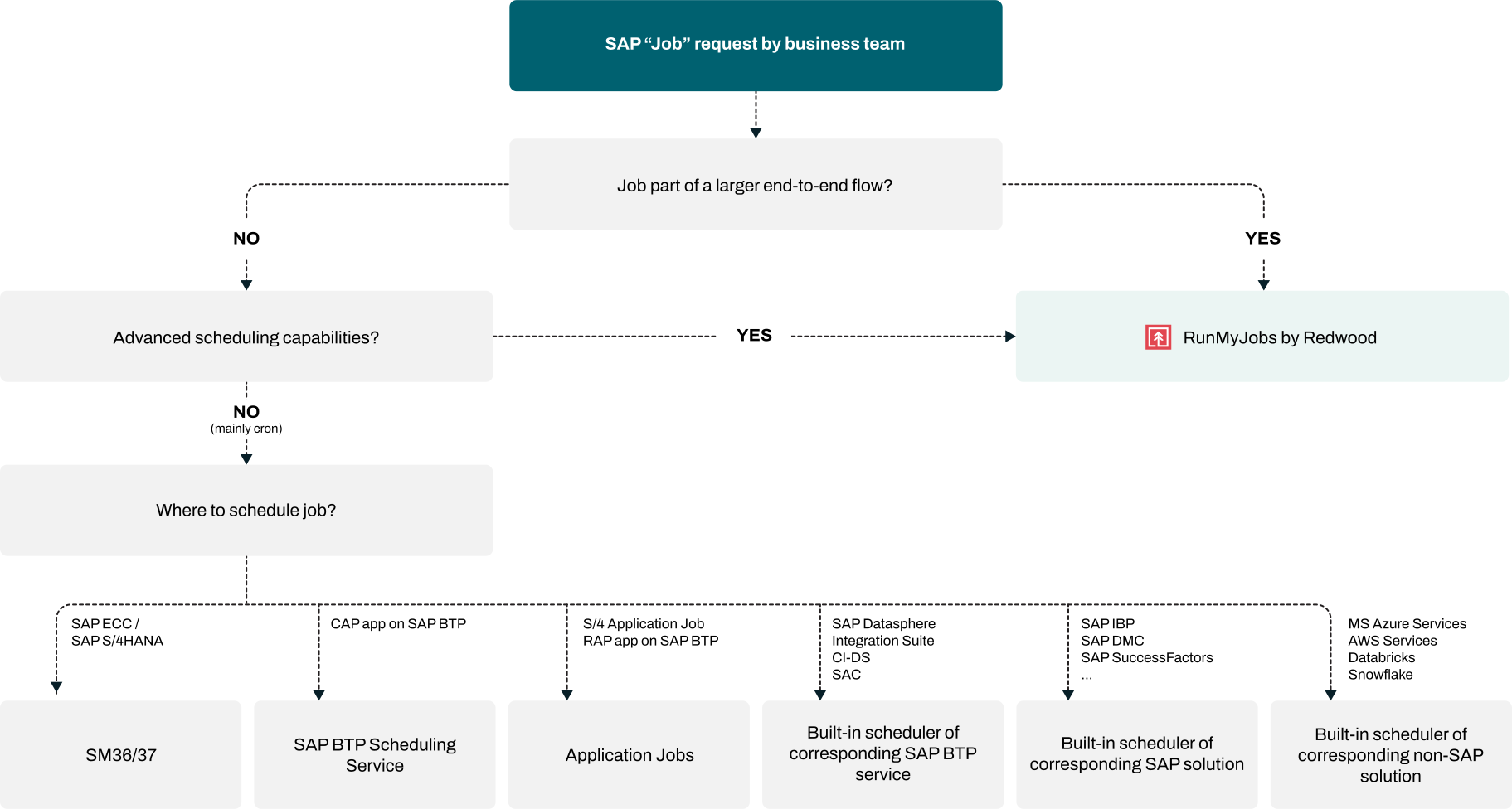
Native scheduling tools are legitimate architectural choices, not placeholders until something better comes along. For isolated, self-contained tasks with no upstream dependencies and no downstream impact — and where advanced or variable calendaring handles any scheduling complexity — they’re often exactly what the job requires.
Across a modern SAP estate, that means:
SM36 and SM37 for standard background processing in SAP S/4HANA and SAP ECC: batch jobs, reports and ABAP programs that live entirely within a single ERP instance and don’t depend on external system state
SAP BTP Job Scheduling Service for Cloud Application Programming (CAP) model applications running on SAP BTP Cloud Foundry: time-based or one-time job execution for CAP services that operate independently within the SAP BTP environment
Application Jobs for RESTful ABAP Programming (RAP) model extensions on SAP S/4HANA: the metadata-driven, Fiori-integrated successor to SM36/SM37 for modern ABAP development, appropriate when the job scope stays within the SAP S/4HANA system boundary
Native scheduling within SAP Integrated Business Planning (IBP), SAP SuccessFactors and SAP Digital Manufacturing: purpose-built schedulers for localized workloads inside those solutions, where cross-system coordination isn’t required
Built-in schedulers in Snowflake and Databricks for internal scripts and transformations that begin and end within those platforms
The common thread is isolation. Each of these tools executes reliably when the task it governs doesn’t depend on the state of another system and doesn’t need to trigger work in one.
Trigger points: When traditional scheduling becomes operational risk
Three conditions reliably signal that native scheduling is no longer sufficient.
The job becomes a link in a cross-system chain. As soon as a task has an upstream dependency outside its own platform or triggers a downstream action in another system, local schedulers start operating on assumptions. For a material requirements planning (MRP) run that depends on an external warehouse feed completing first, a Datasphere refresh that needs to finish before SAP Analytics Cloud models publish or a CAP service on SAP BTP that should only execute after an upstream SAP S/4HANA job confirms success, native schedulers in each of those systems can only confirm that their own job ran. None of them can verify the state of the system that the next step depends on.
You need resource-aware, resilient execution. High-concurrency workloads like SAP Datasphere task chains, Databricks pipeline runs and overnight batch sequences across multiple platforms require load balancing, automated retry logic and intelligent error handling. Without a coordination layer, a single failure can cascade across dependent processes before anyone is notified.
Your roadmap involves eliminating operational blind spots.RISE with SAP and clean core transformations distribute process logic across SAP BTP services, cloud extensions and non-SAP platforms. That distribution improves architectural flexibility and creates a new operational problem: no single view of what’s running, what’s waiting and what failed across the landscape. Each platform reports on itself, but nothing reports on the process.
Governed execution in practice
RunMyJobs by Redwood is designed to take over at the boundary where native scheduling capabilities end. Rather than replacing SM36/SM37, Application Jobs or the SAP BTP Job Scheduling Service, it coordinates them — along with every other system in the landscape — into governed, end-to-end process flows. Workflows execute based on verified event completion and real-time system state, where a downstream process starts because the upstream transformation succeeded, not because a timer reached a predetermined hour.
The difference a dependency makes
Scheduling
Orchestration
Runs isolated tasks
Coordinates end-to-end business processes
Time-based execution
Event-driven, latency-aware execution
Local system visibility
Cross-platform visibility
Static, assumed dependencies
Dynamic, verified dependencies
Reactive troubleshooting
Centralized operational intelligence
RunMyJobs’ out-of-the-box connectors span SAP S/4HANA, SAP BTP, SAP BDC, SAP Datasphere, SAP Analytics Cloud, SAP Cloud ALM, SAP Build Process Automation, Databricks, Snowflake, AWS and ServiceNow, making cross-platform dependency management possible without custom code.
For RISE with SAP and SAP Cloud ERP environments, RunMyJobs connects through its Secure Gateway and agentless architecture, consistent with how SAP Cloud Connector operates. It’s the only workload automation and orchestration platform included in the RISE with SAP reference architecture. With no agents inside the ERP and no custom ABAP, RunMyJobs supports clean core principles from the start.
Coverage extends across the full range of modern SAP development models: Application Jobs, RAP-based extensions, CAP services on SAP BTP, SAP Datasphere pipelines, SAP Integration Suite workflows and AI-driven scenarios involving Joule.
Job requirements decision tree
Build the control layer before you need it
Most teams introduce enterprise orchestration after complexity has already compounded — after the first SLA breach that took half a day to trace, the planning run that produced results on incomplete data or the migration that left three separate scheduling tools running in parallel with no consolidated view across them.
Getting ahead of that inflection point is considerably easier than resolving it afterward. Teams that introduce RunMyJobs early in their RISE with SAP journey retire legacy schedulers, establish governed dependency management and build a control layer that scales with the architecture from the start.
SAP’s native tools still do what they were designed to do, while orchestration governs what happens between them.
4.6.2026 Care Pathway Automation in Practice: Lessons from Helsinki University Hospital’s Cancer Care Implementation. This article is a reflection on a Presentation by Finland’s Largest Hospital District, HUS: Results and Future Opportunities of Care Pathway Automation. Author Juha Nieminen is Global Head of Healthcare at Digital Workforce and a member of the executive leadership team.
At a recent healthcare IT event in Helsinki, HUS representatives Administrative Chief Physician Meri Utriainen and Planning Specialist Johanna Pakarinen shared their experiences of automating end-to-end care pathways. The case example focused on a breast cancer follow-up solution, for which Digital Workforce serves as the contracted supplier.
When a customer shares two years of production experience, it is worth listening carefully. I was particularly interested in three things: the tangible results achieved through automation, the unexpected effects of implementation, and the extent to which HUS believes this operating model can be applied to other care pathways. In this article, I reflect on the key observations and lessons I took away from the presentation.
The presentation examined HUS’s breast cancer follow-up solution from three perspectives:
• the initial challenge
• measured production outcomes
• scalability and potential use cases
Challenge: The Administrative Burden of Care Pathways
Breast cancer follow-up is HUS’s largest long-term post-treatment monitoring programme. After completing active treatment, thousands of patients remain under specialist follow-up, with monitoring programmes that can extend for up to ten years.
The follow-up pathway consists of recurring activities such as imaging, laboratory tests, outpatient appointments, symptom assessments, and patient communications. Managing these activities across a large patient population requires extensive coordination, creating a significant administrative burden and increasing the risk of delays and backlogs. HUS openly described how the COVID-19 pandemic further highlighted the need for better operational control, forecasting, and resource management.
From the patient perspective, follow-up should be timely and predictable. For clinicians and care teams, however, delivering that experience requires extensive coordination, communication, and administrative effort. Once again, this case highlights that a significant portion of healthcare’s productivity challenge stems not from clinical decision-making, but from orchestrating the fragmented workflows, communications, and administrative activities that enable care delivery.
How The Problem Was Addressed
HUS sought to shift towards a model in which the entire care pathway is designed upfront, with automation orchestrating its execution and escalating to clinicians only when clinical input or decision-making is required.
In addition, there was a clear ambition to give patients greater involvement in their own care planning by enabling self-service appointment booking and allowing them to choose their follow-up approach—either symptom-driven or scheduled routine visits.
Measured Impact and Results
HUS replaced a manual operating model with a single configurable care pathway process that orchestrates patient flow and automates administrative tasks.
The solution has been in production for two years. Here are the key figures shared by Meri and Johanna:
6,909 patients on an automated care pathway
95% of all manual tasks in patient follow-up automated
52% of patients chose symptom-based follow-up, leading to a significant reduction in nursing visit volumes annually
47% reduction in inbound calls
Over a three-week measurement period, automation executed 6,768 tasks, with only 1.2% escalated to clinicians
A particularly notable finding relates to the reduction in inbound calls. HUS had expected demand to increase as outpatient visits decreased, based on the assumption that patient uncertainty would grow. However, the opposite occurred. When follow-up is timely and patients have clarity on what will happen next, the need for additional contact is significantly reduced.
For patients, care pathway automation is experienced as timely communication, self-service appointment booking, and selection of follow-up mode. Communication channels remain unchanged—automation executes tasks through HUS-defined channels and can also use traditional channels such as letters where necessary.
The main value of care pathway solutions lies in reduced waiting times and delays, more reliable and timely follow-up, and enabling clinicians to focus more on patients requiring urgent clinical attention.
Scaling The Impact
Although the results presented by Meri and Johanna were impressive, a more interesting question is how widely the same operating model can be applied across other care pathways. In long-term patient monitoring, similar structural patterns tend to repeat, suggesting that HUS’s experience is not limited to a single patient group.
The presentation also identified several emerging use cases, including medication monitoring in dermatology and neurology, imaging-based follow-up in other cancer types, and monitoring of genetic risk carriers and meningioma patients. Further opportunities were highlighted in care coordination between specialist and primary care, such as secondary prevention of coronary artery disease events.
Based on HUS’s experience-based estimates, the scalability potential of the model is significant:
• Over 95% of suitable patient flows can be transitioned to automated pathways
• Over 95% of tasks within these pathways can be handled by automation
• Over 95% of imaging findings are classified as non-actionable and do not require intervention
• Approximately 50% of patients prefer symptom-based contact over scheduled follow-ups
Surprises and Key Learnings
At the end of the session, Johanna and Meri reflected on key lessons from the breast cancer follow-up implementation. Three particularly important insights stood out to me:
“One directive, ten years” framework
Replacing periodic decision-making with a single configurable workflow is key to scalability. The care pathway is implemented as a core template, with variations defined through parameters for different diseases, patient groups, and care plans.
47% reduction in inbound calls as an unexpected outcome
Healthcare automation initiatives are often justified by cost savings and efficiency gains. However, the most significant benefits are frequently those that cannot be predicted in advance. In this case, freed capacity was greater than expected, and more focus on change management could have improved early utilisation of that capacity.
“No rocket if a bicycle is enough”
The breast cancer solution is based on algorithm-driven process automation, not AI. It does not make clinical decisions and is not a medical device; instead, it orchestrates and automates scheduling and administrative tasks, while also managing work coordination in a single seamless flow.
A key lesson is that AI should not be used where simpler automation is sufficient. Instead, it should be applied where it adds real value. HUS identified applicable areas such as document processing, imaging, structured data capture, and referral handling.
HUS is also quite advanced in this area. Digital Workforce has been involved in HUS’s AI-based referral triage solution, which processes and classifies more than 300,000 specialist care referrals annually.
The key principle is simple: first design the process, then select the most appropriate technology for each step. In many cases, the best outcome is achieved through a combination of automation and AI, supported by strong orchestration of the overall system.
Summary
After leaving the session, I reflected on how much of healthcare’s productivity challenge is still driven by fragmented processes, limited coordination, and the burden of communication and administrative work. HUS’s experience shows that these tasks can be extensively automated without shifting clinical decision-making to technology.
As clinicians’ time is freed for clinical work and care pathways become more transparent, predictable, and timely, the benefits extend to patients, professionals, and organisations alike. In my view, transforming care pathways by leveraging automation and advanced process orchestration to create seamless workflows that deliver the core objective—better care and better outcomes at lower cost—is set to become one of the key development directions in healthcare in the coming years.
HUS’s example is compelling: two years in production, 6,909 patients on an automated pathway, and 6,768 tasks in three weeks—only 1.2% of which required manual intervention. While these results are significant for a single patient group, the real impact lies in the scalability of the model across other pathways and organisations.
Key Learnings:
Automation delivers the greatest value at the level of orchestrating entire care pathways
The most significant benefits are not always predictable in advance
Change management is as important as the technology itself
Many care pathways share a common underlying process logic, enabling solutions to be scaled
AI is not a universal solution; automation and AI each have their strengths and can be used together. The starting point should always be clear process design
Author: Juha Nieminen is Global Head of Healthcare at Digital Workforce and a member of the executive leadership team. He has over two decades of experience in sales leadership and business development across healthcare, IT, and other industries. In his current role, he focuses on healthcare process automation and care pathway solutions. He holds a Master of Science in Engineering (Industrial Engineering and Management).
For NHS organisations, this means continuity where it matters, combined with greater scale, resilience and innovation.
What remains the same?
NHS focus
Same specialist healthcare team
Same trusted customer relationships
Practical delivery approach
Commitment to measurable outcomes
Ongoing engagement with the NHS automation community
What is enhanced?
Access to a wider range of automation and AI capabilities
Broader healthcare expertise and access to broader range of proven approaches from the UK, Nordics and the US
Greater delivery capacity and resilience
Managed services and ongoing support
Access to broader automation capabilities and solution models built to scale
NHS organisations now benefit from greater scalability in both solutions and delivery models, helping automation programmes move beyond individual use cases towards wider, sustainable transformation across services.
Specialised solutions for care pathways and end-to-end process transformation
Digital Workforce brings globally leading expertise in end-to-end process transformation and orchestrated care pathway solutions. In collaboration with leading Nordic university hospitals, the organisation has developed configurable care pathway solutions that automate and coordinate entire patient journeys, delivering significant results in live healthcare environments.
Designed to support long-running pathways rather than individual tasks, these configurable solutions can be adapted to a wide range of use cases, including patient monitoring, screening programmes, diagnostics and outpatient care, helping NHS organisations improve patient flow, increase visibility and reduce administrative burden across the patient journey.
Scalable delivery model: multi-technology platform and 24/7 managed service
NHS organisations now have access to Digital Workforce’s Outsmart cloud platform, bringing together all the technologies and services needed for process transformation within a single platform. Combined with 24/7 managed services, Outsmart provides a secure and scalable foundation for automation programmes.
Designed to simplify both delivery and growth, the platform includes pre-built components that help organisations achieve results faster while reducing implementation complexity. A flexible consumption-based model allows organisations to scale up or down as needed, paying only for the capacity they use.
Applying Digital Workforce capabilities to NHS priorities
The Digital Workforce team continues to focus on helping NHS organisations address some of their most significant operational challenges and priorities.
Including->
Reducing waiting lists and improving access
Orchestrated pathway solutions help automate and coordinate referrals, waiting lists, patient communications and outpatient pathways, improving access and reducing delays.
Improving patient flow
By connecting processes across teams, departments and systems, pathway solutions help reduce bottlenecks, improve visibility, enable more effective resource planning and support smoother patient journeys.
Supporting cancer and diagnostic pathways
Configurable pathway solutions support complex, long-running pathways, helping improve coordination, tracking and operational efficiency. These proven solutions have already delivered significant results in cancer care and can be rapidly configured to support a wide range of NHS pathways.
Transforming outpatient care
Proven pathway models can be configured to support a wide range of outpatient, monitoring and follow-up pathways, including patient communications, screening programmes, diagnostics and long-term condition management.
Increasing productivity and reducing administrative burden
Automation, AI and pathway orchestration help reduce manual work, streamline administrative processes and enable staff to focus on higher-value activities.
Efficient and impactful scaling of automation programmes
The Outsmart platform brings together all the technologies needed for process transformation in a single managed environment, reducing complexity and eliminating the need to manage multiple suppliers or rely on a single technology. Through one flexible cloud platform, organisations gain access to market-leading automation, process orchestration and AI technologies, along with pre-built components and proven solution models that support faster deployment and improved outcomes. Combined with a flexible consumption-based model and managed services, organisations can scale securely with demand while helping to optimise costs.
Supporting population health and proactive care
Configurable pathway solutions can be applied to screening programmes, patient monitoring and preventative care pathways, supporting more proactive and preventative models of care.
Get in touch with our team of experts
e18’s NHS expertise is now combined with Digital Workforce’s international healthcare experience, creating a stronger healthcare automation and AI capability for NHS organisations.
If you have any questions or would like to explore how Digital Workforce could support your organisation’s transformation journey, we’d be pleased to hear from you.