Did you know your Samsung TV can double as a SmartThings Hub? Many 2024 and newer models come with the hub built in, which means no extra device is needed. With just a few steps, you can turn your TV into the heart of your smart home and instantly start connecting devices. Read on for a step-by-step guide to activate your SmartThings Hub.
In my role as a Strategic Account Manager at Redwood Software, I work closely with some of the largest Fortune 500 manufacturers in our client base, advising on automation strategy across complex, mostly SAP-centric environments. Those conversations tend to surface patterns that don’t always show up in formal transformation plans, but they’re often where meaningful change starts.
One of the more consistent patterns is surprisingly simple. Procurement teams are often the first to ask a question that cuts through the complexity: “Why are we running multiple workload automation platforms when we could consolidate onto one?”
They’re not aiming to be more technical; they’re surfacing an opportunity that directly supports the CIO’s priorities around standardization, cost control and operational efficiency.
Legacy automation is back in focus
Over the past five years, the workload automation market has consolidated through mergers and acquisitions. Fewer vendors, combined with rising demand for automation, have shifted the balance of supply and demand. Procurement teams are often the first to feel that pressure, and they’ve been reacting by pushing for vendor consolidation. In doing so, they’re forcing CIOs to take a closer look at a part of their environment that has largely been ignored for decades.
This phenomenon has been a blessing in disguise for many of the CIOs we work with at Redwood. What initially seems like a cost-driven initiative is turning into something much more strategic. At the same time procurement is pushing consolidation, most Fortune 500 manufacturers are in the middle of large-scale digital transformation efforts, like moving from SAP ECC to SAP S/4HANA or RISE with SAP, shifting to and/or optimizing workloads in the cloud or introducing AI into core operations. As those changes take shape, it becomes clear that the legacy automation layer doesn’t transition as easily as expected.
In many cases, expecting these legacy tools to support moving operations to a modern, hybrid cloud architecture requires heavy customization, introduces technical debt or simply breaks altogether. Many of the workload automation solutions still in use today were originally built for on-premises, mainframe-based environments in the 1990s. They weren’t designed for cloud, hybrid infrastructure or the pace of change organizations are dealing with today.
According to McKinsey and Bain research for Redwood, only one-third of enterprises consider replacing their automation tools every year. This means two-thirds of manufacturers are going to stumble upon this problem with their next automation vendor renewal, rather than getting ahead of it.
Environments are fragile by accumulation
Very few manufacturers deliberately built the complexity they now live with. It usually happened one sensible decision at a time.
A scheduler went in to support SAP batch jobs, another tool was added for data pipelines and scripts were written to move files between the MES and cloud analytics. A manual handoff that was meant to be temporary became permanent. Each of those choices was justified by an important need. Each solved a real problem. But they cumulatively created a technology landscape that’s harder to manage, slower to change and more fragile than it looks.
Tool sprawl would be bad enough on its own. What makes it worse is the maintenance load and technical debt that comes with it: undocumented scripts, manual fixes, installed software components and agents everywhere, plus the constant churn of patching and version alignment. IT teams are asked to support modernization while spending their days keeping outdated automation systems stable.
78% of manufacturers have automated less than half of their critical data transfers, and nearly 27% still rely on manual or email-based methods to transfer sensitive internal documents like financials and contracts. – “Manufacturing AI and automation outlook 2026”
Fragmentation creates a split operating reality. Production data lives in one place, analytics in another and planning somewhere in between, while supplier updates arrive through EDI, CSVs or inboxes on uneven schedules. If orchestration can’t normalize and route those signals in real time, planners are left working with stale information. Tool sprawl starts hitting the business.
Redwood’s manufacturing research shows the same pattern. Automation is delivering gains in throughput and uptime, but results flatten when the KPI depends on multiple systems moving together. Inventory turns and data accuracy are much harder to improve in fragmented environments. Only 40% of manufacturers have automated exception handling, even though 22% cite it as a top operational disruption. Thus, many manufacturing operations still depend on people to bridge gaps when resilience matters most.
Orchestration changes the equation for the factory
At some point, manufacturers have to decide whether legacy automation will support the operation or define its limits.
It’s possible to find a more connected path when you step away from legacy schedulers that rely on thousands of installed agents spread across plant-floor servers, applications, data sources and virtual machines, each one tied to operating system changes, security patches and version dependencies. In a modern manufacturing environment, that overhead becomes a constant drain.
Moving to a modern application and data pipeline workflow orchestration platform with an agentless, cloud-first architecture cuts that burden at the source and gives technical teams their time and focus back. Instead of babysitting infrastructure, they can align their effort toward enterprise MES rollouts, IIoT connectivity, plant modernization and the data foundation needed for predictive maintenance and better decision-making.
A unified orchestration model changes what teams can see, what they can scale and where they optimize throughput, efficiency and budgets. It gives manufacturers, in particular:
Better visibility across end-to-end processes: In fragmented environments, teams see isolated jobs and individual handoffs. In a unified model, forecasting, procurement, production scheduling and fulfillment become part of the same end-to-end flow. If a supplier update affects material availability or a quality hold changes what can ship, the response can move through the system instead of waiting for human intervention.
A stronger foundation for modernization: Tool consolidation is often treated like cleanup work, but it’s actually foundational. If the orchestration layer remains fragmented, every smart factory or Industry 4.0 initiative built on top of it inherits that fragility.
More room to scale: Manufacturers expanding across plants and regions can’t afford growth that brings license friction, infrastructure bloat or unpredictable costs. A SaaS model with transparent economics makes scalable growth easier to support.
Better use of budget: Too much money still goes into maintaining old schedulers, managing compatibility issues and upgrading platforms that add no new business capability. Consolidation creates a chance to shift that spend toward projects that improve production processes, shorten cycle times and remove bottlenecks.
Bring your orchestration strategy to life
This is where an orchestration platform like RunMyJobs by Redwood fits. Its job is not to add another tool to the pile, but to replace fragmented scheduling and automation with a single execution layer across ERP, MES, IIoT, quality control and plant-floor workflows.
For manufacturers with large SAP landscapes, that matters even more. Redwood’s SAP partnership and SAP Endorsed App status give customers a more reliable way to connect SAP Cloud ERP, SAP Business Technology Platform and SAP Business Data Cloud without leaning on maintenance-heavy scripts and custom workarounds. For teams moving through RISE with SAP, that supports a clean core strategy rather than pulling the architecture away from it.
A unified application and data pipeline orchestration platform also makes governance more practical. Once workflows span plants, business units and systems, consistency balloons into a serious operational issue. Compliance, auditability, security controls and traceability need to be built into execution, not layered on later.
AI raises the stakes further. Manufacturers are investing in it for planning, forecasting and predictive operations, but those efforts depend on reliable workflows and dependable data collection. If the underlying process is still patched together, AI will expose the weakness faster. Traditional automation is deterministic: you know what output to expect. AI is not. Even with consistent inputs, outcomes can vary. As organizations introduce AI agents into finance, supply chain and operations, there’s a growing need for a layer that can govern and control how those systems behave.
A strong orchestration foundation gives teams cleaner execution, earlier visibility into failures and true observability across the plan-to-produce chain. The result is less legacy technical debt and drag, fewer update delays and a better path to faster product introductions, smarter scaling and more resilient manufacturing processes.
The window is open
Manufacturing leaders don’t need more reminders that legacy tool sprawl is a problem; most are living with the consequences already. The real question is how much longer they can afford to let aging automation tools sit underneath the modernization agenda, widening the gap between smart factory ambition and operational reality every time a new initiative is layered onto a cracking foundation.
Consolidating to a modern, SaaS, AI-powered orchestration platform is the act of removing a bottleneck before it becomes the reason transformation stalls.
If a legacy renewal is approaching for your enterprise, treat it like the strategic decision it is.
Most enterprises are running two or more schedulers — and spending millions maintaining them.
They’re at a crossroads, being asked to accelerate AI, cloud transformation and digital service delivery to stay competitive. Yet many remain anchored to self-hosted workload automation (WLA) schedulers built for a different era.
The mandate to modernize is clear: boards expect measurable progress on AI and cloud initiatives, and business leaders are pushing for faster product launches and real-time insights. But inside IT operations, the focus remains on maintaining aging infrastructure and keeping critical jobs running.
This tension starts at the foundation. Legacy WLA platforms were designed for static and long-running batch, on-premises applications, not hybrid ecosystems where cloud services, data platforms and ERP systems need to operate in sync. As expectations rise, these schedulers increasingly constrain the speed and flexibility your business demands.
Service Orchestration and Automation Platforms (SOAPs) represent the modern evolution of WLA. Built for hybrid and cloud-native environments, they orchestrate application and data pipelines across the enterprise without the infrastructure burden legacy schedulers require.
Standing still has become the most expensive option.
Legacy WLA as a constraint
In many enterprises, WLA expanded in pockets, where one team implemented a scheduler for ERP workloads, another introduced a separate platform for data pipelines and a third added tooling to support distributed or cloud-native processes, with custom scripts bridging functional gaps. Each decision solved an immediate need, but those decisions created a layered architecture that’s difficult to unwind.
It’s common to see two or more legacy, self-hosted WLA platforms operating across on-premises and cloud environments. Some are tightly integrated with core systems of record. Others sit alongside newer cloud services.
The operational implications are significant:
Each platform requires dedicated infrastructure, its own upgrade path and compatibility matrix
Agents must be deployed, patched and aligned with operating system changes across environments
Security reviews and audit processes are repeated for each tool
Reporting and monitoring are fragmented
In addition to the above maintenance, security and governance challenges, there are important organizational impacts to consider. Each scheduler operates differently, with its own interfaces, dependencies and operational logic. That puts the burden on your teams to maintain deep expertise across multiple tools rather than building proficiency in a single, unified platform. Cross-training becomes harder because knowledge doesn’t transfer cleanly between systems. Operational efficiency then suffers as teams switch contexts and reconcile differences between tools. Hiring becomes more complex, too. Instead of looking for broadly applicable skills, you’re often searching for experience tied to specific legacy platforms.
That tooling problem soon becomes a people and scalability problem, which limits how quickly your organization can adapt, grow and modernize.
Renewals: A season of potential
Software renewals tend to feel administrative, like it’s just a time to review usage, negotiate terms and sign the contract. In reality, it’s one of the few clean decision points you get.
Each renewal forces a choice: continue funding infrastructure maintenance or redirect that spend toward modernization. Extending legacy WLA contracts locks in your server costs, upgrade projects and agent management for another cycle. It also locks in the opportunity cost of not going with something more efficient and cost-effective.
When digital competition intensifies, inertia becomes a massive risk. The cost of maintaining aging schedulers now outweighs the perceived disruption of migrating to a modern platform.
The hidden cost of the status quo
What makes legacy WLA especially challenging is not just fragmentation, but the operational gravity that comes with it. Agent-heavy architectures require constant attention. Thousands of agents sit across servers and environments, each one tied to operating system updates, security patches and version dependencies. Even routine changes ripple across teams. Major upgrades can stretch six to 12 months, often consuming engineering bandwidth and delaying higher-value initiatives.
Meanwhile, your cloud footprint is expanding, and your data landscape is becoming more complex. AI initiatives are demanding tighter integration across systems, too. Yet, what should be a modern orchestration platform architected for the cloud remains a legacy, self-hosted workload scheduler that wasn’t designed for this level of interdependency or scale.
The result is technical debt that compounds year after year. Every upgrade cycle, server refresh and manual workaround diverts time and budget from initiatives that move the business forward. This is where the opportunity cost becomes real. Every dollar you spend maintaining legacy schedulers is a dollar you’re not investing in AI enablement, data innovation or new digital services.
Resetting the cost and innovation equation
Breaking this pattern requires rethinking the architecture itself.
Legacy schedulers automate jobs. SOAPs orchestrate the business. Legacy schedulers embed operational overhead into their design. Thousands of agents distributed across servers mean constant patching, version alignment and coordination across teams. Moving to an agentless, cloud-first foundation removes that complexity at its source. This is the architectural shift SOAPs introduce: orchestration delivered as SaaS, with fewer moving parts, fewer dependencies and a single control plane instead of fragmented oversight.
Upgrades change as well. Instead of planning around disruptive, multi-month version migrations, agentless-by-design updates arrive as part of the service. Security improvements and new capabilities are introduced without forcing your team into another upgrade cycle. Engineering time shifts from platform maintenance to business enablement.
The commercial model should evolve in parallel. Rigid licensing and usage caps create hesitation during periods of growth. A transparent, scalable SaaS structure provides clarity and room to expand without negotiation under pressure.
What consolidation unlocks
When you consolidate legacy schedulers onto modern SOAP like RunMyJobs by Redwood, the impact extends beyond cost reduction.
You gain:
A native SaaS architecture built for hybrid environments, capable of handling complex, time- and event-driven workflows without managing on-premises infrastructure
Agentless connectivity across SAP systems, data platforms and cloud-native services, eliminating large-scale agent deployment and patching
AI embedded directly into workflow development, monitoring and optimization, accelerating delivery and surfacing issues earlier
A single control plane shared by Dev, Ops and Data teams, replacing disconnected scheduling silos
Enterprise-grade reliability, including 99.95% uptime, for mission-critical processes
One orchestration layer across ERP, data, cloud and AI workloads
Turn automation into a competitive edge
Tool consolidation only matters if it changes the economics and trajectory of the business. Legacy WLA environments drive unplanned cost increases and technical debt. Spend becomes unpredictable, and modernization projects get delayed.
Lower total cost of ownership (TCO) and faster modernization don’t have to compete. Done right, they reinforce each other. A true SaaS SOAP solution helps you move to predictable operating costs and reduce time spent on upgrades and remediation. Instead of funding maintenance, you fund innovation. At the same time, you unlock the level of transformation you’re being pressured to achieve.
It’s time to decide whether you want another cycle of maintenance or a foundation built to scale with your business.
Start with a free automation assessment before your next renewal. See what consolidation would look like in your environment, and get a data-driven migration plan specific to you in days.
Walk into almost any manufacturing boardroom and you’ll hear the same word within minutes: AI.
AI for predictive maintenance. AI for demand forecasting. AI-driven production optimization. AI-powered workforce planning. Machine learning for quality control. Computer vision on production lines. Generative AI for product development.
Interest, ambition and investment aren’t the issue. Readiness is.
In Redwood Software’s “Manufacturing AI and automation outlook 2026,” 98% of manufacturers say they’re investing in or exploring AI in manufacturing. Yet only 20% consider themselves fully prepared to operationalize AI at scale.
That gap isn’t surprising, as most manufacturers still frame AI readiness as a technology decision. They think: Which AI models? Which vendor is best? Which is cheapest? The only area that consistently gets business-level attention is AI model security.
In practice, AI readiness has very little to do with model selection. It has everything to do with whether your manufacturing systems can integrate and interoperate in a governed, effective and efficient way — in real time.
AI readiness is operational, not conceptual
When an AI system flags a product quality deviation using computer vision, predicts equipment downtime through predictive maintenance models or detects supply chain disruptions based on real-time data analysis, something must happen next:
Data must move
Systems must synchronize
Exceptions must trigger action
Processes must execute end to end
If your environment can’t respond automatically to new information, even the most advanced machine learning or AI-powered solutions become little more than storytellers.
Redwood’s research shows that while 85% of manufacturers have deployed at least one workload automation solution, most remain in mid-stage maturity. Automation exists, but orchestration across manufacturing systems is incomplete.
We see the consequences clearly. Insights arrive, and human workers review them. Emails circulate, and someone manually initiates a downstream workflow in a manufacturing execution system (MES) or ERP platform. Hours pass, sometimes days.
The sophistication of the AI model matters far less than the operational environment in which it must operate.
How work is triggered: A critical but overlooked signal
Manufacturing is a tightly coupled business. One delay in raw materials affects scheduling. A quality deviation slows an entire production line. A missed procurement adjustment ripples into customer delivery commitments. The environment is dynamic by default.
AI models are designed to identify those inflection points. What determines value isn’t the model’s accuracy, but whether your workflows can act before a minor deviation turns into lost throughput, higher costs or unplanned downtime.
Redwood’s research reveals that many manufacturers still rely on scheduled scripts for critical workflows. They have batch jobs running at predetermined intervals and time-based polling to check for changes. This creates a fundamental disconnect: manufacturing runs in real time, with every process affecting the next, but the automation supporting it does not. Scheduled automation introduces latency that AI can’t compensate for. A model may detect a defect instantly, but if the remediation workflow runs every four hours, the window for prevention is gone. This is where many AI initiatives stall — because the execution layer can’t keep up.
Event-driven orchestration, where systems react immediately to production, quality or supply chain events, is a prerequisite for scaling AI.
Mid-stage automation creates false confidence
The report indicates that while automation tools are widespread across the industry, coordination remains heavily manual. Tasks may be automated, but manufacturing processes aren’t fully streamlined across system boundaries.
Humans still bridge gaps between supply chain systems, production scheduling, inventory management and quality control. Exceptions require manual intervention. And while data analysis happens, execution lags. This creates a false sense of AI readiness among leadership. What looks like automation to operations teams looks like fragmented infrastructure to AI systems expecting consistent, automated workflows.
Step back and consider what these AI use cases actually assume:
Production scheduling updates in lockstep across systems
Forecasting flows directly into procurement decisions
Optimization spans the entire production process, not just isolated tasks
Those are orchestration assumptions, and when they’re unmet, AI’s impact shrinks accordingly. Without orchestration maturity, AI use cases remain pilots rather than enterprise capabilities.
The slow transition from pilot to production
The readiness gap isn’t only technical. It’s also organizational. According to the report, 73% of teams require some level of approval to implement automation changes. Only 26% can act independently.
That’s not necessarily a flaw in governance; it’s often a reflection of how much control and visibility teams actually have. In environments where systems are fragmented or hard to monitor, centralized approval becomes a necessity.
The problem is what that slows down. When teams identify inefficiencies in data flows, manufacturing systems or supply chain integrations, they can’t act on them quickly. Changes get pushed into review cycles, and AI-driven initiatives struggle to move beyond controlled pilots.
AI readiness isn’t just about better models. It’s about being able to evolve workflows continuously, within a system you trust. Without that, even the most promising AI initiatives stall before they ever reach real-world operations.
AI use cases assume orchestration that doesn’t yet exist
The data shows that manufacturers prioritize AI use cases that depend on coordination across multiple systems. Predictive production scheduling ranks highest, followed by supply chain anomaly detection. Workforce optimization also appears frequently on roadmaps. These use cases require continuous data synchronization, automated exception response and end-to-end workflow execution.
In many environments, these foundations are incomplete. If your data arrives late because transfers run on schedules rather than triggering immediately, and exceptions require manual handling because automated response protocols don’t exist, those AI initiatives will only look promising in theory. That’s why 98% may be investing in AI, but only 20% believe they’re truly ready.
The new AI readiness conversation
AI isn’t failing in manufacturing. Many are just attempting to deploy it on incomplete foundations, and the technology performs exactly as expected when critical data flows remain manual and workflows require human intervention. The readiness gap reflects an unfinished automation journey.
From a technical perspective, this outcome is predictable. AI can’t scale on fragmented execution layers any more than a car can run on half-built roads. Your infrastructure must be complete first.
Manufacturers closest to operational AI readiness share clear characteristics. They:
Design automation around processes, not tasks
Connect systems with event-driven workflows
Reduce reliance on manual coordination
Treat orchestration as strategic infrastructure, not tactical scripting
In other words, AI readiness appears as a byproduct of automation maturity, not the result of aggressively pursuing AI. This is an important shift in perspective. The critical question is not: “Which AI tools should we adopt?”, but “Are our operations structured to support AI at scale?”
Redwood customers demonstrate this pattern: Equipped with the leading orchestration platform for the autonomous enterprise, they’re 50% more likely to be exploring AI-driven automation and 2.7x as likely to be in the higher stages of automation maturity.
The opportunity is significant. Manufacturers are eager to apply, but the competitive differentiator won’t be who experiments first. It will be who orchestrates best.
See how your fellow manufacturers define AI readiness today — and what separates prepared organizations from the rest. Read AI insights and more in the “Manufacturing AI and automation outlook 2026.”
Instead of asking what agentic AI is, leaders are asking a more practical question: Is it actually driving measurable results for the business?
Agentic AI systems are built to act. Unlike traditional genAI, which focuses on producing content or summarizing information, agentic AI moves into execution. It interprets objectives, breaks them into subtasks and completes multi-step workflows with limited human intervention. That shift — from recommendation to resolution — is what matters.
Consider supply chain operations. A traditional model might simply surface a potential delay and leave it to a human to interpret, who spends valuable time context-switching to understand the history and balance risk and other contextual factors. But an agentic system doesn’t stop at the alert. It weighs alternate carriers against budget constraints, reroutes the shipment, updates your ERP and documents the change for compliance. By the time your team sees the notification, corrective action is already underway.
Turning agentic AI into enterprise capability depends on three structural requirements.
1. A connected digital core
There’s a clear pattern many are finding when they review their 2025 AI initiatives. Projects didn’t stall because the models lacked sophistication, but because the surrounding infrastructure wasn’t ready for autonomous action. Autonomy isn’t just about advanced AI. It depends on having a digital foundation that can coordinate action across systems, workflows and data in real time.
Agentic AI doesn’t operate in a vacuum. It depends on APIs, real-time data and coordinated workflows that span cloud services, SaaS applications and on-premises systems. If those systems remain siloed, autonomous agents can identify the right course of action but can’t carry it through end to end. They can recommend and analyze, but they can’t fully execute. That integration gap is the primary barrier to scaling AI value. In many cases, the limiting factor isn’t the agent itself. It’s the maturity of the digital core it’s operating within. Autonomy can’t move faster than the systems it depends on.
When connectivity is shallow, insights don’t translate into action. They sit inside individual systems, waiting for someone to notice them, interpret them and push the next step forward. That friction limits scale.
This is where orchestration becomes essential. At Redwood Software, we see how AI-powered automation must be grounded in structured workflow orchestration, with built-in frameworks for security, governance, accountability and cost control. When agentic systems operate within that foundation, organizations gain control over identity, model selection and token usage, along with the visibility needed to manage performance and risk. A connected, governed ecosystem allows agentic AI to move beyond advisory outputs and begin driving real-world outcomes.
2. Orchestration embedded at the center
The companies pulling ahead aren’t bolting AI onto old infrastructure or just leaving it in the hands of individual contributors to use as a stand-alone tool. They’re reexamining how work flows across the enterprise and reshaping those paths to support autonomous execution from the start.
It starts with architecture. A robust workflow engine provides the structure that keeps automation aligned across cloud, SaaS and data center environments. Deep, bi-directional connectivity ensures AI agents can both consume enterprise data and critical context and perform actions across enterprise systems.
Many organizations try to accelerate AI adoption by stitching together isolated tools across departments. That approach often creates fragility in the form of disconnected automations, unclear ownership and security gaps that grow harder to manage over time. Sustainable autonomy depends on embedding intelligence directly into the systems that already govern how work flows across the enterprise, not layering another silo on top.
Orchestration defines the broader objective within a business process and creates a clear operating model. The agentic AI system handles specific tasks, like analyzing real-time data, optimizing parameters or interacting with external tools, and returns structured outputs to the workflow. Built-in validation and guardrails determine what happens next.
Governance isn’t optional; human oversight remains central. Financial thresholds, compliance controls and cybersecurity policies must be encoded directly into workflows. High-risk decisions can include human-in-the-loop validation. That’s how you combine large language models and machine learning with enterprise-grade accountability.
Redwood’s approach to AI-powered automation reflects this model, unifying orchestration, automation and real-time decision-making across complex workflows and allowing autonomous agents to streamline business processes without sacrificing control. The more connected your ecosystem becomes, the more powerful your agentic AI work will be.
3. Clear ownership and governance
As agentic AI systems become embedded in daily operations, the role of your teams must evolve. This isn’t a headcount conversation. It’s about moving people closer to judgment, governance and strategic decision-making. People aren’t focused on triage, menial activities and executing every little step manually or through traditional automation tools anymore. They’re managing autonomous agents, setting guardrails and monitoring performance. Oversight shifts from doing the work to improving how the work gets done and managing risk along the way.
The most effective companies begin with contained, high-impact scenarios, such as:
Vendor reconciliation that once required manual intervention
Customer support requests routed intelligently in real time
Scheduling that adapts automatically as upstream workflows change
Automated Know Your Customer (KYC) risk analysis that accelerates approvals
These practical starting points build confidence and momentum.
Cultural readiness matters just as much as technical capability. Leaders need to clarify permissions, define escalation paths and ensure transparency in decision-making processes. Certainty around how AI models, datasets and workflows work together enables teams to improve and scale those systems with confidence.
Your systems determine your ceiling
This shift is already reshaping how leading enterprises operate, steadily and decisively. Agentic AI has moved out of the lab and into production. Large language models are widely available. Simply having access to powerful models no longer sets you apart. What matters now is how effectively you put them to work.
Leadership in the next decade won’t come from isolated AI initiatives. It will come from embedding autonomous agents into the core of how work runs and unifying orchestration, automation and human oversight into a scalable operating model. In the new autonomous world, staying competitive depends on how well you operationalize AI across your business.
AI has quickly risen to the top of the manufacturing agenda, with many COOs defining bold visions for how it can transform operations and committing significant investment to support it. Leaders are prioritizing AI as a strategic lever for improving resilience and efficiency. But translating that ambition into scaled impact remains a challenge. Pilot programs and early deployments are common, yet progress is uneven.
Redwood Software’s “Manufacturing AI and automation outlook 2026” explains why. What stands out isn’t a lack of ambition or even a lack of technical capability. The constraint appears deeper and more structural. While AI systems are advancing rapidly, the environments they depend on, particularly the way data moves across production processes, supply chain management and quality control systems, are often fragmented.
AI is highly sensitive to context. When that context is incomplete, delayed or manually reconciled across systems, performance suffers. It’s not the algorithms that are failing, but rather the operational foundation underneath them not having been designed for synchronized, real-time orchestration.
Data-rich environments, flow-limited systems
Manufacturing operations generate extraordinary volumes of information. ERP platforms manage planning and financial functions. MES environments track execution across production lines and assembly lines. IoT devices and sensor data capture activity on the shop floor. Supply chain systems oversee inventory management, shortages and supplier coordination.
Individually, these systems perform as designed, but they rarely operate as a unified environment.
The report reveals that a majority of manufacturers have automated fewer than half of their critical cross-system data transfers. That gap creates friction precisely where AI applications require continuity. An AI model designed to optimize production schedules or reduce downtime through predictive maintenance assumes consistent, event-driven inputs. When updates move through batch processes, manual uploads or delayed workflows, the model works with a partial representation of real manufacturing operations.
The result isn’t catastrophic failure. It’s subtle misalignment between AI-driven recommendations and current operational realities. In many cases, that’s harder to detect. A major system failure is obvious and immediate, but misalignment is different — it builds gradually, as small inconsistencies move downstream, decisions compound and systems drift out of sync. By the time the impact surfaces, the root cause can be difficult to trace. For leaders focused on operational efficiency, that kind of erosion is a persistent barrier to trust.
The limits of human-mediated workflows
Despite widespread automation investments, many manufacturing companies still rely on spreadsheets, shared files and email-based processes to move information between systems, including data tied to product quality, compliance, financial reporting and supply chain coordination. If people serve as the bridge between platforms, variability increases. Updates may not propagate immediately, and different teams may interpret the same data differently.
That variability is particularly problematic because AI systems assume structured inputs. Machine learning models and neural networks are built to detect patterns in datasets, not reconcile conflicting versions of operational truth.
When systems work — but not together
The manufacturing sector has made meaningful progress in automating repetitive tasks and streamlining functions inside individual platforms. AI tools are accelerating product development and strengthening quality assurance, and robotics is increasing flexibility on assembly lines. These advancements signal real progress toward an Industry 4.0 approach.
However, AI-driven decision-making frequently spans multiple systems at once. If inputs from ERP planning data, MES execution states, real-time sensor data and supply chain updates aren’t synchronized through event-driven workflows, fragmentation becomes inevitable.
Misalignment often starts with small breaks in flow:
A forecast update that doesn’t immediately adjust production scheduling
A production shift that fails to update inventory management
A quality control signal that never reaches planning teams
Each system may be optimized independently, and the absence of cross-system orchestration constrains broader AI adoption.
The strain becomes even more visible during disruptions. Equipment failures, supplier delays, cybersecurity incidents and logistics constraints introduce complexity that demands rapid coordination. Redwood’s research shows that exception handling remains heavily manual for many manufacturers. When teams intervene sequentially across systems rather than through coordinated workflows, data divergence accelerates precisely when clarity is the most critical.
If AI systems can’t consistently “see” disruptions across platforms, they can’t adjust effectively.
Orchestration as a scaling factor
The research reveals a clear pattern: manufacturers who prioritize automation and orchestration maturity across end-to-end processes are more likely to report improvements in areas like downtime and better positioned to scale AI-driven initiatives.
Reliable, real-time data flow across production, supply chain management and quality control systems acts as a multiplier for AI adoption. Without it, even strong AI use cases can’t generate the impact many hope it will.
Synchronization gaps and the data quality illusion
A persistent structural constraint is reliance on time-based automation. Batch jobs and scheduled scripts still synchronize critical systems in many environments. While that works for reporting and historical data analysis, it introduces latency that conflicts with AI-enabled decision-making.
Manufacturing operations are increasingly continuous and don’t happen in batches. Machine states change throughout the day, sensor data updates continuously and supply chain disruptions emerge unpredictably. When systems reconcile information on fixed intervals instead of in response to events, AI models operate on delayed context. Even small timing gaps can compound across production processes.
This dynamic also reshapes how data quality should be understood. Governance frameworks and normalization efforts matter, especially as generative AI and advanced analytics expand into new use cases. But many quality challenges originate earlier, during data movement itself. Workflows that rely on manual intervention or delayed synchronization embed inconsistencies before analytics even begin.
For manufacturers evaluating AI solutions, the implication is straightforward: improving orchestration and real-time data alignment across systems often delivers more impact than refining algorithms alone.
Act on this structural inflection point
Small breaks in data flow compound quickly. A minor synchronization issue can ultimately limit the operational impacts of AI. Thus, competitive advantage increasingly depends on the ability to optimize data movement across production lines, supply chain management and quality assurance. Automated, event-driven workflows managed in a centralized orchestration control layer will be the answer for manufacturers looking to stay not only on track, but ahead.
Redwood’s “Manufacturing AI and automation outlook 2026” provides visibility into how data movement maturity, exception handling practices and workflow automation shape AI readiness. Read the full report to see how your organization compares and what it takes to move from isolated AI use cases to scalable, real-time intelligence.
There’s a moment happening right now, unlike any we’ve seen before in enterprise technology. Agentic AI is not just changing interfaces, but it’s actually starting to take on real work.
This is evident in recent advances in SAP’s Joule. With the introduction of Joule Agents, what began as a conversational interface is evolving into something truly capable. A system that can coordinate tasks, reason through decisions and use advanced AI capabilities to initiate action across business functions and processes. That’s a meaningful step forward, but it also surfaces new questions.
You’re no longer architecting systems just for human efficiency. You’re designing for autonomous agents that can drive substantial efficiency gains and be accountable for execution across workflows — reliably and at enterprise scale.
That’s an altogether different kind of pressure for most. As McKinsey notes, agentic AI brings new operational risks that require governance from day one. Once AI begins to act, accountability and auditability are non-negotiable. Otherwise, can you trust what it does next?
Execution: The real differentiator
With Joule, everything begins with intent inside your SAP processes. You might ask, “Are we ready to close?” or “Why did this process fail?” or simply “What needs to happen next?”
Joule can understand that, acting as a context-aware layer that pulls from across your SAP landscape and coordinates agents to determine and act on the next steps. That is new and powerful. But I keep coming back to the same question in conversations with technology leaders: What actually does happen next?
In an enterprise environment, the answer isn’t usually straightforward. That’s because a real process doesn’t live in one system, and it doesn’t follow a straight line. Nor does it complete because one decision was made. It depends on dozens of things happening in the right order. Jobs, dependencies and handoffs must happen perfectly, and underneath it all, business data needs to be accurate and ready. It’s easy to underestimate this complexity.
When agents begin to take action, they don’t just trigger workflows, but they also trigger data movement, relying on pipelines and outputs that may sit outside SAP entirely. If that data is late, incomplete or inconsistent, the process will fail. So, while Joule can coordinate agents and initiate work, the outcome still depends on whether your underlying data and systems are orchestrated end to end.
Execution is where intent meets reality — and where dependencies either hold together or break apart. Unlike AI, execution can’t be approximate. Jobs must run in the right sequence, and systems have to stay in sync. Data must arrive when it’s expected, having already been formatted, cleansed, mapped and approved. If something fails, you need it to recover, reroute or escalate in a controlled way. The necessary level of consistency doesn’t happen by accident.
Joule thinks, RunMyJobs executes across SAP and non-SAP
Joule changes how work starts. It makes it easier to move from question to action. But enterprise value is defined by how work finishes:
Whether the process completes
Whether the data is right
Whether the outcome can be trusted
That’s what RunMyJobs by Redwood delivers. It orchestrates and continuously optimizes end-to-end process execution and automation across SAP and non-SAP systems, coordinating not just workflows and data pipelines but the agent-driven actions within them — including triggering additional agents as part of a process or error remediation. While an agent can begin or resolve part of a process, the business still needs to understand what happened, how it happened and whether it followed the right controls.
So when Joule initiates work, RunMyJobs ensures:
The right jobs run in the right sequence
Data moves when and where it’s needed
Dependencies are resolved across systems
The process completes as expected
Every action is observable and traceable, end to end
Required approvals, reviews and escalations happen at the right points in the process
Critical SLAs are met — or flagged and escalated if at risk
Additional Joule Agents are involved in the process when required
Most enterprise processes don’t stop at SAP. A good portion of the work already lives outside the core ERP in data platforms like Databricks and Snowflake — and often in legacy databases that are still part of the pipeline. External systems feed inputs back into SAP, and integrations connect everything in between. From a user perspective, it’s still one process. From a systems perspective, it’s distributed. Orchestration must, therefore, extend beyond SAP.
Joule can initiate work across that landscape. But for that work to complete, those systems need to operate as part of a single, coordinated flow. That’s what RunMyJobs enables: consistent execution across SAP and non-SAP environments within the broader enterprise ecosystem, with full visibility into how work progresses from start to finish. No fragmentation between AI agents, systems and workflows.
Agentic orchestration in practice
The pattern that’s possible:
A user expresses intent in Joule
Joule evaluates business context and coordinates the required actions
RunMyJobs executes those actions across systems, workflows and data pipelines
The process completes end to end with governance, visibility and control
For the financial close, for example:
A user asks Joule: “Are we ready to close?”
Joule evaluates readiness across SAP and determines that the close can proceed, then initiates the process. From there, RunMyJobs executes the close across systems.
Allocations run
Consolidation jobs are triggered
Reporting workflows are executed
Dependencies are enforced so that each step completes in the correct order
Potential issues are identified across the process chain, with RunMyJobs triggering the necessary resolution steps before they impact the close
If an issue arises, it’s handled within the process, not discovered after the fact.
The control plane for agentic operations
As agentic AI moves from isolated use cases into core business processes, something else becomes clear: you don’t just need execution; you need control. This is what makes enterprise AI viable at scale. When agents are initiating work across systems, the questions change. It’s no longer just knowing whether a process can run. It’s whether you can see, govern and trust it while it runs across your SAP environment and everything connected to it.
Which systems were touched?
What data moved, and where?
Why did a process take a specific path?
What happens if two actions conflict?
These are everyday concerns in enterprise environments.
RunMyJobs acts as the control plane for agentic operations, ensuring that work runs within defined boundaries. Every action is tracked, and every dependency is visible. Policies and approvals are enforced before execution, not after. If something deviates from the expected path, it can be detected and handled before it becomes a business issue.
This is what allows agentic AI to move beyond experimentation, because autonomy without control doesn’t scale. Instead, it creates risk. To make autonomy usable, you must expand from individual agent-driven tasks to fully orchestrated, end-to-end processes — with confidence in the outcome.
Let orchestration build your path to autonomy
Agentic AI, including agentic Joule, changes how work starts. Do you have a plan for what happens after?
This is where most organizations are hesitating right now. Initiating work through AI is one thing, but relying on it to run across SAP, connected systems, and every data dependency without introducing risk is something few have fully envisioned, much less put into practice.
Autonomy takes shape over time, as each action runs as it’s supposed to and each process becomes predictable and governed. Move your enterprise forward now, with the leading orchestration platform for the enterprise, turning AI-driven intent into reliable business value.
Payment volumes are rising across every rail, channel and operating environment. Real-time payments now coexist with traditional batch settlement, and most digital transactions pass through multiple interconnected systems before they’re complete.
A single eCommerce checkout can trigger authentication, AI-driven fraud detection and validation in milliseconds. Cross-border and global payments introduce additional pricing logic, regulatory compliance requirements and richer transaction data standards. Cloud-based payment providers and APIs now connect directly to on-premises systems of record, widening the operational surface area of payment processing across financial services.
This growth reflects real advancement in digital payments, but operationally, it introduces strain.
Many financial institutions still rely on layered automation, custom scripts and manual exception handling that were meant to operate in a simpler ecosystem. As transaction data grows and payment methods multiply, those legacy workflows don’t scale cleanly. What once worked predictably becomes fragile under volume and variability.
Thus, payments modernization is now largely about controlling execution across increasingly complex hybrid environments and maintaining operational resilience as real-time and batch workloads expand. Artificial intelligence delivers value when it strengthens that execution layer. It shouldn’t just power fraud analytics, but it also needs to support how payments are built, monitored and governed end to end.
How AI strengthens payment operations at scale
Most discussions about AI in payments center on fraud detection, machine learning algorithms and predictive analytics. Those use cases are important, as AI-driven fraud prevention has significantly improved real-time risk scoring and reduced false positives across digital payments. But if you look at your broader payment environment, fraud is only one part of operational risk.
The real strain often sits in the workflow itself — in how payment systems are configured, updated, monitored and recovered when something fails. APIs connect cloud-native services to legacy infrastructure, while new payment providers plug in through separate interfaces and integrations. Each new rail, API or partner adds another dependency across your digital payments ecosystem, creating greater risk and making it harder to scale these additions.
AI systems deliver the most impact when they strengthen how those payments are executed.
Building and deploying payment workflows with less risk
Every new payment method, regulatory update or pricing change introduces operational risk. Without structured control, even small modifications can create downstream instability.
AI-assisted workflow development helps contain that risk. By analyzing existing transaction data, APIs and structured configurations, AI models can validate dependencies, identify configuration gaps and surface potential conflicts before deployment. AI-based tools powered by generative AI and large language models assist with documentation, onboarding and testing by interpreting system metadata and historical execution logs.
AI doesn’t replace governance. It reduces manual rework, limits human error during change management and supports safer adoption of new payment capabilities across financial institutions looking to modernize operations.
Monitoring and governing payment execution
Traditional monitoring tools focus on infrastructure metrics, such as whether servers are healthy, containers are running and APIs are responsive. Those signals do matter, but they don’t tell you whether your payment processing is actually performing as expected. In modern digital payments, success or failure happens at the workflow level, where authentication, fraud detection, validation and settlement must execute in the right sequence across interconnected payment systems.
If fraud detection slows under peak transaction volumes, downstream settlement can stall. And if authentication thresholds aren’t calibrated correctly, legitimate digital payments may be declined, damaging customer experience and revenue. Infrastructure dashboards alone won’t surface the business impacts of these events because they can’t show how delays in AI-driven decision-making ripple through payment workflows and disrupt real-time processing.
AI-driven monitoring connects transaction data, workflow timing and service-level agreement (SLA) thresholds into a single operational view. It detects anomalies in payment processing behavior early. That visibility helps you protect payment experiences before customers feel disruption.
Recovering predictably when failures occur
No payment system is immune to disruption. Network latency, API timeouts and unexpected data formats are a normal part of operating at scale. Resilience depends on how quickly and predictably recovery is handled.
AI improves recovery by analyzing historical payment failures, transaction patterns and workflow logs to identify repeat breakdowns. You can train it toapply standardized retry logic, dynamic routing adjustments or structured escalation paths based on transaction value and fraud risk. In much the same way, machine learning models separate temporary API latency from systemic issues that need immediate intervention, helping stabilize payment processing without adding manual oversight.
Orchestration as the execution layer for AI-driven payments modernization
Payment workflows don’t typically run in a single environment. A transaction may begin in a cloud-based checkout interface, call fraud detection services in a separate analytics platform, post to a core banking system on-premises and settle later through batch processing. Reporting and reconciliation might execute in yet another system. In most enterprise financial services environments, the architecture is hybrid by necessity.
Orchestration brings structure to this complexity by defining how execution actually moves across systems. It enforces dependencies and ensures that validation, authentication and settlement steps occur in the correct sequence, whether they run in public cloud, private cloud or on-premises systems.
AI strengthens that orchestration layer by accelerating workflow onboarding and clarifying dependencies across payment systems. It continuously analyzes execution patterns to surface unusual behavior in real-time and batch processing. At the same time, it supports governed execution by ensuring AI-driven decisions around routing, authentication and fraud detection are logged, traceable and compliant.
Predictive SLA management for modern payment systems
In many payment systems, SLA monitoring remains reactive. You often don’t see a problem until a reconciliation batch misses its window or an API connection to a payment provider starts timing out. By the time alerts escalate, your payment processing performance has already slipped, and the negative impact on customer experience is underway.
AI-powered SLA monitoring changes that dynamic. AI technologies analyze historical execution patterns, transaction volumes and retry behavior to identify early warning signals. A steady rise in processing latency or an unusual spike in authentication challenges can indicate emerging instability long before SLAs are breached. That gives you time to adjust routing rules, scale resources or rebalance workloads before customers feel disruption.
Scaling payments without increasing operational burden
Seasonal peaks, digital expansion, new fintech partnerships and global payments initiatives introduce variability. If your operational model depends heavily on manual reconciliation, isolated automation tools or ad hoc scripts, complexity increases alongside transaction volume. Each new integration introduces another coordination point, and each new payment method adds more exception paths.
AI makes automation more adaptive and context-aware. Embedded into orchestration, AI models continuously refine routing algorithms across payment providers, calibrate authentication thresholds based on real-time fraud risk and identify inefficiencies in your payment workflows. They support faster, more informed decision-making across both real-time and batch processing environments. The outcome is true control, which translates to sustainable scaling.
As transaction volumes and complexity increase, you don’t have to expand headcount at the same pace. Structured automation absorbs growth by coordinating payment workflows across systems and payment providers without adding manual oversight. Instead of chasing alerts across disconnected tools, you get unified visibility into execution across real-time and batch payment processing. It’s then possible to move beyond constant firefighting and focus on optimizing the customer experience and improving overall performance in your digital payments ecosystem.
Why governed automation matters in financial services
Every transaction touches customer data, financial records and compliance obligations. AI-assisted decision-making must be transparent, auditable and explainable.
If an algorithm declines a transaction, you need to understand why. If an AI model adjusts routing across payment providers, that change has to be traceable. Data usage should align with privacy frameworks such as GDPR and other regional mandates.
Orchestration establishes the guardrails that responsible AI requires by centralizing workflow definitions and enforcing standardized validation and authentication rules across payment systems. Every execution step is logged, creating consistent audit trails that support regulatory compliance and transparent decision-making. For enterprise payment systems, that level of control is foundational to stability, compliance and long-term modernization success.
Embed AI into the foundation of payments modernization
AI already shapes fraud detection, authentication, routing and customer interactions, but its long-term value depends on how well it integrates into your operational foundation. Payments modernization today is about controlling execution across real-time and batch processing, hybrid environments and global payment networks and ensuring that AI-driven insights translate into governed, reliable action inside payment workflows.
When AI is built into your orchestration solution, fraud prevention becomes more precise, SLA management becomes predictive and customer experience becomes more consistent.
Automation has earned its place in manufacturing. The results are real, and most operations leaders don’t question that anymore.
In Redwood Software’s latest manufacturing research, nearly 60% of manufacturers report reducing unplanned downtime by at least 26% thanks to automation, with many seeing even larger gains. Production uptime, throughput and quality metrics are trending in the right direction.
Yet, many of those same organizations struggle to move the needle on outcomes that matter just as much, like inventory performance, planning reliability and data accuracy. Automation is successful in some areas and stubbornly incomplete in others.
That contrast tells a very specific story about how automation is being applied today and why some manufacturers are running into limits.
Why some KPIs respond quickly to automation
Uptime, throughput and quality improvements tend to come from automating contained workflows. When a process lives primarily inside one system, whether it’s an MES routine, a machine-monitoring loop or a quality check, the impact is immediate and measurable.
These automations reduce variability and limit human error. They’re relatively easy to design, test and scale because the inputs and outputs are well understood. For many manufacturers, this first wave of automation delivers exactly the ROI promised.
That’s why confidence in automation remains high: because the tools work and the benefits show up quickly.
Industry outlooks for 2026 reflect a broader shift: manufacturers are moving from experimentation with individual automation technologies toward connecting digital tools and systems into cohesive operations that support agility, resilience and value across the enterprise.
The outcomes that lag behind
Inventory performance tells the rest of the story. Even as uptime improves, inventory turns remain difficult to improve at scale, highlighting the limits of siloed execution.
Unlike uptime, inventory performance doesn’t belong to any one system. It depends on coordination across forecasting, production planning, warehouse operations and supplier execution. The same is true for data accuracy and planning reliability. These outcomes live in the spaces between systems.
When data moves slowly or manually between ERP, MES and supply chain platforms, the best automation in the world can’t compensate. By the same token, a production line may be running efficiently, but if demand signals arrive late or exceptions don’t propagate across systems, inventory decisions can drift out of alignment. It makes sense that this is where frustration sets in.
Automation delivers clear wins, but only where the workflow is contained. The KPIs that require cross-system coordination respond much more slowly if you don’t have reliable orchestration in place.
The real constraint
The data reinforces this pattern. 78% of manufacturers have automated less than half of their critical data transfers. Many still rely on email, file drops or scheduled scripts to move information between systems. Nearly 30% depend on time-based scripts rather than event-driven workflows that respond to real-world conditions.
As automation expands without orchestration, complexity increases. Each new automated system introduces another boundary. Each boundary creates another place where manual intervention becomes necessary. Over time, teams spend more effort reconciling data and managing exceptions than benefiting from the automation itself.
The result is uneven KPI performance: strong gains in localized metrics, limited improvement in outcomes that depend on end-to-end flow.
Exception handling amplifies the problem
Exception handling makes this especially visible. Only 40% of manufacturers have automated exception handling, even though 22% cite it as a top operational disruption.
Exceptions don’t occur neatly within system boundaries. A supplier delay, quality hold or production disruption immediately affects schedules, inventory positions, customer commitments and financial forecasts. When that response isn’t automated end to end, each system updates independently — if it updates at all. One manual exception can cascade across multiple KPIs, undoing the gains automation delivered elsewhere.
Manufacturers that don’t address the siloed automation problem will continue to see a skewed KPI picture.
Moving toward balanced outcomes
Manufacturers that surpass mid-stage maturity show a consistent pattern. They focus less on adding automation and more on orchestrating what already exists. As a result, they see improvement across both operational and cross-functional KPIs.
This isn’t about perfection. It’s about balance.
Automation alone stabilizes operations. Orchestration coordinates execution to deliver true stability. When systems work together, gains compound instead of flattening.
If your automation results feel strong in some areas, stubborn in others, the issue likely isn’t effort or investment but a lack of orchestration. To see how your peers at different maturity levels perform across KPIs and what differentiates those moving beyond the plateau, download the full “Manufacturing AI and automation outlook 2026.”
Enterprise business intelligence (BI) has always promised clarity with dashboards, KPIs and data visualization that help leaders make confident decisions. But clarity on screen doesn’t automatically translate into operational strength.
Enterprise BI isn’t a niche capability. The global business intelligence and analytics market is already valued in the tens of billions of dollars and projected to grow significantly through the decade as organizations invest in real-time insight, advanced analytics and scalable visualization platforms. The “2026 CIO and Technology Executive Survey” from Gartner reinforces that analytics and digital initiatives remain central to technology agendas, even amid economic volatility.
In SAP environments, enterprise BI now spans SAP BusinessObjects on-premises landscapes, SAP Analytics Cloud in the cloud and increasingly complex hybrid architectures, all of which sit within SAP’s broader enterprise data management strategy. Forecasting models draw directly from ERP activity, supply chain dashboards rely on overnight integrations to stay accurate and financial reports must meet strict governance and compliance standards.
The more sophisticated your analytics become, the more critical the underlying orchestration becomes.
The SAP enterprise BI landscape today
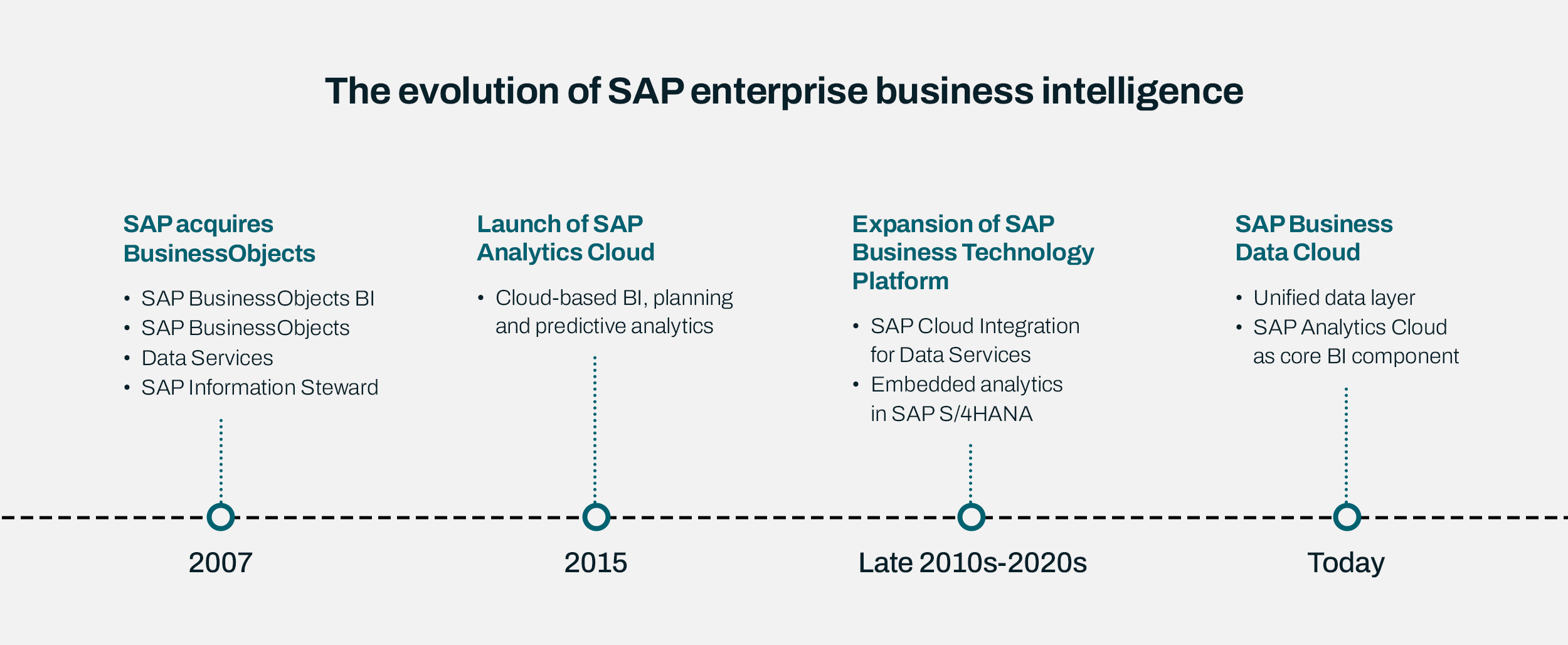
SAP’s analytics portfolio has evolved over nearly two decades, from on-premises SAP BusinessObjects environments to cloud-based analytics and integrated data services. In late 2024, SAP introduced the SAP BusinessObjects BI 2025 release with an updated release timeline and maintenance strategy, shifting to a two-year minor release cadence and extending mainstream maintenance for SAP BusinessObjects BI 4.3 through the end of 2026 to support hybrid BI modernization plans.
SAP continues to deliver new versions and long-term support for SAP BusinessObjects and related products, and many enterprises plan to run them well into the next decade.
Today, most SAP-centric enterprises operate across several layers of that evolution. SAP BusinessObjects often remains the system of record for regulated reporting, while SAP Data Services feeds SAP BW or SAP Datasphere environments with transformed data. SAP BW process chains handle scheduled aggregations overnight, and SAP Analytics Cloud, now positioned as a core analytics component within SAP Business Data Cloud (BDC), consumes that data for dashboards, planning models and predictive scenarios.
These systems don’t operate independently. A typical analytics chain resembles something like this:
An SAP S/4HANA job posts financial entries → SAP Data Services executes transformation jobs → SAP BW process chains or SAP Datasphere aggregate data → SAP Analytics Cloud refreshes models → Executive dashboards update before 8 AM.
If any step fails, the impact extends beyond IT to finance, operations and executive reporting.
In hybrid environments, especially those moving to RISE with SAP, these workflows often span on-premises systems, SAP Business Technology Platform (BTP) services and cloud analytics. Without centralized orchestration across all of them, organizations rely on disconnected schedulers, manual triggers or custom scripts tied to individual components. That’s how complexity accumulates.
Bringing control to SAP analytics processes
RunMyJobs by Redwood addresses this challenge at the orchestration layer by coordinating how they execute together.
RunMyJobs is the only workload automation solution that is both an SAP Endorsed App and included in the RISE with SAP reference architecture. It connects to SAP systems through supported APIs and secure gateway connectivity and avoids invasive agents or direct ERP modifications. Plus, it provides out-of-the-box connectors for SAP BusinessObjects BI, SAP Data Services (formerly known as SAP BusinessObjects Data Services), SAP Integration Suite – SAP Cloud Integration for Data Services, SAP Analytics Cloud and more, allowing you to orchestrate reporting, transformation and dashboard refresh workflows without custom code.
In practical terms, that means you can:
Orchestrate SAP BusinessObjects report executions as part of financial close workflows
Trigger SAP Data Services and SAP Cloud Integration for Data Services jobs based on ERP events instead of fixed-time scheduling
Coordinate SAP BW process chains and SAP Datasphere with downstream SAP Analytics Cloud model refreshes
Monitor end-to-end dependencies across ERP, data transformation and BI layers
Instead of scheduling each BI platform independently, you establish a single control plane that understands upstream and downstream dependencies. For example, rather than refreshing a dashboard at 6 AM regardless of data readiness, you can configure SAP Analytics Cloud data actions to trigger only after data transformations and aggregations complete successfully. If a job fails, alerts and remediation steps execute automatically — before business users log in.
Because RunMyJobs is delivered as a SaaS platform with centralized monitoring and AI-assisted troubleshooting, you gain visibility across the entire analytics chain rather than just within a single BI tool.
Strengthening analytics without increasing complexity
Instead of isolated projects, enterprise BI initiatives are typically tied to broader transformation goals like improving operational efficiency, reducing risk and enabling growth. Redwood Software’s framework highlights those same value drivers for SAP customers pursuing modernization and cost control.
Practically speaking, reporting cycles stay on track, data flows cleanly between ERP and analytics platforms and the need for redundant schedulers or scripts falls away. That stability allows analytics initiatives to grow without expanding infrastructure or teams. Most importantly, business users don’t have to question whether the numbers on their dashboards reflect completed, validated workflows. They can focus on insights instead of exceptions.
Reliable insights create real advantage
SAP Analytics Cloud continues to expand its role in predictive analytics, embedded analytics and advanced data visualization. And SAP BusinessObjects remains a stable foundation for many complex or regulated reporting environments. Together, they form a powerful enterprise BI ecosystem, one that delivers its full value when execution across systems is fully orchestrated.
If you’re expanding cloud-based BI solutions, consolidating traditional BI tools or embedding analytics more deeply into ERP-driven workflows, orchestration should be part of the design from the start.
Enterprise business intelligence should enable better decision-making at scale without introducing new bottlenecks behind the scenes. With the right automation foundation in place, your SAP analytics landscape can deliver insights that aren’t just compelling but dependable.